
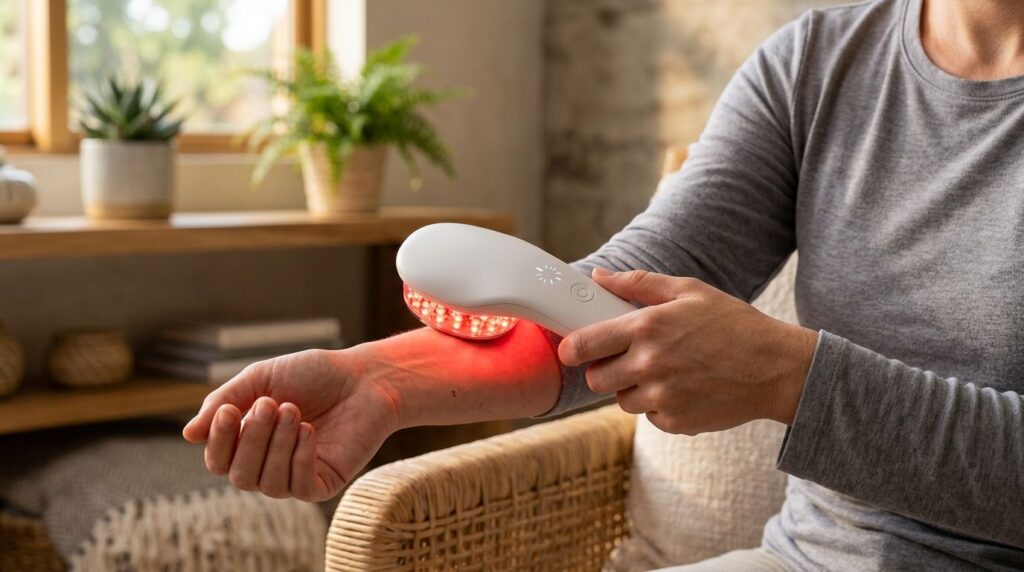
Handheld red light therapy devices bring the same red and near-infrared wavelengths used in clinical LED panels into a wand you can hold at your desk. LightStim for Wrinkles wins overall for full-face coverage with FDA clearance, CurrentBody Skin LED Light Therapy Perfector wins for targeted spot treatment on fine lines and blemishes, and Solawave's Bio-Wand wins for a fast daily routine that folds red light into a two-minute habit instead of a sit-down session.
- LightStim for Wrinkles is the best handheld red light therapy device overall for full-face, FDA-cleared coverage in 2026.
- CurrentBody Skin LED Light Therapy Perfector wins for spot-treating fine lines and blemishes.
- Solawave Bio-Wand suits a fast, low-commitment daily routine over a longer sit-down session.
- Dr. Dennis Gross SpectraLite EyeCare targets the under-eye area specifically.
- NuFACE FIX pairs LED with jawline and neck contouring in one device.
Why this matters
Red and near-infrared light in the 630-660nm and 810-850nm ranges is the same band used in dermatology-office LED panels, and it's been studied for supporting collagen activity and calming visible redness. A handheld device puts that wavelength range in a wand instead of a mask or panel, which matters if you want to work one area at a time rather than treat the whole face at once.
The category split in best FDA-cleared red light therapy devices in 2026 covers panels and masks. This guide narrows to handheld wands specifically, because the buying decision is different: a wand trades coverage for precision, and precision is what makes it worth owning alongside a mask rather than instead of one.
Not medical advice. Red light therapy supports the appearance of skin over time; it doesn't replace treatment for a diagnosed skin condition.
What makes the best handheld red light therapy device
- Clinically relevant wavelength — red light in the 630-660nm range and near-infrared in the 810-850nm range, not a generic "red LED" with no published spec
- FDA clearance status — a device cleared for wrinkle reduction has gone through a specific regulatory review; a device that just uses red LEDs has not
- Treatment area size — a wand head built for the eye area behaves differently than one built for the jawline or cheeks
- Session length and habit fit — some wands run 3-minute cycles built into a facial massage motion, others need a stationary hold
- Cordless vs. corded operation — cordless wands travel and store easier but need charging discipline
- Build and skin contact — metal or ceramic contact plates read as more premium and typically distribute warmth more evenly than plastic housings
Handheld red light therapy devices at a glance
| Device | Best for | Standout feature | Key limitation |
|---|---|---|---|
| LightStim for Wrinkles | Full-face, FDA-cleared coverage | Broad treatment head, cleared for wrinkle reduction | Needs a stationary hold, not a glide-and-go wand |
| CurrentBody Skin LED Light Therapy Perfector | Targeted spot treatment | Compact head built for fine lines and blemishes | Smaller coverage area per session |
| Solawave Bio-Wand | Fast daily routine | Combines red light with warming and micro-massage in one pass | Not built for deep, stationary treatment |
| Dr. Dennis Gross SpectraLite EyeCare | Under-eye area | Curved head shaped for the orbital bone | Single-purpose, not a full-face tool |
| NuFACE FIX | Jawline and neck | LED layered on top of a contouring device | Adds LED as a secondary feature, not the core function |
1. LightStim for Wrinkles: best handheld red light therapy device for full-face coverage
LightStim for Wrinkles is an FDA-cleared handheld panel built to move across the whole face rather than one spot. It uses LED in the wavelength range associated with clinical treatment for wrinkles, and its broader head means fewer passes to cover cheeks, forehead, and jaw in one session.
LightStim for Wrinkles pros:
- FDA clearance specifically for wrinkle reduction
- Wider treatment head covers more skin per session than a spot wand
- No attachments or accessories to manage
LightStim for Wrinkles cons:
- Requires holding the device stationary against skin rather than gliding it
- Bulkier in the hand than a slim wand
- No secondary features like massage or warming
Best for: anyone who wants one device that treats the whole face and carries an actual FDA clearance. Verdict: Buy.
2. CurrentBody Skin LED Light Therapy Perfector: best for targeted spot treatment
The CurrentBody Skin LED Light Therapy Perfector is built smaller and more precise than a full-face panel, aimed at fine lines around the mouth and eyes or individual blemish-prone areas. It's the pick when you don't need to treat the entire face every time.
CurrentBody Skin LED Light Therapy Perfector pros:
- Compact head fits into smaller, harder-to-reach areas
- Faster to use for a single problem area than a full-face device
- Lightweight for one-handed use
CurrentBody Skin LED Light Therapy Perfector cons:
- Slower to cover the whole face if that's the goal
- Smaller treatment window means more passes for larger areas
Best for: spot-treating fine lines, crow's feet, or a specific blemish zone. Verdict: Buy if full-face coverage isn't the priority.
3. Solawave Bio-Wand: best for a fast daily routine
Solawave's Bio-Wand pairs red light with gentle warming and a facial massage motion, built to move quickly across the face rather than sit in one place. It's designed around habit formation — something you can run through in a couple of minutes before the rest of a skincare routine.
Solawave Bio-Wand pros:
- Combines red light, warming, and massage in one motion
- Fast enough to fit before a serum-and-moisturizer routine without adding real time
- Comfortable to glide rather than hold stationary
Solawave Bio-Wand cons:
- Not built for a longer, stationary treatment session
- Multi-function design means red light is one feature among several, not the sole focus
Best for: people who want red light exposure folded into an existing routine rather than a separate step. Verdict: Buy for convenience-first users.
4. Dr. Dennis Gross SpectraLite EyeCare: best for the under-eye area
This device is shaped specifically around the orbital bone, built to treat the thinner skin around the eyes rather than the broader face. It's a single-purpose tool, and that focus is the whole point.
Dr. Dennis Gross SpectraLite EyeCare pros:
- Curved head matches the contour of the eye area
- Compact and easy to hold in one position
- Purpose-built rather than adapted from a full-face design
Dr. Dennis Gross SpectraLite EyeCare cons:
- Does nothing for the rest of the face
- Limited use case if under-eye concerns aren't the priority
Best for: treating crow's feet and under-eye fine lines specifically. Verdict: Buy as a second device, not a first one.
5. NuFACE FIX: best for jawline and neck
NuFACE FIX layers LED onto a device built primarily for jawline and neck contouring. Red light here is a secondary feature added to a device whose core function is elsewhere, which matters for expectations.
NuFACE FIX pros:
- Targets jawline and neck, an area most red light wands skip
- LED addition gives a second benefit without a second device
- Slim shape works well along the jaw and neck line
NuFACE FIX cons:
- LED is a secondary feature, not the primary design goal
- Not shaped for cheeks or forehead
Best for: jawline and neck focus alongside contouring. Verdict: Hold if red light is your main goal — buy it for the contouring, treat the LED as a bonus.
“A wand trades coverage for precision, and precision is what makes it worth owning alongside a mask rather than instead of one.”
How this list was ranked
Each device was weighed against the six criteria above: wavelength relevance, FDA clearance status, treatment area size, session length, cordless operation, and build quality. No two devices share the same "best for" slot — the goal is a decision tree based on where on the face you need coverage, not a single leaderboard.
Which handheld red light therapy device should you choose?
If you want one device for the whole face with an actual FDA clearance behind it, LightStim for Wrinkles is the default answer for 2026. If you're targeting one problem area — fine lines, under-eyes, or jawline — pick the device built for that specific zone instead of forcing a full-face panel to do a spot job.
Red light therapy also pairs naturally with topical actives. A copper peptide serum applied after a session gives the skin something to work with while it's still warm and receptive, and a broader peptide skincare routine fills in the days you skip the wand entirely.
Build a full peptide routine
Pair red light sessions with a peptide-led skincare lineup.
FAQ
What’s the best handheld red light therapy device in 2026?
LightStim for Wrinkles is the best handheld red light therapy device overall in 2026 for full-face, FDA-cleared coverage. For a single problem area, a spot device like the CurrentBody Skin LED Light Therapy Perfector fits better than a full-face panel.
Is a handheld red light device better than an LED mask?
A handheld wand is better for targeting one area, while a mask covers the entire face in one session. Compare full options in the best LED face masks in 2026 guide before deciding which format fits your routine.
How often should you use a handheld red light therapy device?
Most handheld devices are designed for a few sessions a week rather than daily use, though this varies by device and manufacturer guidance. Check the specific device’s instructions since session length and frequency differ across brands.
Are handheld red light therapy devices FDA-cleared?
Some are and some aren’t — FDA clearance is device-specific, not category-wide. LightStim for Wrinkles carries a clearance for wrinkle reduction; not every handheld wand on the market does.
Can you use red light therapy with peptide skincare?
Yes, red light sessions and peptide serums are commonly used together as separate steps in the same routine. Applying a peptide serum after a session is a common sequencing choice, not a requirement.
How long until you see results from red light therapy?
Results build gradually with consistent use over weeks, not after a single session. This is general category guidance, not a specific claim, since results vary by individual and device.
Do handheld red light devices work for under-eye wrinkles?
Devices shaped specifically for the orbital area, like the Dr. Dennis Gross SpectraLite EyeCare, are built for that zone. A general full-face wand can reach the area but isn’t contoured for it.
What wavelength should a red light therapy device use?
Look for red light in the 630-660nm range and, ideally, near-infrared in the 810-850nm range. These are the wavelength bands most commonly cited in clinical LED research.
One last thing
The device with the widest treatment head isn't automatically the best pick — a wand shaped for the under-eye area will outperform a full-face panel on that specific zone every time, even though it does nothing everywhere else. Match the shape to the spot before you match the brand name.
Related guides
- Best FDA-cleared red light therapy devices in 2026
- Best LED face masks in 2026
- Best copper peptide serums in 2026
- Best peptide skincare products in 2026