
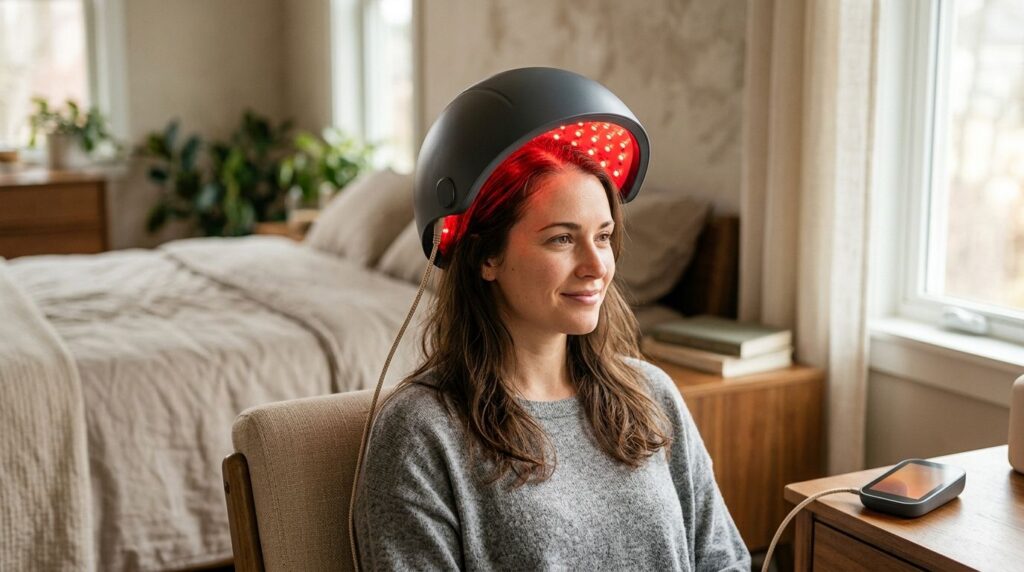
Red light therapy for hair regrowth stopped being a niche dermatology tool years ago — in 2026 it's a crowded shelf of caps, panels, bands, and combs, and most of them look identical in a product photo. Best overall for full-scalp coverage: CurrentBody Skin LED Hair Regrowth Device. Best for a snug, hands-free fit: iRestore Professional. Best budget-conscious pick: HairMax LaserBand. The rest of this guide breaks down six FDA-cleared or clinically-referenced options so you can match the device to how you'll actually use it, not just how it photographs.
- CurrentBody Skin LED Hair Regrowth Device wins overall for full-scalp, hands-free coverage in 2026.
- Theradome EVO is the best red light therapy device for hair regrowth if you want laser-only, no-heat treatment.
- HairMax LaserBand suits short, mobile sessions; Capillus caps work best under a wig or hat.
- Every device on this list needs consistent weekly use for months before shedding slows — none work overnight.
Why this matters
Low-level light therapy (LLLT) for androgenetic alopecia has more regulatory backing than most at-home beauty tech. Several of the devices below carry FDA clearance specifically for hair regrowth in men and women, which puts them in a different category than a novelty gadget. The FDA-cleared red light therapy devices roundup covers clearance status across the wider LED category if you want the regulatory detail before you buy.
The catch: clearance tells you a device is safe and was tested for the claim, not that every model fits your scalp, your schedule, or your patience. A helmet that takes 20 minutes and needs an outlet nearby is a different commitment than a band you can wear while making coffee. That's the actual decision here in 2026 — not which brand has the shiniest packaging.
What makes the best red light therapy device for hair regrowth
- FDA clearance for androgenetic alopecia — regulatory review beats manufacturer marketing copy every time.
- Full scalp coverage design — helmets and panels reach more follicles per session than a narrow comb or band.
- Red and near-infrared wavelength combination — LLLT devices for hair typically pair red light in the 630-660nm range with near-infrared in the 810-850nm range, a combination widely referenced in dermatology literature on photobiomodulation.
- Hands-free operation — a device you can wear while working beats one you have to hold against your scalp.
- Independent or peer-reviewed trial data — not just an in-house study funded by the manufacturer.
- Comfort over a full session — most LLLT protocols run several sessions a week for months, so weight and heat matter more than they look like they would in a product shot.
At a glance
| Device | Best for | Standout feature | Key limitation |
|---|---|---|---|
| CurrentBody Skin LED Hair Regrowth Device | Full-scalp, hands-free coverage | Panel design, no cap needed | Bulkier to store than a band |
| iRestore Professional | Snug helmet fit, daily consistency | Full-dome LED coverage | Tethered power cord limits mobility |
| Theradome EVO | Laser-only precision, no LED heat | Laser diodes instead of LEDs | Smaller coverage footprint per session |
| HairMax LaserBand | Short, mobile sessions | Compact band, quick sessions | Requires manual sweeping motion |
| Capillus caps | Wearing under a wig or hat | Low-profile cap silhouette | Battery pack adds a separate component |
| Revian Red | App-guided compliance tracking | Built-in session logging | Requires a paired app to get full value |
1. CurrentBody Skin LED Hair Regrowth Device: best red light therapy device for full-scalp coverage
The CurrentBody Skin device uses a flexible panel rather than a rigid helmet, which means it conforms to different head shapes instead of forcing a one-size dome onto your scalp. It's positioned for people who want broad coverage without committing to a bulky cap-and-battery-pack setup.
CurrentBody Skin pros:
- Panel flexes to scalp shape instead of a rigid dome
- No separate battery pack to carry around
- Broad coverage per session compared to comb or band designs
CurrentBody Skin cons:
- Still requires a stationary session near an outlet or charged unit
- Panel design means less compatibility with wearing a hat over it mid-session
Best for: anyone who wants full-scalp coverage without a rigid helmet. Verdict: Buy.
2. iRestore Professional: best red light therapy device for daily helmet-style consistency
iRestore's helmet design covers the scalp in one motion — you put it on, it runs its cycle, you take it off. That predictability is the appeal for people who do better with a fixed daily habit than a device that needs repositioning.
iRestore Professional pros:
- Full-dome design covers the scalp in a single fitting
- No manual repositioning required mid-session
- Straightforward on/off routine builds habit consistency
iRestore Professional cons:
- Corded design limits movement during a session
- Helmet shape doesn't suit every head size the same way
Best for: people who want a fixed daily routine with zero guesswork. Verdict: Buy.
3. Theradome EVO: best red light therapy device for laser-only precision
Theradome uses laser diodes instead of LEDs, which is the core technical difference in this whole category. Laser light stays more collimated (less scattered) than LED light, and Theradome markets that as a precision advantage for follicle-level targeting.
Theradome EVO pros:
- Laser diodes instead of LED bulbs
- Cordless helmet design for mobility during sessions
- No separate cooling or heat management needed
Theradome EVO cons:
- Smaller total coverage area per session than panel-style devices
- Higher upfront commitment than band-style options
Best for: users who specifically want laser over LED technology. Verdict: Buy.
4. HairMax LaserBand: best red light therapy device for short, mobile sessions
The LaserBand is a handheld sweep-style device — you move it across your scalp in sections rather than sitting under a stationary helmet. That makes it the fastest device on this list to fit into a morning routine, at the cost of needing active attention during use.
HairMax LaserBand pros:
- Compact, easy to store and travel with
- Session requires less total sit-still time than a helmet
- No cap or panel bulk to manage
HairMax LaserBand cons:
- Requires manually sweeping the band across the scalp
- Coverage depends on your technique, not just the device
Best for: people who travel often or want the shortest hands-on commitment. Verdict: Hold if you're inconsistent with routines — the manual sweep only works if you actually do it every session.
5. Capillus caps: best red light therapy device for discreet wear
Capillus makes a line of low-profile caps designed to sit under a wig, hat, or hair covering, which matters to anyone who doesn't want to look like they're mid-treatment. The tradeoff is a separate battery pack you clip on or carry.
Capillus pros:
- Low-profile cap fits under a hat or wig
- Discreet enough for use in public or at work
- Full-cap coverage similar to helmet-style devices
Capillus cons:
- Battery pack is a separate component to manage
- Higher price tier than band-style alternatives
Best for: anyone who needs to wear the device somewhere it can't be visible. Verdict: Buy for discretion-first buyers.
6. Revian Red: best red light therapy device for tracking compliance
Revian pairs its cap with an app that logs sessions, which matters more than it sounds — the biggest reason LLLT devices underperform at home is inconsistent use, not the hardware. If you know you'll forget sessions without a nudge, the tracking is the actual feature you're buying.
Revian Red pros:
- App-based session logging and reminders
- Encourages the consistency the whole category depends on
- Cap-style full coverage
Revian Red cons:
- Full value depends on actually using the paired app
- Less useful if you prefer a device with zero digital component
Best for: people who know they need reminders to stay consistent. Verdict: Buy if you'll actually open the app.
How we ranked these
Each device above was scored against the criteria listed earlier — FDA clearance status, coverage design, wavelength combination, hands-free operation, trial backing, and session comfort. None of the six wins on every axis. CurrentBody Skin took the overall spot because full panel coverage plus a hands-free wear style covers the most ground for the most users in 2026, not because it beats every competitor on every single metric.
“The biggest reason at-home red light therapy underperforms isn’t the device — it’s inconsistent use.”
Which red light therapy device should you choose?
If you want one answer: the CurrentBody Skin LED Hair Regrowth Device is the best red light therapy device for hair regrowth in 2026 for most people, because full-scalp panel coverage without a rigid helmet fits the widest range of routines. Pick Theradome EVO if laser precision matters more to you than LED coverage area. Pick HairMax LaserBand if you travel constantly and need something compact. Pick Capillus if discretion under a hat or wig is non-negotiable.
Whatever device you choose, pair it with a scalp routine that supports the same goal instead of working against it. A copper peptide shampoo for hair growth addresses the topical side of scalp health while the device handles the light-therapy side — the two aren't competing approaches, they're complementary ones.
Build a full scalp health routine
Compare copper peptide shampoos to pair with your light therapy sessions.
FAQ
What is the best red light therapy device for hair regrowth in 2026?
The CurrentBody Skin LED Hair Regrowth Device ranks best overall in 2026 for full-scalp, hands-free coverage. Theradome EVO and HairMax LaserBand are better fits if you want laser-only technology or a compact travel option.
Is red light therapy actually FDA-cleared for hair regrowth?
Several devices, including models from CurrentBody, iRestore, Theradome, HairMax, Capillus, and Revian, carry FDA clearance specifically for androgenetic alopecia. Clearance confirms the device was reviewed for that claim, not that every model fits every user.
How long before red light therapy shows results for hair loss?
Consistent use over several months is standard across the LLLT category before shedding slows or density changes become visible. Devices used inconsistently rarely show the results seen in clinical settings.
Is a laser device better than an LED device for hair regrowth?
Laser diodes, used in devices like Theradome, produce more collimated light than LEDs, which some manufacturers position as a precision advantage. LED panels and helmets, like CurrentBody and iRestore, cover more scalp area per session.
Can I use red light therapy with a hair growth shampoo?
Yes. Light therapy devices address follicle stimulation while a topical product like a copper peptide shampoo supports scalp condition, and the two approaches don’t conflict with each other.
Do red light therapy caps work under a wig or hat?
Capillus caps are specifically designed with a low-profile shape that fits under a wig or hat, which makes them the most discreet option on this list for daytime use.
What’s the difference between a red light cap, band, and panel?
Caps and helmets cover the full scalp in one fitting, bands require manually sweeping the device across sections, and panels flex to scalp shape for broad coverage without a rigid dome.
One last thing
The device you'll actually use every week beats the device with the best spec sheet sitting in a drawer. If a helmet feels like a chore, a band you can wear for a few minutes while getting ready is the one that gets used through 2026 and into 2027 — and consistency is the single variable every LLLT study points back to.
Related guides