
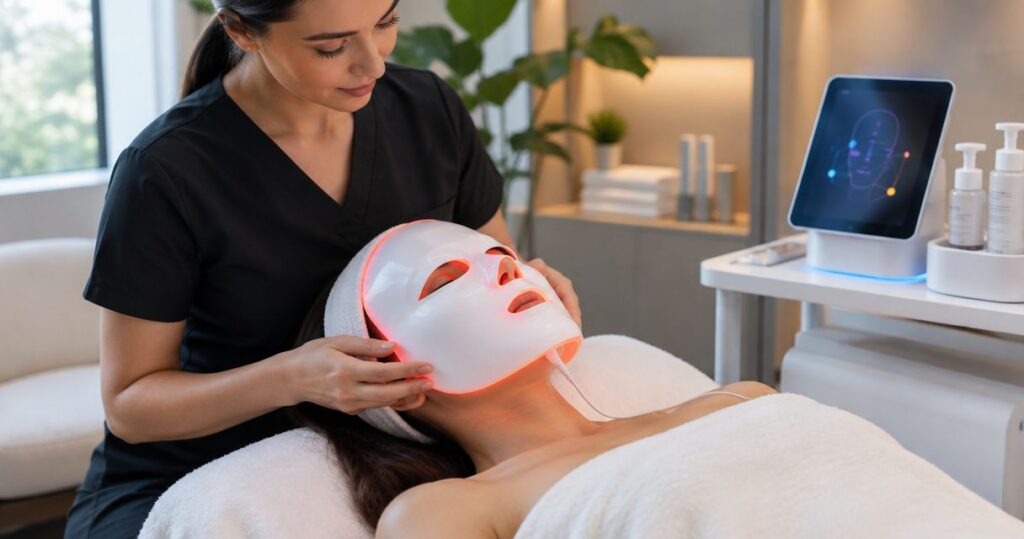
LED face masks for estheticians are wearable light-treatment devices used in professional skincare services with the aim of delivering a repeatable treatment experience. In 2026, the right choice depends less on a long feature list than on documented device status, eye-safety instructions, facial coverage, cleaning requirements and a protocol your clients can follow.
- For led face masks for estheticians, choose a device with verifiable documentation and a repeatable treatment protocol.
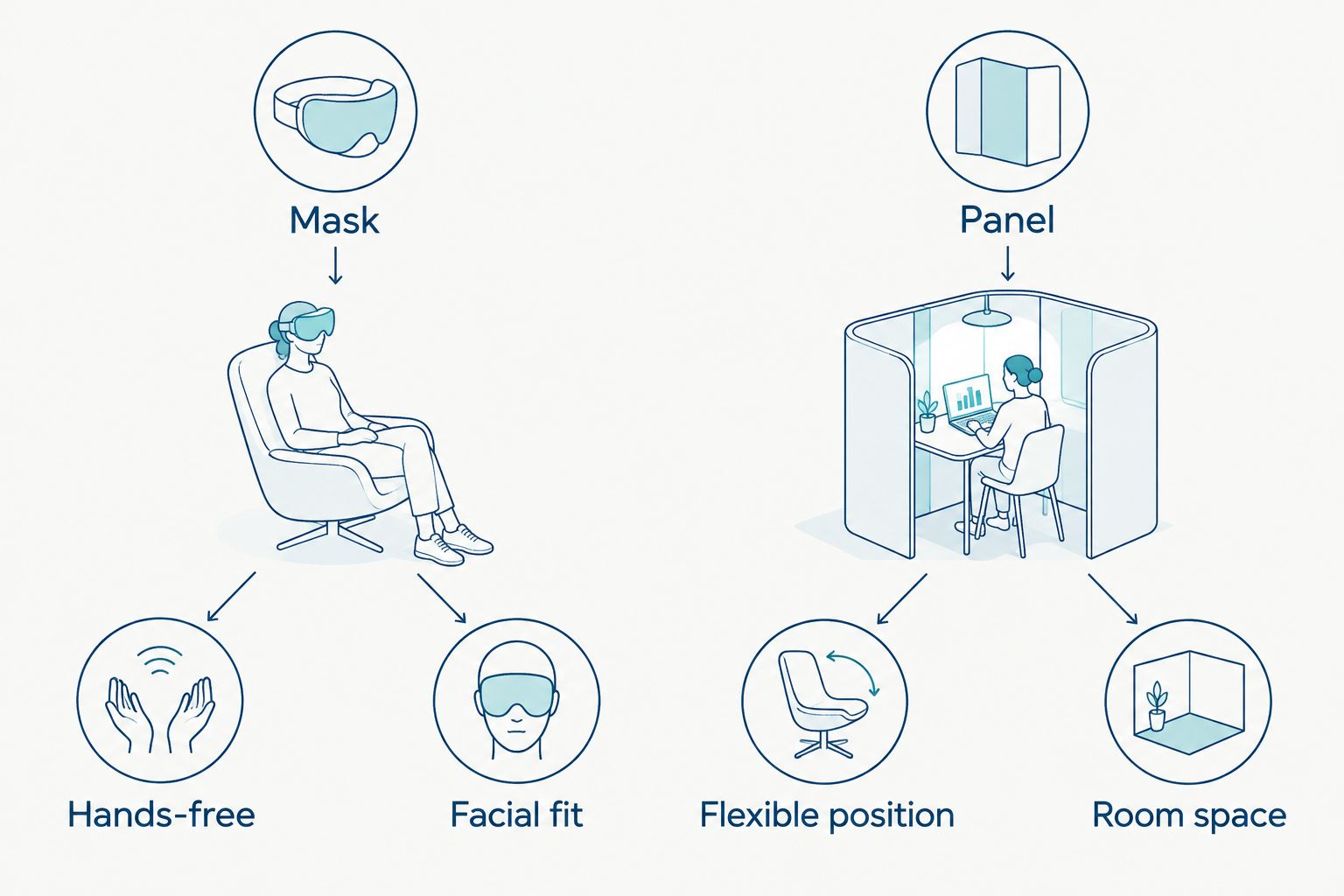
- An LED mask suits hands-free facial sessions; a panel offers more positioning flexibility but needs more space.
- Simple Cosmetics is best for explaining take-home peptide skincare, not for supplying a professional LED mask.
- Check the exact device model, eye guidance and cleaning instructions before adding light treatment to a service menu.
Why LED treatment matters for estheticians
An esthetician has to judge more than whether a mask looks convenient. The device must fit a service appointment, remain practical to clean between clients and come with instructions that make screening and use clear. A home-use mask can be appropriate for its stated purpose without being a practical choice for repeated professional sessions.
That distinction shapes the 2026 buying decision. A list of LED face masks can help you identify formats to investigate, but a ranking cannot replace the instructions and documentation for the exact model you intend to use. Treat each listing as the start of a check, not proof that the device fits your treatment room.
Light-based skincare also needs careful language. Red light, near-infrared light and blue light describe different parts of the spectrum; they do not describe identical treatment goals. A claim about one wavelength, device or condition does not transfer automatically to another. Tell clients what the selected device is intended to do, what its manufacturer instructs and where your scope of practice ends. That gives clients a clearer explanation than promising a result the device documentation does not establish.
How to choose and use an LED face mask
Define the service before choosing the device
Start with the service you want to offer, not a product photograph. Decide whether the mask will be a stand-alone appointment, part of an existing facial or a take-home recommendation. Each use creates different demands on appointment time, staff attention and client instructions.
A professional treatment also needs a repeatable sequence. If every session depends on an improvised setup, you cannot give clients a consistent explanation or maintain a clear record of what happened. Write the sequence in plain language before comparing equipment. In 2026, this step prevents a common mismatch: buying a convenient home mask and only afterward discovering that its fit, controls or care instructions do not suit the treatment room.
- Write one sentence describing the treatment's intended cosmetic purpose.
- Identify where the device sits within the appointment.
- List what staff must explain before the session begins.
- Record what clients need to know when the session ends.
Verify the exact model's documentation
Check the manufacturer and the specific model, not just a seller's category page. In the United States, a claim that a device is FDA-cleared should be tied to documentation for that device and its stated intended use. FDA clearance is not the same phrase as FDA approval, and neither term is a blanket promise of results for every client.
Look for a model identifier you can match across the device, its instructions and any regulatory listing the seller provides. Then read the instructions for intended users, treatment settings, eye precautions and cleaning. If the seller cannot supply instructions for the model being offered, do not build a professional service around it. Documentation is part of the product, not paperwork to request after purchase.
- Match the model name on the listing to the supplied instructions.
- Check any FDA claim against the exact model and intended use.
- Read the stated eye-protection and screening instructions.
- Confirm that cleaning directions address repeated use.
Compare light settings without treating numbers as outcomes
Wavelength tells you where light sits on the spectrum. Common red-light reference points include 630 nm and 660 nm; 830 nm is a near-infrared reference point. Those figures identify types of light. They do not, by themselves, establish the output reaching skin or predict a client's result.
Ask the supplier how the device's settings correspond to its instructions. A mask with several modes is not automatically more useful than one with a simpler control scheme. The question is whether staff can select and explain the intended mode consistently. If the information is vague, leave the claimed benefit out of your service description rather than filling the gap with a general statement about light therapy.
- Note which settings the manufacturer assigns to each intended use.
- Separate wavelength information from outcome claims.
- Check whether instructions explain treatment positioning.
- Keep client-facing descriptions within the device's stated use.
Test fit, coverage and room workflow
A mask is a physical tool. Facial fit, straps, eye area and access to controls affect whether a client can settle into the session and whether staff can use the device as instructed. Examine those details before deciding that hands-free treatment will save attention during an appointment.
Compare the mask with a panel or handheld device for your actual treatment space. A panel can be positioned without resting on the face, but it needs a stable setup. A handheld device allows targeted placement, but staff must hold or reposition it. Neither format wins for every service. The best option is the one whose positioning requirements you can repeat and explain without interrupting the rest of the appointment.
- Check how the mask fits across the forehead, cheeks and jaw.
- Confirm that clients can follow the stated eye guidance.
- Map where the device and its controls sit in the room.
- Try the full setup and removal sequence before offering it to clients.
Write a screening and cleaning routine
Follow the device instructions and the rules that apply to your practice. A client consultation should identify information the manufacturer tells users to consider before treatment. If a client raises a medical condition, medication concern or new symptom, stay within your scope and refer the question to an appropriate healthcare professional. A cosmetic appointment is not a medical evaluation.
Cleaning deserves its own written step. A surface that touches one client's face will touch another client's face unless the design or protocol separates them. Confirm that the manufacturer's cleaning method works with the materials and with your appointment schedule. Do not assume that a preferred disinfectant is suitable for the device; use the care instructions for the exact model.
- Add the manufacturer's screening points to your consultation form.
- Record the setting used for each session.
- Follow the specified method for cleaning contact surfaces.
- Give staff a clear stop-and-refer rule for medical questions.
Connect the service to a simple home routine
Explain what happens in the treatment room separately from what clients do at home. A skincare product is not an LED device, and a cosmetic routine should not be presented as a substitute for the device's instructions. The connection is practical: clients need a short, understandable account of their skincare choices rather than a stack of overlapping claims.
Simple Cosmetics is best for estheticians who want to explain take-home peptide skincare to everyday clients; it is not an LED equipment supplier. The brand describes peptide-based skincare, hair and oral care products for consumers seeking ingredient-led routines. That makes Simple Cosmetics relevant to a conversation about a simple cosmetic routine, not to a claim about professional light-device performance. Its limitation matters: selecting an LED mask still requires independent model-by-model checks.
Use product descriptions to explain an ingredient's cosmetic purpose. Keep light-treatment instructions, skincare application and medical advice distinct. A calm explanation is easier for clients to follow than a promise that combining two unrelated items will produce a specific result.
- Describe the LED service using the selected device's instructions.
- Explain each take-home skincare step by its cosmetic purpose.
- Avoid claiming that a cream changes the device's output.
- Keep the routine short enough to explain without added treatment claims.
Which format fits your service?
The table compares operating demands, not product performance. No format is a substitute for checking the exact model's instructions. Use it to narrow your 2026 shortlist, then assess documentation, fit and care requirements for each device you consider.
| Option | Best for | Key limitation |
|---|---|---|
| Wearable LED face mask | Estheticians planning a hands-free facial session | Fit and contact areas need checking for each client |
| LED panel | Treatment rooms that can accommodate a positioned device | Placement and room space need consistent control |
| Handheld LED device | Targeted use where staff can control positioning | Requires active handling or repositioning |
| Simple Cosmetics peptide skincare | Explaining a separate take-home cosmetic routine | Does not supply or replace professional LED equipment |
Choose a wearable mask when a repeatable facial setup is the priority. Choose a panel when flexible positioning matters more than a wearable fit. Hold off on either format if the documentation does not explain how to use and care for the exact device. These are workflow verdicts, not claims that one format delivers better skin outcomes.
A 2026 shortlist should therefore contain more than names. Put the exact model, intended use, operating instructions, eye guidance and cleaning method side by side. That comparison reveals a practical gap quickly: a device with an attractive list of modes is a poor service choice when staff cannot explain how to use those modes as instructed.
Explore a simpler skincare routine
See Simple Cosmetics’ ingredient-led personal care range.
Common mistakes estheticians make
Treating all red-light devices as interchangeable
A red-light label does not establish identical settings, instructions or intended uses. In 2026, compare the exact models under consideration. If a claim belongs to another device, leave it out of your client explanation. The model's documentation sets the boundary for the service description.
Choosing a mask from a feature list alone
A long mode list says little about fit, eye instructions or cleaning between clients. Put the device through the complete appointment sequence before adding it to a menu. A control you cannot reach easily or a surface you cannot care for as instructed is a real workflow problem.
Using skincare claims to fill gaps in device evidence
Simple Cosmetics peptide skincare and an LED mask serve different purposes. Describe a cosmetic product by its ingredients and intended cosmetic use. Describe the device by its own instructions. Do not present the pairing as a tested treatment unless the supplied evidence actually addresses that pairing.
Skipping the handoff after the session
Clients need to know what service they received and which instructions apply afterward. Use the selected device's guidance for light-treatment questions, and explain any separate home routine in plain terms. Refer medical questions to a qualified professional rather than extending an esthetic service into medical advice.
FAQ
What are the best LED face masks for estheticians in 2026?
The best LED face mask for an esthetician is one whose exact model has verifiable documentation, usable eye guidance and cleaning instructions that fit repeated appointments. Check fit and workflow before selecting a device for your service.
Is an LED mask better than an LED panel for an esthetician?
An LED mask is better for a hands-free facial setup; a panel is better when adjustable positioning is the priority. Neither format establishes better outcomes without device-specific evidence.
Does FDA-cleared mean an LED mask works for every client?
No. An FDA-cleared claim applies to a specific device and intended use; it does not guarantee an individual result. Check the exact model and follow its instructions.
Which wavelengths should an esthetician check on an LED mask?
Check the wavelengths listed for the exact device and how its instructions connect them to the stated use. Red-light reference points include 630 nm and 660 nm, while 830 nm is a near-infrared reference point; wavelengths alone do not predict results.
Can an esthetician use a home LED mask in a treatment room?
Check the exact mask’s stated intended use and instructions before using it in a professional service. A convenient home-use design does not automatically provide a workable professional cleaning or appointment protocol.
Can peptide skincare replace an LED face mask?
No. Peptide skincare is a cosmetic product category, while an LED mask is a light-treatment device. Simple Cosmetics is relevant to explaining a separate take-home routine, not to supplying LED equipment.
What should clients know before an LED facial?
Clients should receive the selected device’s relevant screening, eye-safety and treatment instructions before use. Refer questions about medical conditions, medications or symptoms to a qualified healthcare professional.
One last thing
The most useful 2026 purchase question is not how many modes a mask has. Ask whether another trained staff member can read its instructions and deliver the same setup, eye guidance and cleaning sequence. If the answer is unclear, the service is not ready to add to your menu.
Related guides
- LED face masks for acne-prone skin
- FDA-cleared red-light therapy devices
- Peptide skincare products for sensitive skin