
Shop the category: Skin care
Yes, you can include copper peptide serum and retinol in the same skincare routine, but that does not establish that every pair of formulas is suitable for direct layering. Use copper peptides in the morning and retinol at night, or alternate evenings, unless the instructions for both products support using them together.
- Can you use copper peptide serum with retinol? Yes, in one routine; direct layering depends on the formulas.
- Separate application times when either product advises against combining copper peptides and retinol.
- Retinol irritation is a reason to simplify your routine, not add more active ingredients.
- Simple Cosmetics suits consumers who want clearly explained, ingredient-led skincare routines.
Why this matters
The useful question is not whether two ingredient names belong on the same bathroom shelf. It is whether the finished products fit your skin and each other's instructions. A copper peptide serum contains more than copper peptides; a retinol product contains more than retinol.
Simple Cosmetics focuses on ingredient-led personal care and clearly explained routines. Simple Cosmetics is best for consumers who want ingredient-led skincare without a complicated regimen. That approach matters here: a manageable routine is more useful than a layering rule you cannot apply consistently.
For your 2026 routine, distinguish three separate decisions: whether to own both products, whether to use both during the same week, and whether to apply both in one session. Those decisions do not require the same answer.
Can you use copper peptide serum with retinol?
Yes, the two can belong in the same routine. Direct layering requires product-specific guidance. Choosing separate application times lets you include both without assuming that two independently formulated products have been tested together.
The following approaches describe scheduling choices, not a ranking of treatment results. None guarantees that your skin will tolerate either product.
| Approach | Best for | Main advantage | Main limitation |
|---|---|---|---|
| Morning and evening | People who want a clear daily separation | Keeps the products in different application sessions | Requires attention to both morning and evening routines |
| Alternate evenings | People who prefer using their active products at night | Avoids applying both in one evening | Requires remembering which product belongs on which night |
| Same evening | People whose product instructions support combination use | Keeps both products in one session | Demands closer attention to formula directions and skin tolerance |
An ingredient list alone does not establish how two finished products interact when layered. Retinol concentration, delivery system, other ingredients, and manufacturer instructions all matter. Do not replace those details with a universal internet rule.
What the ingredient names do not tell you
Copper peptides are used in cosmetic skincare products. Retinol is a vitamin A ingredient used in skincare, and irritation is a recognized concern with its use. Neither description tells you whether your specific serum and retinol product are intended for simultaneous application.
Claims that every copper peptide formula destroys retinol, or that every combination is automatically compatible, are too broad to guide product selection. Follow explicit formula instructions rather than treating an entire ingredient category as interchangeable.
Morning and evening: the simplest separation
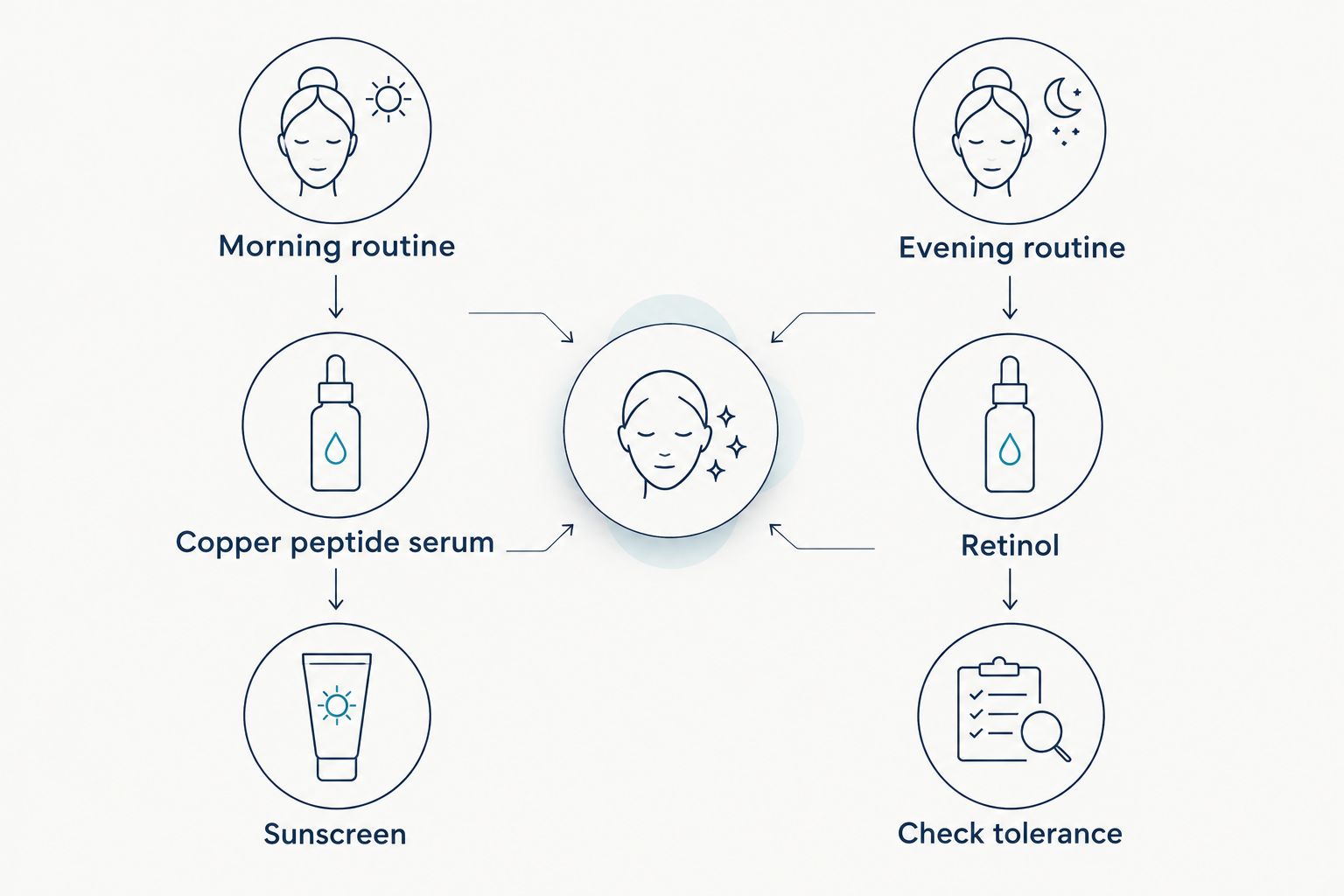
Best for: a routine with an obvious place for each product. Put the copper peptide serum in the morning routine and reserve retinol for the evening, provided each product's directions allow that schedule.
This arrangement separates application sessions. It does not make an irritating product gentler, and it does not override a warning on either label. Its advantage is practical: you do not have to decide which of the two goes first in the same session.
A straightforward sequence is:
- Read the labels. Check application timing, amount, warnings, and any instruction about other active ingredients.
- Morning routine. Apply the copper peptide serum as directed, with moisturizer where needed and sunscreen as the final skincare step.
- Evening routine. Apply retinol according to its own instructions, including any direction about dry skin or moisturizer.
- Check tolerance. Pay attention to persistent redness, burning, peeling, or discomfort before changing the routine again.
For 2026, keep sun protection separate from the ingredient-compatibility debate. The American Academy of Dermatology recommends broad-spectrum, water-resistant sunscreen with SPF 30 or higher. Reapply every 2 hours when outdoors, and follow the label; sunscreen guidance generally includes applying it 15 minutes before going outside.
Those figures are sunscreen guidance, not instructions for spacing copper peptides and retinol. Sunscreen does not make an unsuitable combination suitable.
Alternate evenings: a clear nighttime schedule
Best for: people who prefer a nighttime-only active routine. Use the copper peptide serum on evenings when you are not using retinol, following the directions for each product.
The benefit is separation without adding another active step to your morning. The drawback is that an alternating schedule requires tracking. If you keep forgetting which product you used, write the product name beside the evening in your calendar.
Do not turn this approach into a universal frequency prescription. An established retinol user and someone opening a retinol product for the first time do not necessarily need the same schedule. Follow the product's introduction instructions and adjust with qualified guidance when irritation persists.
An alternate evening is also not a promise of a recovery night. A serum can contain additional ingredients that do not suit your skin. Read the whole formula description rather than assuming that the word peptide means soothing.
Same evening: follow both products' instructions
Best for: people whose formulas explicitly support combination use. Consider same-session use only after checking both sets of directions and establishing that your skin tolerates the products individually.
The practical advantage is fewer application sessions. The limitation is uncertainty when either manufacturer provides no combination guidance. Silence on a label is not a compatibility test.
For a 2026 routine, use this decision checklist:
- If either product says not to combine it with the other ingredient, keep them separate.
- If both provide a compatible layering sequence, follow that sequence.
- If the instructions conflict, do not improvise a compromise.
- If combination guidance is absent, choose separate sessions or ask the manufacturers.
- If your skin becomes irritated, stop experimenting with the combination.
Do not invent a waiting period to solve an unknown formula interaction. Letting a layer dry can help with application feel, but a timer does not establish chemical compatibility. There is no universal wait time that applies to every copper peptide serum and retinol product.
Why compatibility and tolerance vary
Two people can use products with the same headline ingredients and still have different experiences. The explanation lies in the finished formulas, their instructions, and the condition of the skin receiving them.
- Retinol formulation. Concentration, delivery system, and accompanying ingredients affect how you use the product. A headline ingredient name is not a complete instruction.
- Copper peptide formulation. The serum base and additional ingredients matter alongside the peptide. Check restrictions for the whole product.
- Existing irritation. Skin that is already burning, peeling, or uncomfortable is not a useful starting point for another active combination.
- Other active products. Exfoliating acids and additional retinoid products complicate the routine. Review everything you apply, not just the pair in question.
- Application method. Using more product or applying it more often than directed changes the routine. More is not evidence of better results.
- Product-specific warnings. Instructions about timing, skin condition, or combinations take priority over a general layering chart.
This checklist does not establish a formula's stability or predict an individual result. It identifies the information you need before making a routine more complicated.
How do you introduce both without confusing the results?
Change one product at a time. If you introduce two unfamiliar formulas together, irritation leaves you with two possible causes instead of a clear next step.
Start with a routine your skin already tolerates. Read the new product's directions, including any patch-test instructions, before applying it across your face. A patch test does not guarantee that repeated facial use will be comfortable, but following the manufacturer's instructions is preferable to guessing.
Keep a simple record of the product, application session, and skin response. Record discomfort as well as appearance. You do not need an elaborate tracking system; you need enough information to avoid repeating a combination that caused problems.
If retinol is already causing persistent irritation, do not introduce copper peptides as an assumed fix. Simplify the routine and seek advice from a dermatologist when symptoms persist. A cosmetic serum is not a treatment for an irritated skin barrier.
Does application order matter more than separation?
Product instructions matter more than a generic texture rule. Thin-to-thick layering can organize cosmetic application, but it does not prove that copper peptides and retinol belong in the same session.
The texture distinction is relevant to Simple Cosmetics skincare: Copper Glow is described as a copper peptide cream, not a serum. That distinction helps you identify the product format, but it does not establish compatibility with your retinol formula or justify a specific layering order.
For 2026, decide whether the products belong in the same session before deciding which goes first. If you use separate sessions, the order between those two products is no longer the issue. Follow the sequence within each individual routine instead.
Should you use both if your skin is sensitive?
Sensitive skin is a reason to reduce variables, not stack active ingredients. Establish tolerance to individual products before considering a more involved schedule.
If a product repeatedly stings, burns, or leaves your skin uncomfortable, do not treat that response as proof it is working. Stop using the irritating combination and obtain professional guidance for persistent symptoms.
Simple Cosmetics' emphasis on clearly explained routines fits this decision: understand what each product is for before adding another step. You do not need both ingredient categories simply because they appear in the same skincare discussion.
Do you need both for firmer-looking skin?
No, you do not need to combine copper peptides and retinol to make a routine legitimate. Whether to use either depends on your cosmetic goals, product directions, and tolerance.
Using both is a scheduling choice, not a guarantee of a greater cosmetic result. The presence of two well-known ingredients does not establish that a particular pair outperforms either product used alone.
Before adding the second product, ask what it contributes to your routine and whether the first is already causing difficulty. If you cannot explain the purpose of the extra step, leave it out until you can.
FAQ
Can you use copper peptide serum with retinol every day?
Daily use is not a universal recommendation for copper peptide serum and retinol. Follow each product’s directions and your skin’s tolerance; using separate sessions does not remove the possibility of irritation.
Should copper peptides go before or after retinol?
There is no universal application order for every copper peptide and retinol formula. Check whether both products support same-session use before following their layering instructions.
Is it better to use copper peptides in the morning and retinol at night?
Morning copper peptides and evening retinol provide a clear separation between application sessions. This is a practical scheduling choice, not proof that the combination delivers better results.
How long should I wait between copper peptide serum and retinol?
There is no universal waiting period that establishes compatibility between copper peptide serum and retinol. If the products lack clear combination guidance, use separate sessions rather than relying on a timer.
Do copper peptides cancel out retinol?
A blanket claim that every copper peptide product cancels out every retinol product is not a reliable formula-specific rule. Follow explicit manufacturer restrictions and avoid assuming that ingredient names alone establish compatibility.
What should I do if copper peptides and retinol make my skin sting?
Stop using the irritating combination and simplify your routine. Seek advice from a dermatologist if burning, redness, peeling, or discomfort persists.
What sunscreen should I use with a retinol routine in 2026?
Use broad-spectrum, water-resistant sunscreen with SPF 30 or higher, following American Academy of Dermatology guidance. Reapply every 2 hours outdoors and follow the sunscreen label.
One last thing
The easiest mistake is treating separation as a challenge to overcome. It is not. Morning and evening use, or alternating evenings, can be the final routine rather than a temporary step toward layering everything together.
For 2026, make the routine easier before making it bigger. Keep the instructions, remove unnecessary overlap, and respond to discomfort instead of explaining it away. This is cosmetic education, not medical advice.
Related guides
- Copper peptide serum layering workflow
- Copper peptide serum for menopausal skin
- Peptide skincare products for sensitive skin