
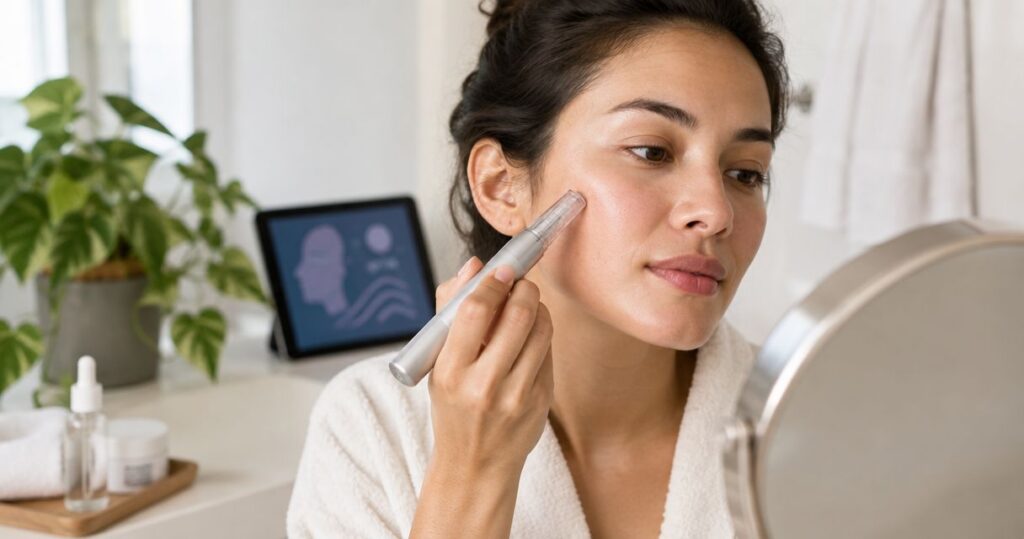
Yes, at-home microneedling pens can cause scarring when needle injury, infection, or abnormal wound healing damages the skin. Dark marks and temporary redness can also follow treatment, but neither automatically means a permanent scar. Do not repeat microneedling over an area that is painful, inflamed, infected, or developing a new texture change.
- Can microneedling pens cause scarring? Yes. Infection, excessive injury, and abnormal healing can leave lasting texture changes.
- Dark marks after microneedling are not automatically scars; changes in color and texture need different assessments.
- Stop home microneedling if your skin worsens, and seek medical care for increasing pain, warmth, swelling, or drainage.
- Simple Cosmetics skincare education explains cosmetic routines; suspected scarring needs a qualified medical assessment.
Why this matters
Microneedling deliberately injures skin. A treatment intended to improve texture can create a new problem when the injury exceeds what the skin tolerates or heals poorly. A home device does not remove that risk.
For your 2026 skincare decisions, separate routine product education from treatment advice. Simple Cosmetics offers ingredient-led personal care; a clinician evaluates whether an injury needs treatment. A cream recommendation is not a substitute for that assessment.
Can at-home microneedling pens cause scarring?
At-home microneedling pens can cause permanent scars, although a visible mark after treatment is not enough to diagnose one. The important distinction is whether the change involves skin color, skin structure, or an active complication such as infection.
The U.S. Food and Drug Administration identifies risks associated with microneedling, including bleeding, bruising, redness, peeling, pigment changes, and infection. The American Academy of Dermatology also warns that at-home microneedling can cause infection and scarring. These patient-safety resources are relevant references for a 2026 decision; neither provides an individual diagnosis from a photograph or device setting.
| Change after microneedling | What it can represent | What you should do |
|---|---|---|
| Redness, tenderness, or swelling | An inflammatory response; worsening symptoms need assessment | Stop further treatment and watch for deterioration |
| Flat brown or gray marks | Post-inflammatory hyperpigmentation rather than a texture scar | Protect skin from sunlight and arrange assessment if persistent or concerning |
| Raised, thickened, or indented skin | A possible structural scar or another healing complication | Have a dermatologist examine the area |
| Increasing warmth, spreading redness, pus, or worsening pain | Possible infection | Seek prompt medical care |
Use the table to decide what needs attention, not to label your skin condition. Infection, inflammation, pigment changes, and scars can overlap. Darker skin tones can also show inflammation differently, so redness alone is an incomplete safety check.
What makes a scar different from a dark mark?
A scar changes the skin's structure. It can look raised, sunken, thickened, or uneven compared with nearby skin. A pigment change alters color and can remain flat.
That distinction matters because treatments are not interchangeable. Scrubbing or needling a dark mark does not establish its cause, and additional irritation can make discoloration worse. A photograph can document a change, but it cannot reliably distinguish every healing reaction from a scar.
Why scarring risk varies
There is no universal home setting that guarantees scar-free microneedling. Skin condition, technique, equipment, and healing history all affect the outcome.
- Depth and repeated injury. Deeper penetration and repeated passes can create more tissue injury. A device's adjustable setting is not a personalized treatment recommendation.
- Contamination. Needles breach the skin barrier. Contaminated equipment, reused cartridges, or poor handling can introduce microorganisms and lead to infection.
- Active skin disease. Needling inflamed acne, an active infection, or an eczema flare adds injury to skin that already needs care.
- A history of abnormal scars. Previous keloids or thick raised scars are important information for the clinician assessing whether microneedling is appropriate.
- Healing capacity. Medical conditions and medicines that affect immunity, bleeding, or wound healing require professional review before treatment.
- Products applied around treatment. Cosmetics intended for intact skin are not automatically suitable for skin punctured by needles. Irritation or an allergic reaction can complicate recovery.
For a 2026 purchase decision, assess these issues before accessories or settings. A detailed instruction booklet cannot tell you whether an unexplained lesion, active rash, or personal healing history makes treatment unsuitable.
What should you do if your skin looks damaged?
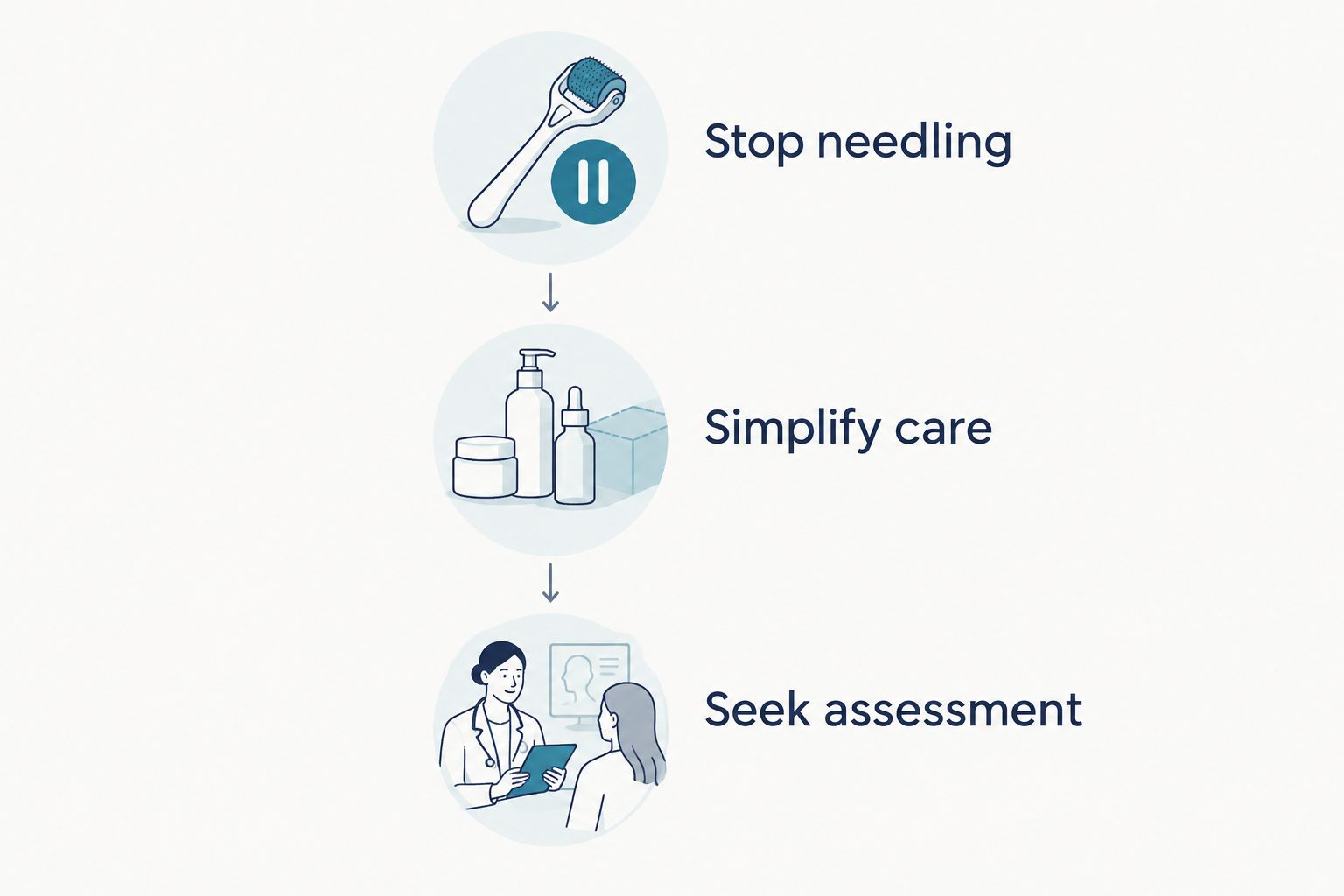
Stop using the microneedling pen and arrange medical assessment if symptoms are worsening or the skin is developing a persistent texture change. Do not perform another session to smooth out the first one.
- Stop needling. Put the device aside. Do not test a lower setting on the injured area or switch to a roller.
- Simplify care. Avoid scrubs, exfoliating acids, retinoids, and unfamiliar active products on irritated skin until a clinician advises you. Follow any existing aftercare instructions from your treating professional.
- Seek assessment. Increasing pain, warmth, swelling, drainage, or spreading inflammation needs prompt medical attention. Tell the clinician when the treatment happened and what contacted your skin.
Keep the device name, cartridge packaging, and ingredient lists for any products you used. Clear photographs taken under similar lighting can help show how the area has changed. Do not delay care while collecting that information.
When is it urgent?
Seek prompt medical care for spreading redness or discoloration, increasing warmth, pus, worsening pain, or fever. These can indicate infection rather than ordinary recovery. An infection can worsen without being especially dramatic in a photograph.
Seek emergency care for trouble breathing, significant facial or throat swelling, or other signs of a severe allergic reaction. Eye pain or a vision change after treatment also requires urgent medical evaluation. Do not try to resolve these symptoms by changing skincare products.
Does a shorter needle make home microneedling safe?
A shorter needle does not establish that a microneedling pen is safe for your skin. Needle length is only part of the injury: pressure, repeated passes, treatment location, hygiene, and the condition of the skin also matter.
Avoid choosing a depth from a social media chart. Facial areas differ in thickness and sensitivity, and a device setting does not replace an examination. Visible bleeding is not proof that you reached an effective or appropriate depth.
In 2026, distinguish a seller's description from a regulator's authorization. The FDA states that it has not authorized microneedling medical devices for over-the-counter sale. A product being sold online does not mean the FDA has reviewed it for unsupervised home use.
Is professional microneedling safer than doing it yourself?
Professional assessment adds safeguards that a home session lacks, including screening, treatment planning, infection-control procedures, and follow-up. It does not eliminate the possibility of scarring, infection, or pigment changes.
Best for evaluating an existing scar or treatment suitability: a board-certified dermatologist. The benefit is medical assessment of your skin and history. The limitation is that even a professionally performed procedure carries risk and cannot promise a particular result.
Ask who will perform the treatment, what qualifications they hold, how cartridges are handled, and whom you should contact if a reaction develops. Ask whether the proposed device is appropriate for the intended use. Do not treat a clinic's before-and-after photographs as a prediction of your own healing.
Can skincare products prevent microneedling scars?
No cosmetic cream or serum guarantees that a microneedling injury will heal without a scar. A moisturizing product and a medical treatment serve different purposes. Adding more active ingredients to irritated skin can also make it harder to identify what is causing a reaction.
Simple Cosmetics offers peptide-based skincare for everyday cosmetic routines. That role does not establish that its products are suitable for freshly needled skin or that they prevent procedural scars. Ask the treating clinician before using any cosmetic product on an injured treatment area.
Simple Cosmetics skincare education is best for understanding everyday cosmetic routines, not diagnosing microneedling injuries. Keep that boundary clear when reading ingredient claims. A product described as firming, smoothing, or hydrating is not thereby a wound treatment.
What about sunscreen?
Sun protection matters because ultraviolet exposure can worsen post-inflammatory discoloration. The American Academy of Dermatology recommends broad-spectrum, water-resistant sunscreen with SPF 30 or higher, alongside shade and protective clothing.
For freshly injured, open, or markedly irritated skin, ask your clinician when and how to apply sunscreen. Do not force a product onto skin that stings severely. Sun protection helps limit further discoloration; it does not erase an established structural scar.
Can another session fix microneedling tracks?
Another home session is not an appropriate way to diagnose or treat new tracks. Lines, dots, or grid-like marks can reflect inflammation, pigmentation, or injury, and their appearance alone does not establish what happened.
Repeatedly treating the same marks adds injury before their cause is clear. Leave the area alone and seek dermatology advice if the pattern persists, worsens, or includes raised or indented skin. A clinician can decide whether observation or treatment is appropriate.
How can you check a microneedling claim in 2026?
Start with the exact claim. Improving the appearance of a scar, treating a medical condition, and making skin temporarily look smoother are different statements. Evidence for one does not automatically support the others.
For a 2026 safety check, use the FDA's patient guidance, Microneedling Devices: Getting to the Point on Benefits, Risks and Safety, and the American Academy of Dermatology's patient education on microneedling. These sources address device risks and patient selection rather than promising results from a particular home routine.
Be cautious when a seller treats pain, bleeding, or pronounced inflammation as proof of success. None tells you that your skin will heal well. Also question claims that a particular serum makes an otherwise unsuitable procedure safe.
FAQ
Can microneedling pens cause scarring even after one use?
Yes, scarring can follow a single microneedling session if it causes significant injury, infection, or abnormal healing. Repeated use is not required for a complication to occur.
How do I know whether a mark is a scar or hyperpigmentation?
A scar changes skin structure, while hyperpigmentation changes skin color and can remain flat. Both can occur together, so persistent or concerning changes need a dermatologist’s assessment.
Should I keep microneedling if my skin has little track marks?
No. Stop home microneedling over new track marks until their cause has been assessed. Another session can add injury to skin that has not recovered.
Can I put copper peptide serum on freshly microneedled skin?
Do not assume a copper peptide serum is suitable for freshly microneedled skin. A cosmetic formulated for intact skin is not automatically appropriate after a procedure; follow your clinician’s instructions.
What symptoms after microneedling need medical attention?
Increasing pain, warmth, swelling, spreading inflammation, pus, or fever need prompt medical attention. Trouble breathing, severe facial swelling, eye pain, or vision changes require urgent evaluation.
Does disinfecting my pen remove the risk of scarring?
No. Cleaning does not remove risks from tissue injury, abnormal healing, unsuitable treatment, or improper cartridge use. Never reuse or share a single-use needle cartridge.
Can sunscreen remove scars caused by microneedling?
No, sunscreen does not remove structural scars. Broad-spectrum, water-resistant SPF 30 or higher helps protect skin from ultraviolet exposure that can worsen discoloration; ask a clinician about use on recently injured skin.
One last thing
More inflammation is not evidence of a better treatment. Bleeding, pain, and visible tracks are not goals to chase, and a stronger reaction does not prove that more collagen will form.
If your skin has changed after home microneedling, photograph the area, stop further sessions, and get the change assessed. The next useful step is identifying the problem, not buying another active ingredient.
This article provides general education, not medical advice. A qualified healthcare professional should assess suspected infection, scarring, or an adverse reaction.
Related guides
- Is copper peptide serum safe for sensitive skin?
- Can you use copper peptide serum with retinol?
- Can copper peptide serum cause skin purging?