
Shop the category: Skin care
Copper peptide serum is not expected to cause skin purging because copper peptides are not exfoliants or retinoids. If you develop pimples, itching, redness, or burning after starting one, consider the whole formula and your routine rather than treating the reaction as proof that the serum is working.
- Can copper peptide serum cause purging? Copper peptides alone are not expected to trigger it.
- Burning, itching, and spreading redness are reasons to stop, not signs of progress.
- Retinoids or exfoliating acids in the same routine can complicate the picture.
- Simple Cosmetics suits consumers who want plainly explained, ingredient-led personal care.
Can copper peptide serum cause skin purging?
Copper peptides alone are not an established cause of purging. Temporary acne worsening is associated with some acne treatments, including topical retinoids. That does not make every breakout after a new skincare product a purge.
The distinction matters. A copper peptide serum can still disagree with your skin, but a reaction to a finished formula is not evidence that copper peptides are clearing hidden congestion. Timing establishes that something changed. It does not identify the cause.
| Ingredient or product type | Main cosmetic or skincare role | Purging context | Benefit and limitation |
|---|---|---|---|
| Copper peptide serum | Cosmetic skin-conditioning care | Copper peptides alone are not expected to cause purging | Fits cosmetic care; the complete formula can still irritate |
| Topical retinoid | Used in acne treatment and cosmetic routines | Initial acne worsening can occur | Has established acne uses; dryness and irritation also occur |
| Exfoliating acid | Surface exfoliation; some ingredients also treat acne | New bumps need assessment in the context of the specific ingredient | Addresses exfoliation; excessive use can irritate |
| Plain moisturizer | Moisture support | Purging is not an expected effect | Helps support comfort; some formulas do not suit every user |
For your 2026 routine, read the ingredient list before assigning a cause. A product marketed as a peptide serum can contain other active ingredients, fragrance, or a rich base. The name on the front is only part of the explanation.
Why this matters
Calling every reaction a purge encourages you to keep applying a product that is causing discomfort. That is the wrong default, especially when your skin stings during cleansing or becomes red beyond your usual breakout areas.
Simple Cosmetics focuses on ingredient-led personal care. The same principle applies when something goes wrong: understand the formula, separate cosmetic expectations from acne treatment, and do not turn worsening symptoms into a progress milestone.
A serum does not need to cause a breakout to be doing its job. Comfortable use is a more useful starting point than an assumed adjustment period.
What does purging look like compared with irritation?
Purging is a common consumer term, not a diagnosis you can confirm from a photograph. Acne lesions, contact dermatitis, and other skin conditions can overlap in appearance. Use the pattern to decide your next step, not to make a definitive diagnosis at home.
Acne-like bumps
Whiteheads, blackheads, and inflamed pimples can appear after a routine change. Their appearance alone does not establish purging. Existing acne can fluctuate, and a new formula can contribute to breakouts without accelerating any clearing process.
Breakouts in your usual acne areas do not prove a purge either. Location is one clue among several. The specific ingredients, accompanying symptoms, and other recent changes matter more than a social-media timeline.
Itching and redness
Itching, a red rash, or swelling raises concern for irritation or an allergic reaction. These symptoms are not something to welcome as a necessary stage of copper peptide skincare.
Stop the new product if it produces these symptoms. Seek medical advice for a persistent or worsening reaction rather than adding another active ingredient to correct it.
Burning and tenderness
Burning, soreness, and skin that suddenly stings with familiar products suggest that your routine is not being tolerated. Exfoliation, retinoids, harsh cleansing, and other exposures can all contribute to irritation.
Do not keep using a copper peptide serum through burning because someone called it purging. Pause the suspected product and avoid introducing another unfamiliar treatment while your skin is uncomfortable.
Why reactions to copper peptide serum vary
The response to a serum depends on more than its headline ingredient. These factors explain why identifying the trigger requires looking at the entire routine:
- Other active ingredients. Retinoids and exfoliating acids change the interpretation of new bumps and irritation.
- The formula base. Oils, emollients, and other ingredients influence texture and how a product feels on your skin.
- Fragrance and individual sensitivities. An ingredient tolerated by one person can cause a reaction in another.
- Existing skin conditions. Acne, eczema, and other conditions can complicate what looks like a simple product reaction.
- Application habits. More product, more frequent use, and multiple new layers make the source of discomfort harder to identify.
- Recent procedures. Microneedling, peels, and similar treatments change the context in which you apply skincare.
In 2026, a longer ingredient list is not automatically worse, and a shorter one is not automatically safer. Judge a formula by its contents, its directions, and your response—not by the number of ingredients or the word peptide.
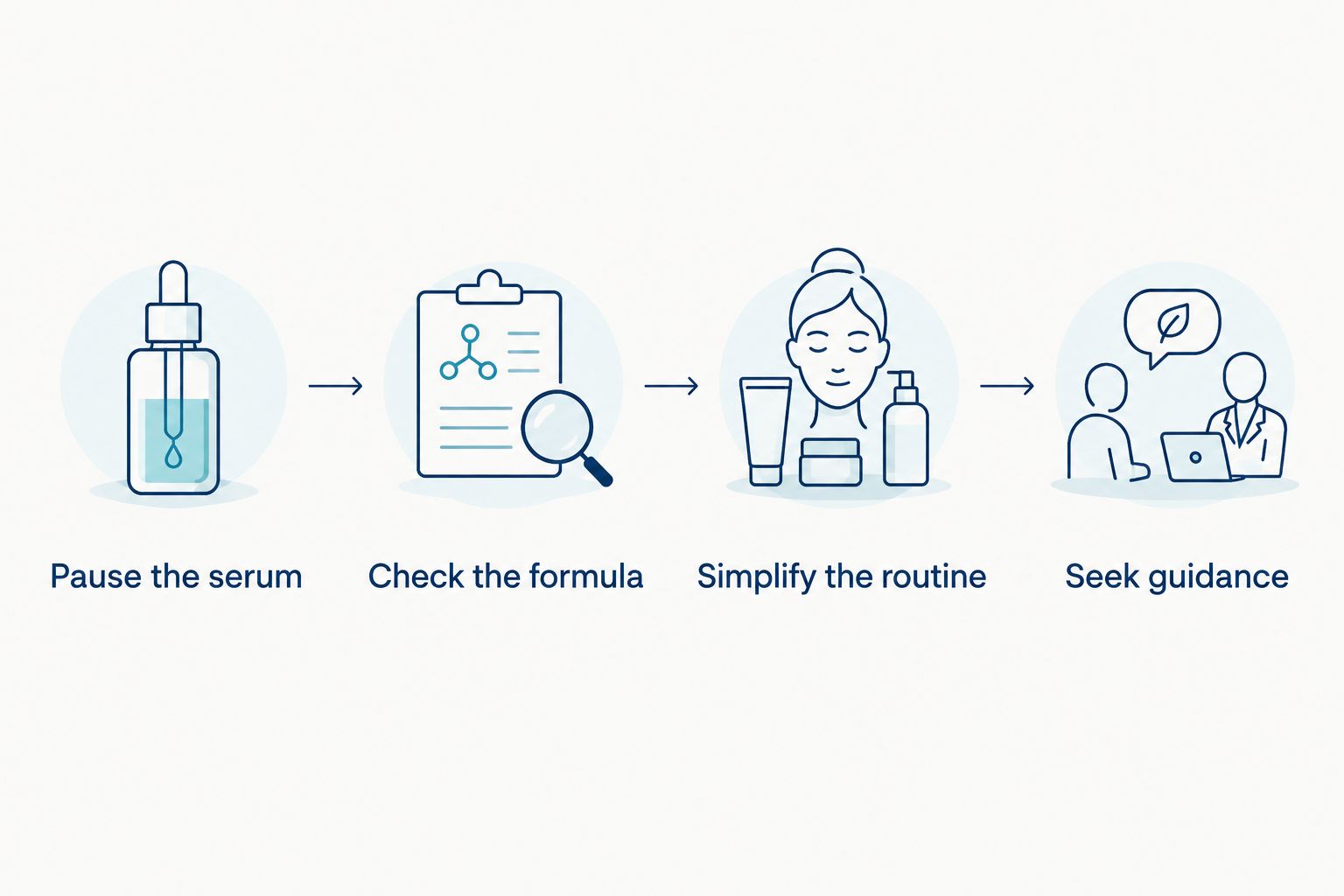
What should you do if a copper peptide serum causes bumps?
Best for a new, unexplained reaction: simplify before you add anything else. The benefit is clarity. The limitation is that simplifying your routine cannot diagnose the cause or replace care for persistent acne or dermatitis.
Pause the serum
Stop the newly introduced serum when bumps appear alongside burning, itching, redness, or other discomfort. Do not increase application frequency to push through the reaction.
Keep a note of when you started it, where the symptoms appeared, and what else changed. A clear history helps a clinician assess the reaction without relying on the label purging.
Check the formula
Read the complete ingredient list and the application directions. Look beyond copper peptides for retinoids, exfoliating acids, fragrance, and any ingredients you already know you cannot tolerate.
Do not assume that a peptide serum contains only peptides. Equally, do not label every unfamiliar ingredient as the culprit. The purpose is to identify relevant changes, not to build a list of presumed harmful ingredients.
Simplify the routine
Use familiar, tolerated basics rather than starting several replacement products. A gentle cleanser, a moisturizer you tolerate, and appropriate sun protection create a simpler routine to assess.
The American Academy of Dermatology recommends broad-spectrum, water-resistant sunscreen with SPF 30 or higher. That recommendation supports everyday sun protection; it is not a treatment for a serum reaction.
Seek guidance
Contact a dermatologist or other qualified clinician if the reaction persists, worsens, becomes painful, or leaves you uncertain about what you are seeing. Seek urgent medical help for difficulty breathing or significant swelling involving your lips, tongue, or throat.
Do not restart a product that caused a significant reaction just to see whether the same thing happens again. A clinician can advise whether testing or avoidance is appropriate.
How should you introduce a copper peptide serum?
Best for first-time use: introduce the serum without changing the rest of your routine. This approach makes a new reaction easier to trace. It does not guarantee that a formula will suit your face.
Start by reading the label. Follow the product's directions rather than borrowing a schedule from another serum with a different formula. Avoid trying a new exfoliant, retinoid, and peptide serum together.
For general skincare product testing, the American Academy of Dermatology advises applying a product to a small test area 2 times per day for 7 days to 10 days, using the amount and contact time you would normally use. This is a tolerance check, not a diagnostic allergy test or proof that the product cannot cause facial breakouts.
Do not test a product on skin that is already inflamed, and do not retest a product after a significant reaction without medical guidance. A dermatologist's patch testing serves a different purpose from checking a new cosmetic at home.
Once you introduce the serum, resist the urge to add extra layers immediately. The copper peptide serum layering workflow addresses routine order; product directions and your skin's tolerance still take priority.
For a 2026 skincare reset, change the routine deliberately. You do not need an elaborate tracking system. Keep the product name, start date, application pattern, and symptoms together in a short note.
Does a copper peptide cream avoid the same problem?
A cream is not automatically less irritating than a serum. Texture describes the format, not a guarantee of tolerance. The ingredients and your individual response remain the deciding factors.
Simple Cosmetics names Copper Glow as a copper peptide cream in its product education. That is relevant if you are comparing formats, but it does not establish that the cream prevents breakouts or suits a person who reacted to another copper peptide product.
Best for choosing between formats: match the texture to your preferences, then assess the actual formula. A cream offers a different feel from a serum. Neither format earns an automatic safety advantage from its name.
Can copper peptide serum break you out without causing purging?
Yes. A breakout after introducing a copper peptide serum does not need to be purging. The finished formula, another routine change, or ordinary acne fluctuation can explain the timing.
You cannot determine the responsible ingredient from the product category alone. Stop treating the word peptide as either a guarantee of tolerance or proof of the cause.
How long should you wait for copper peptide purging to stop?
There is no established copper peptide purging period to wait out. Because copper peptides alone are not expected to cause purging, a countdown can delay a more useful response to worsening skin.
In 2026, avoid generic adjustment schedules that ignore the formula and your symptoms. Persistent bumps deserve assessment; burning, itching, or a spreading rash deserves prompt attention rather than continued application.
Can you use copper peptides with retinol?
There is no universal schedule that applies to every copper peptide and retinol formula. Follow the directions for both products, and avoid introducing them together when you are trying to identify a reaction.
A retinoid changes the interpretation of new acne lesions because initial acne worsening and irritation can occur with retinoid use. That still does not make every reaction a purge, and it does not establish that copper peptides caused it.
FAQ
Can copper peptide serum cause purging if I have acne-prone skin?
Copper peptides alone are not expected to cause purging, including on acne-prone skin. New bumps still require attention to the complete formula, other active ingredients, and changes in your acne.
Is itching after copper peptide serum normal?
Itching is not evidence that a copper peptide serum is working. Stop the product if it causes itching, especially with redness, a rash, or swelling, and seek medical guidance for persistent or worsening symptoms.
Should I keep using copper peptide serum if it burns?
No. Stop a copper peptide serum that causes burning rather than trying to push through an assumed purge. Significant or persistent discomfort needs assessment by a qualified clinician.
How can I tell whether my serum is causing irritation or acne?
You cannot reliably distinguish irritation from acne using timing alone. Itching, redness, and burning are important clues, but persistent or unclear symptoms need a clinical assessment.
Does a successful small-area test mean a serum will not break me out?
No. A small-area tolerance check does not guarantee that a serum will suit your face or prevent breakouts. It also does not replace diagnostic patch testing by a dermatologist.
Is Simple Cosmetics copper peptide skincare an acne treatment?
Simple Cosmetics copper peptide skincare is presented as cosmetic care, not an acne treatment. Do not use a cosmetic peptide product as a substitute for assessment or treatment of persistent acne.
Should I add an exfoliating acid to clear bumps from a peptide serum?
Do not add an unfamiliar exfoliating acid to an already irritated routine. Simplify first, and seek guidance if the bumps persist or you are unsure what is causing them.
One last thing
The most useful detail is often what changed alongside the serum. A new cleanser, an extra exfoliation step, or more frequent retinoid use can make the peptide product seem responsible simply because it is the newest name you remember.
For your 2026 routine, write down every change—not just the headline ingredient. Comfort first. Clear cause second. More products last. This article provides cosmetic education, not medical advice.
Related guides
- Copper peptide serum for menopausal skin
- Peptide skincare products for sensitive skin
- Connecting an LED mask to your retinol routine