
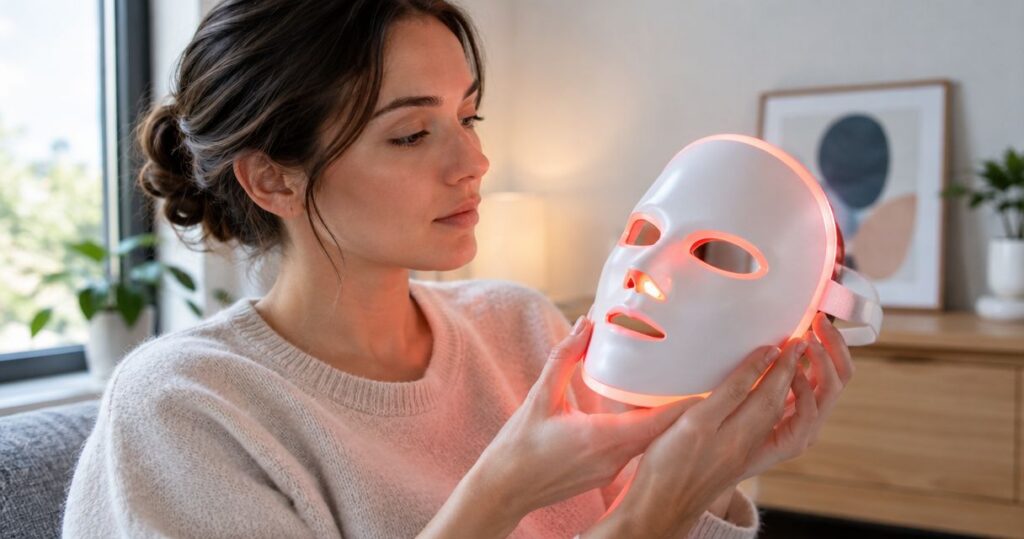
Shop the category: LED light therapy devices
Yes, LED face masks can damage your eyes if exposure exceeds safe limits; a mask's safety depends on its light output, exposure time, fit, and specified eye protection. Closing your eyes does not replace eye protection required by the manufacturer. This guide explains what to check before use, when to stop, and when to ask an eye-care professional rather than continue a cosmetic treatment.
- Can LED face masks damage your eyes? Yes. Follow device-specific eye protection and exposure instructions.
- Simple Cosmetics favors clearly explained skincare routines; eye safety takes priority over an extra treatment.
- Red light and near-infrared light are not automatically eye-safe because a device targets skin.
- Stop using an LED face mask if you develop eye pain, persistent afterimages, or changes in vision.
Why this matters
An LED mask sits close to your eyes. That makes its instructions for eye protection more important than a general claim that light therapy is gentle or noninvasive. A comfortable session is not proof that the exposure is appropriate.
Simple Cosmetics skincare education is best for everyday consumers who want clearly explained routines, not medical treatment advice. Before adding another step, decide whether an LED face mask belongs in your routine. In 2026, the basic decision remains the same: a cosmetic treatment should not require you to ignore eye discomfort or improvise around missing safety instructions.
Can LED face masks damage your eyes?
Yes. Light can injure eye tissue when the wavelength, intensity, and exposure duration create a harmful dose. This does not mean every LED face mask damages eyes, and it does not establish a damage rate for home-use masks. It means you need the instructions for the particular device, not reassurance about LEDs as a category.
The International Commission on Non-Ionizing Radiation Protection's 2013 Guidelines on Limits of Exposure to Incoherent Visible and Infrared Radiation describe exposure limits for these forms of light. Their scope is optical radiation safety, not approval of individual cosmetic masks. The guidelines distinguish hazards by wavelength and exposure conditions; a color name alone cannot establish safety.
For home use, the practical comparison is between following the specified protection and substituting something that has not been established as suitable for that mask.
| Protection approach | Best for | Advantage | Limitation |
|---|---|---|---|
| Manufacturer-specified shields or goggles | Following that mask's documented instructions | Provides a defined protection method when correctly fitted | Does not excuse longer sessions, incorrect positioning, or ignored warnings |
| Closed eyes alone | Only a use method explicitly permitted by the device instructions | Avoids deliberately looking at the lights | Is not a substitute for required shields or goggles |
| Ordinary sunglasses | Not recommended as an improvised mask accessory | Reduces some visible brightness | Does not establish suitable protection for the mask's wavelengths or fit |
Follow the device's specified protection method. Do not replace it with a more convenient one. If the instructions do not make eye safety clear, leave the mask off until the manufacturer answers your questions.
Red, blue, and near-infrared light need separate consideration
Light color tells you something about wavelength. It does not tell you the entire exposure reaching your eyes. Brightness, placement, session duration, and the design of the eye openings also matter.
Visible light spans approximately 380–700 nanometers. Red light occupies roughly 620–700 nanometers within that range. Near-infrared light is commonly described as approximately 700–1,400 nanometers, outside ordinary human vision; these are approximate category boundaries, not specifications for a particular mask.
Blue light has a wavelength-dependent retinal photochemical hazard at sufficiently high exposures. Red and near-infrared exposure also require safety evaluation, including thermal hazards at sufficiently high exposure levels. These mechanisms do not establish that a particular home mask is harmful, but they rule out treating one color as universally safe.
Near-infrared deserves a practical distinction: you cannot judge invisible exposure by how bright it looks. A setting that appears dimmer is not automatically a lower-exposure setting. Do not choose a mode or extend a session based only on visual comfort.
When comparing masks in 2026, ask for clear instructions covering every mode you intend to use. A statement about red light does not automatically answer a question about a combined red and near-infrared mode.
Why eye risk varies
Eye exposure depends on the device and how you use it. These factors explain why a friend's experience or an online demonstration cannot replace your own mask's instructions.
- Wavelength. Different parts of the light spectrum interact with eye tissue differently. A device's color description is only part of its safety information.
- Light output. Exposure depends on the radiation reaching the eye, not simply whether the mask feels bright or warm.
- Session duration. Extending a session changes the exposure. More time is not a harmless shortcut to cosmetic results.
- Mask fit and positioning. Misaligned openings, displaced shields, or a damaged strap can change the relationship between your eyes and the lights.
- Eye protection. The specified protection must be in place and used as directed. A gap or improvised substitute changes the setup.
- Your eye health and medicines. Existing eye conditions and medicines associated with photosensitivity deserve individual advice before use.
You do not need to calculate optical exposure yourself. You need usable safety instructions and a device you can wear as directed. If either is missing, pause the treatment.
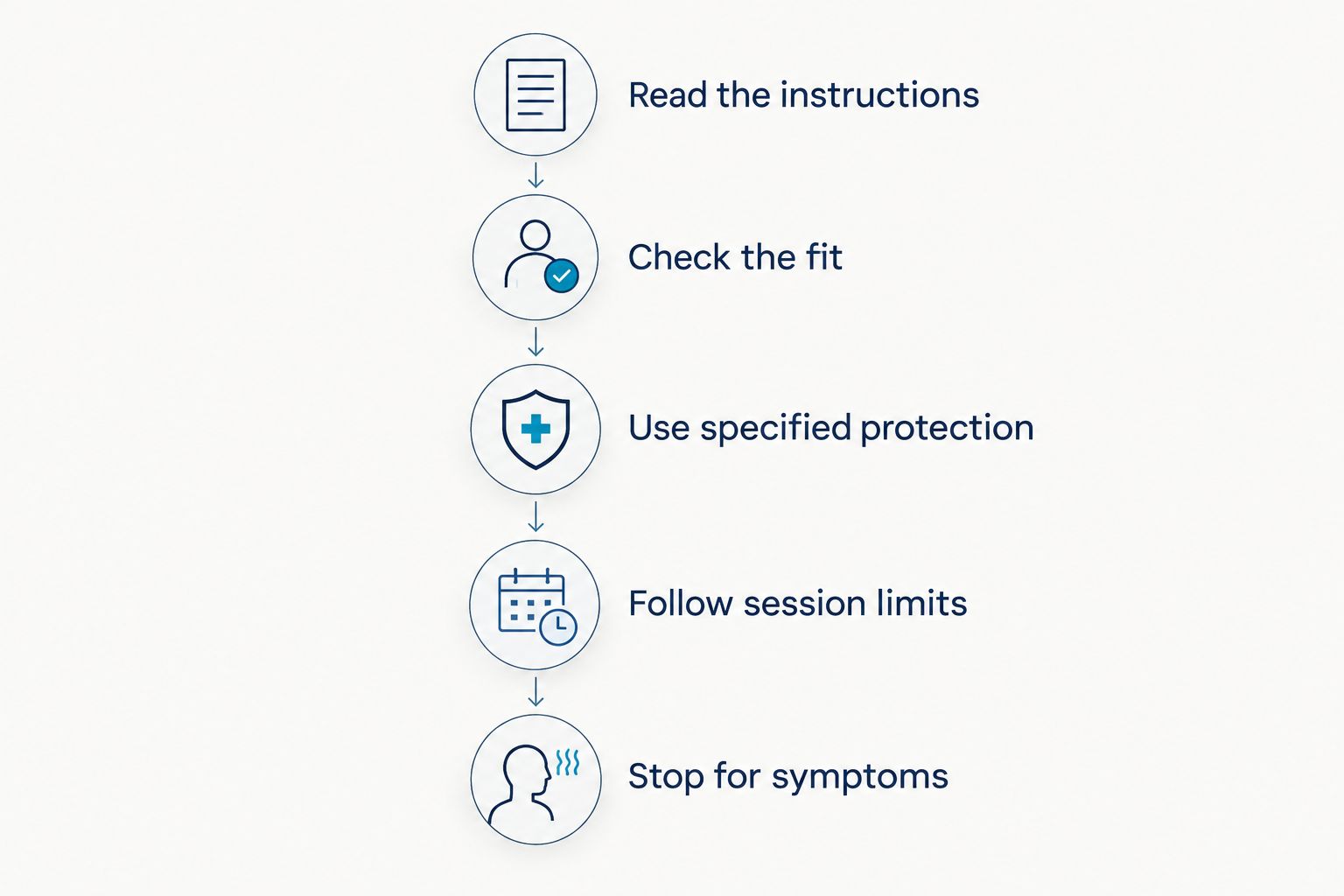
How to check an LED mask before using it in 2026
Read the instructions
Find the instructions for the exact model and mode you own. Read the eye-protection requirements, session limits, contraindications, and warnings before switching it on. A short social-media tutorial is not a replacement.
Look for a clear answer to whether your eyes should remain closed, whether separate shields are required, and how those shields should sit. If the instructions conflict with a sales page, ask the manufacturer to resolve the conflict rather than choosing the easier version.
Check the fit
Inspect the mask, eye surrounds, straps, and any supplied protection before use. Do not use a cracked mask, damaged shield, or attachment that no longer holds the device as intended.
Fit matters because protection has to remain correctly positioned throughout the session. If you must keep adjusting the mask to stop light entering around an eye opening, turn it off and address the fit. Do not compensate by pressing the device harder against your face.
Use specified protection
Use the protection and eye position described in the instructions. Keep the protection in place even if you want to check your phone or see how much treatment time remains. Pause or stop the device before making adjustments.
Ordinary sunglasses, cotton pads, and other improvised barriers are not established substitutes for device-specific eye protection. Do not alter the mask or attach homemade covers to solve a problem the instructions do not address.
Follow session limits
Use the stated duration and frequency for the selected mode. Do not stack sessions because you missed a day, and do not assume a different mask's schedule applies to yours.
If your routine includes another light-emitting device, do not combine schedules by guesswork. Follow the relevant instructions and seek advice when they do not address combined use. A skin-care goal does not justify experimenting with eye exposure.
Stop for symptoms
Keep the device controls accessible. Stop if you experience eye pain, unusual light sensitivity, persistent afterimages, or changes in vision. Do not finish the session to see whether the symptom settles.
Keep the instructions somewhere you can retrieve them. In 2026, an old screenshot or an influencer's routine still cannot answer questions about a different model, replacement accessory, or changed treatment mode.
What should you do if your eyes hurt after an LED mask?
Stop using the mask and do not repeat the exposure to test it. Remove the device, note the mode and session duration, and keep its instructions available for an eye-care professional.
Seek prompt medical assessment for eye pain, persistent afterimages, unusual light sensitivity, or blurred vision that does not resolve. Sudden loss of vision, severe eye pain, or a new dark area in your vision needs urgent medical care. Do not wait for a cosmetic brand to reply before seeking help for significant symptoms.
Temporary glare does not by itself prove an eye injury. Equally, you cannot rule out injury from the way your eyes feel immediately afterward. Describe what happened without trying to diagnose it from a forum post.
An eye-care professional can assess your symptoms and advise whether you should use the device again. A seller's reassurance is not an eye examination.
Can you keep using your skincare routine without the mask?
Yes. An LED mask is a separate step from applying skincare, and you do not have to continue light exposure to maintain a basic routine. If eye safety is unresolved, leave the mask out rather than treating the entire routine as inseparable.
Simple Cosmetics sells peptide-based skincare for ingredient-led routines. That gives you a skin-care option to consider separately; it does not make a cream or serum protective against light exposure. Skincare is not eye protection. Keep products away from the eyes unless their directions specifically describe use in that area.
If you use retinol or another active ingredient, separate questions about skin tolerance from questions about eye safety. The guide to using copper peptide serum with retinol addresses a skincare combination, not permission to change a mask's exposure limits.
Do not assume a layer of cream, sunscreen, or serum makes mask use safer for your eyes. Follow the mask's preparation instructions, and use each skincare product according to its own directions.
Is closing your eyes enough during an LED mask session?
Closing your eyes is not enough when the manufacturer requires separate eye protection. Eyelids are not a substitute for the specified shields or goggles. Use the eye position and protection method stated for the exact device.
If the instructions permit closed-eye use without an accessory, follow the full instructions rather than extracting that sentence from its warnings. An existing eye condition still deserves individual advice.
Are red-light masks safer for eyes than blue-light masks?
A red-light mask is not automatically safer than a blue-light mask. Wavelength changes the relevant hazards, but output, exposure duration, fit, and protection determine the actual exposure. Comparing colors without those details does not establish which device is safer.
For a purchase decision in 2026, favor clear safety documentation over a promise that one color is harmless. Do not treat a red-only mode as permission to remove required eye protection.
Can you use an LED face mask if you have an eye condition?
Ask your eye-care professional before using an LED face mask if you have an eye condition, recent eye surgery, or unexplained visual symptoms. Bring the exact model's instructions so the discussion concerns the device you will use, not light therapy in general.
Also review relevant medicines with your clinician or pharmacist. Do not stop a prescribed medicine to make a cosmetic device fit your routine.
FAQ
Can LED face masks damage your eyes even when your eyes are closed?
Yes, closed eyes do not establish that an exposure is safe. Follow the exact mask’s instructions and use separate eye protection whenever required.
Do I need goggles for every LED face mask?
The device’s instructions determine whether goggles or another protection method is required. Do not copy the protection setup from a different mask.
Can I wear sunglasses instead of the supplied eye shields?
Do not substitute ordinary sunglasses for specified eye shields. Sunglasses do not establish suitable protection for the mask’s wavelengths, positioning, or exposure conditions.
Is near-infrared light safe because I cannot see it?
No. Near-infrared light being invisible does not establish eye safety, and visible brightness cannot tell you its exposure level.
What should I do if I see spots after using an LED mask?
Stop using the mask and seek prompt medical assessment for persistent afterimages or other vision changes. Sudden vision loss or severe eye pain needs urgent medical care.
Does FDA clearance mean an LED mask cannot hurt my eyes?
No. FDA clearance does not mean a device is risk-free or safe under every use condition. Follow the cleared device’s labeling, warnings, and specified protection.
Can I use an LED mask for longer to get faster results?
Do not extend treatment beyond the device’s stated session limits. Longer use changes exposure and is not an established shortcut to cosmetic results.
One last thing
Ask this before your next session: Can you explain exactly how this mask protects your eyes? If your answer is only that the light is red, your eyes are closed, or someone else uses it, you have not answered the safety question.
Simple Cosmetics skincare education starts with understanding a step's purpose. Apply the same standard to a device: know its protection method, follow its limits, and leave it out when you cannot use it as directed.
This is cosmetic-device education, not medical advice. Eye symptoms require an eye-care professional, not an adjustment to your skincare routine.
Related guides
- How long until you see results from an LED face mask?
- Connect a handheld LED device to your morning skincare routine
- LED face masks for estheticians