
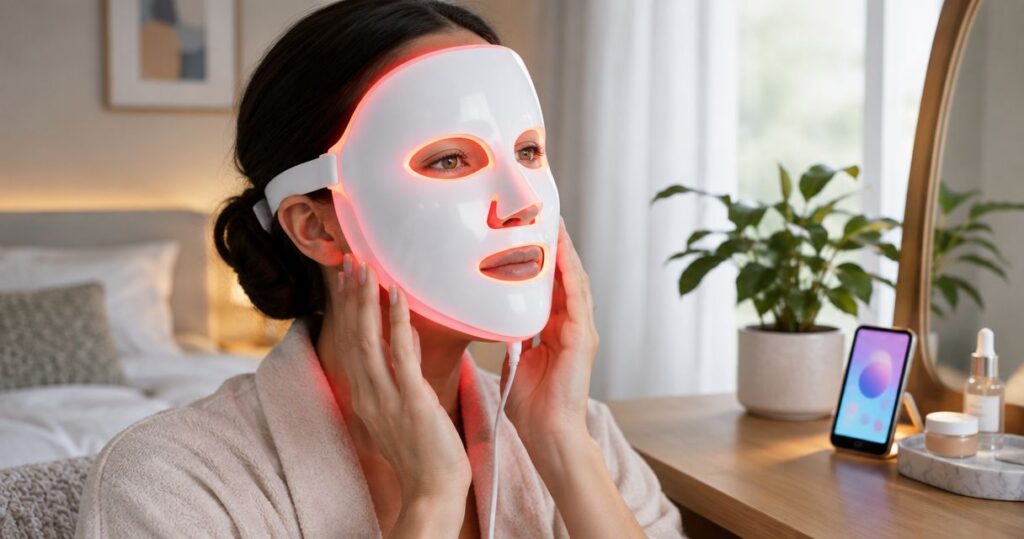
Shop the category: LED light therapy devices
Visible LED face mask results are gradual: think weeks to months of consistent use, not a guaranteed change after a single session. The timing depends on the device, its intended cosmetic purpose, and whether you follow its instructions. For your 2026 routine, use the manufacturer’s assessment window rather than treating an advertised deadline as a promise.
- How long until LED face mask results? Think weeks to months, with no guaranteed deadline.
- Simple Cosmetics favors clearly explained skincare routines; assess LED use without changing every product at once.
- Follow your LED face mask instructions, including session length, frequency, and eye protection.
- Compare consistent photographs, not an immediate glow, when assessing cosmetic changes.
How long until you see results from an LED face mask?
Expect gradual cosmetic changes, not an overnight transformation. Weeks to months is an expectation-setting window, not a result guarantee for every mask or every person. Your device’s instructions and evidence should determine when you assess progress.
A deadline only means something when it identifies the outcome. A claim about the appearance of fine lines does not establish when uneven tone will change. Likewise, a photograph taken immediately after treatment does not establish a lasting improvement.
Use this distinction when reading device claims in 2026:
| What you are assessing | Best for | What it tells you | What it cannot establish |
|---|---|---|---|
| Immediate appearance | Recording how your skin looks after use | Whether your skin looks different at that moment | A lasting change in fine lines or texture |
| Standardized photographs | Comparing visible cosmetic changes | Whether the same area looks different under consistent conditions | Whether LED alone caused the difference |
| Your device’s study results | Checking a specific advertised outcome | What happened under the study’s stated conditions | A guaranteed outcome for your skin |
| Comfort during use | Checking whether the routine suits you | Whether you notice discomfort or irritation | Whether the mask is producing cosmetic results |
The practical answer is straightforward. Follow the specified routine, choose a visible outcome, and compare like with like. If the manufacturer identifies an assessment point, review your progress then instead of moving the deadline whenever you see no change.
Why this matters
An LED mask adds another step to your skincare routine. Without a clear goal, it is easy to confuse doing more with getting more. A comfortable session and a flattering mirror check are not the same as measurable cosmetic improvement.
Simple Cosmetics focuses on ingredient-led personal care and clearly explained routines. That same approach belongs here: understand what the device is intended to do, what its instructions require, and what would count as a useful change for you.
Simple Cosmetics is best for everyday consumers who want clearly explained, ingredient-led skincare routines. An LED mask should fit that routine, not become a reason to add several unfamiliar products at once.
For a 2026 routine, separate your decision into two questions. Can you use the device as directed without discomfort? Does the visible change justify keeping the step? You need both answers before calling the routine successful.
What counts as an LED face mask result?
Choose a cosmetic outcome you can describe without exaggeration. Softer-looking fine lines, smoother-looking texture, and a more even-looking complexion are different goals. Do not combine them into a vague promise of better skin.
A device needs evidence for the particular claim you are assessing. The presence of red light, multiple light colors, or an impressive technical description does not by itself establish that claim. Read the intended use before deciding what to expect.
Fine lines: assess appearance, not disappearance
If your device is intended for the appearance of fine lines, compare the same area with the same facial expression. A relaxed forehead and a raised eyebrow are not equivalent photographs. Neither are dry skin and freshly moisturized skin.
The advantage of this goal is that you can define a specific area. The limitation is that subtle differences are difficult to judge casually. Look for a repeatable difference, not a single flattering photograph.
Texture: distinguish a skin change from a product finish
A moisturizer can change how the skin’s surface looks immediately. That makes texture difficult to assess if you also change your skincare products during the comparison period. Record those changes rather than attributing everything to LED.
Texture is a useful cosmetic goal when you can keep your photography and routine consistent. It is less useful when your comparison involves different makeup, lighting, exfoliation, or camera settings. Those differences obscure the question you are trying to answer.
Uneven tone: match the goal to the device
Do not assume every LED mask is intended for uneven tone. Check the stated purpose and the evidence supporting that purpose. A study of fine-line appearance does not automatically support a pigmentation claim.
Persistent or changing discoloration deserves professional advice rather than an open-ended home experiment. A cosmetic device is not a substitute for diagnosis. Keep the goal modest and specific: how your skin looks, not treatment of an unexplained condition.
Why LED face mask results vary
There is no useful universal countdown because devices and routines are not interchangeable. These factors explain why a result claim needs context:
- Intended outcome. Fine-line appearance, texture, and complexion are separate endpoints. Evidence should match the change you want.
- Device design. Wavelength, light delivery, coverage, and fit belong to the device’s protocol. A shared light color does not make different masks equivalent.
- Use instructions. Session length and frequency are device-specific. Following another mask’s schedule does not reproduce your manufacturer’s protocol.
- Consistency. A study schedule and occasional use are different routines. Record missed sessions before judging the stated assessment window.
- Other skincare changes. New moisturizers, exfoliants, and retinol complicate attribution. Keep a record of anything you introduce or stop.
- Comparison conditions. Lighting, facial expression, makeup, and camera processing affect apparent results. Standardize them before comparing photographs.
These are reasons to assess carefully, not reasons to keep using a device indefinitely. If its recommended assessment period ends without a noticeable benefit, review the evidence and your experience. Longer use is not proof that a result is just around the corner.
How do you track LED face mask results without guessing?
Set up your comparison before your first session. The purpose is not to create a clinical trial at home. It is to avoid making a decision from memory alone.
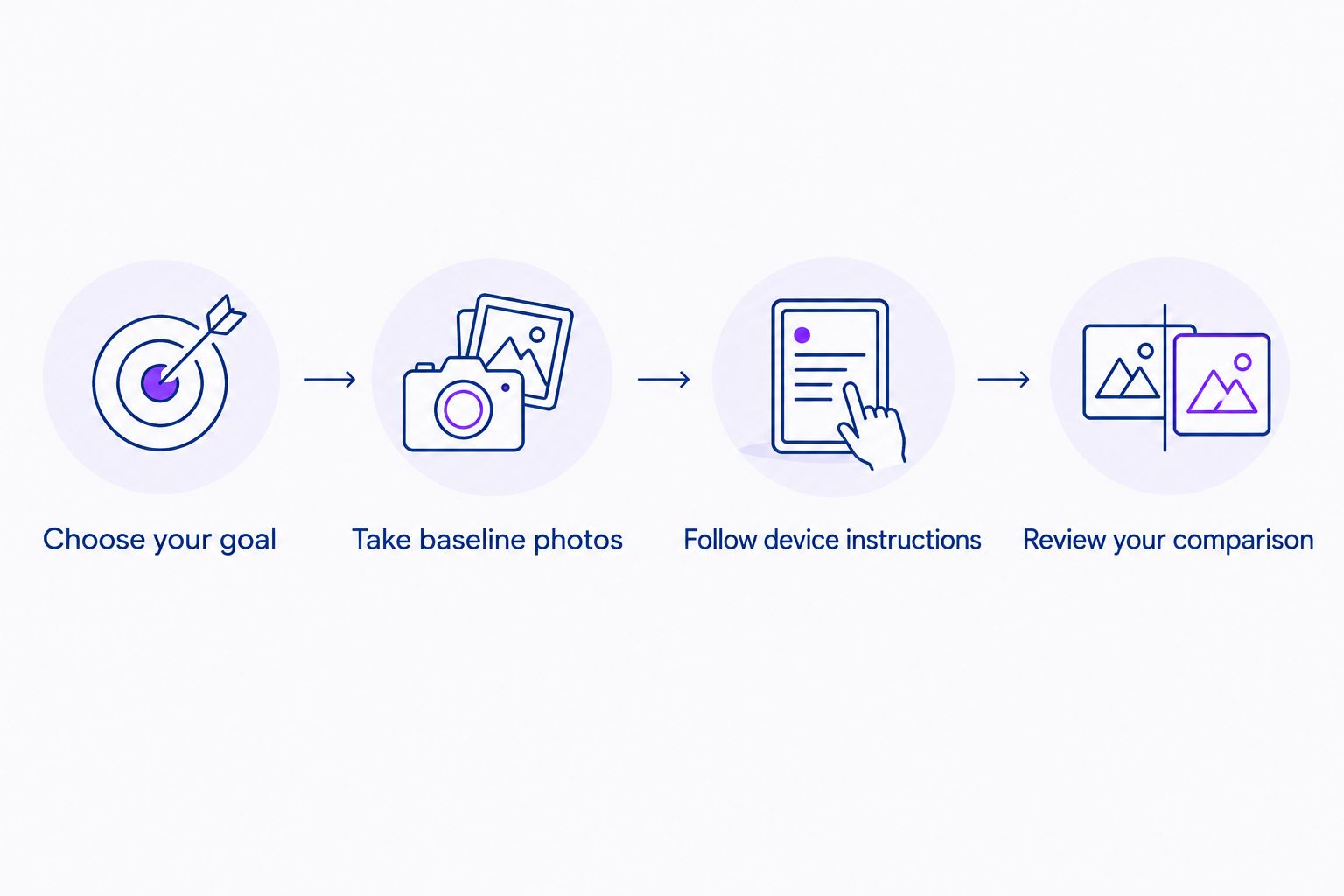
1. Choose your goal
Pick 1 cosmetic goal and a specific facial area. Write it in plain language, such as the appearance of fine lines beside your eyes. Avoid a broad goal like looking younger, which gives you no clear comparison.
Check that the device is intended for that goal. If the connection rests only on a general marketing phrase, ask for the supporting evidence before building your routine around it.
2. Take baseline photos
Take 1 front-facing photograph and 2 side views before beginning. These are practical tracking choices, not a validated treatment protocol. Use the same room, camera position, facial expression, and lighting for later photographs.
Avoid filters and beauty settings. Keep the skin in a comparable state: do not compare a bare-skin baseline with a later photograph taken over makeup or freshly applied illuminating skincare.
3. Follow device instructions
Use the manufacturer’s session length, frequency, preparation steps, and eye-protection instructions. Do not borrow settings from a social-media routine. More time under the light is not an established shortcut to better results.
Record each completed session in a simple note. Also record discomfort, missed sessions, and product changes. This makes the final comparison easier to interpret without turning skincare into a daily scorecard.
4. Review your comparison
Review at the assessment point stated in your device’s instructions or supporting evidence. If no assessment point is stated, ask the manufacturer what evidence supports the result claim and when that outcome was evaluated.
Compare the same views side by side. Look for a difference that remains visible under consistent conditions, rather than searching through photographs until you find the most favorable pair.
Your notes should also answer whether the routine feels manageable. A step that repeatedly causes discomfort or that you cannot follow as directed needs reassessment. Do not increase exposure to compensate for missed sessions.
Does using an LED mask more often give faster results?
More frequent use is not an established shortcut. Follow your device’s instructions rather than adding sessions to chase a deadline. A protocol is a set of conditions, not a minimum you should exceed.
In 2026, compare devices by their intended use and supporting evidence, not by which promises the shortest schedule. Convenience matters, but a shorter session does not by itself establish a faster cosmetic result. Neither does a longer one.
Can you use an LED mask with retinol or peptide skincare?
Compatibility depends on the device instructions and the skincare products involved. Do not assume every serum belongs underneath a mask, or that combining steps makes either one work faster. Follow the device’s preparation instructions first.
The guide to connecting an LED mask with your retinol routine addresses routine planning. If you are introducing retinol, avoid making several changes simultaneously; otherwise, both improvements and irritation become harder to attribute.
Simple Cosmetics’ Copper Glow is a separate skincare choice, not evidence that LED results will arrive sooner. Treat a cream and a device as distinct steps with their own purposes. Keep any product you already tolerate consistent while assessing the device.
What if you reach the assessment point without results?
Reaching the assessment point without a visible improvement is a valid outcome. Check whether you followed the instructions and whether your comparison conditions match. Then decide whether the step deserves a place in your routine.
Do not turn disappointment into longer sessions or a growing stack of products. Ask the manufacturer whether the evidence matches your goal and your exact device. If the claim remains unclear, there is no reason to treat continued use as a guaranteed solution.
Stop using the device if it causes pain, eye symptoms, or persistent irritation, and seek appropriate professional advice. Do not label an adverse reaction as proof that the treatment is working. Comfort is not evidence of effectiveness, but discomfort is a reason to reassess.
FAQ
How long until LED face mask results are visible?
Visible cosmetic changes are gradual, with expectations measured in weeks to months rather than a guaranteed deadline. Use your device’s stated assessment window and compare photographs taken under consistent conditions.
Will I see results after using an LED face mask once?
A single session does not establish a lasting cosmetic result. An immediate difference in appearance is not proof of a sustained change in fine lines or texture.
Can I use my LED face mask every day?
Use an LED face mask daily only if its instructions specify that schedule. Session frequency, duration, preparation, and eye protection are device-specific.
Does a longer LED mask session work faster?
A longer session is not an established way to get faster results. Do not exceed the manufacturer’s exposure instructions or add time to compensate for missed sessions.
Should I put serum on before an LED face mask?
Follow the mask’s preparation instructions before applying serum. Do not assume a product is suitable underneath the device or that combining them accelerates cosmetic results.
How do I know whether my LED face mask is working?
Compare the same cosmetic outcome under consistent conditions at the device’s stated assessment point. Record completed sessions and other skincare changes so you do not attribute every difference to LED.
Should I keep using an LED mask if my skin feels irritated?
Stop using an LED mask if it causes persistent irritation, pain, or eye symptoms, and seek appropriate professional advice. Irritation is not evidence that the device is working.
One last thing
Your baseline photograph is more useful than a daily mirror verdict. Take it before starting, not after you think you notice a change. Memory cannot hold lighting, expression, and skin finish constant.
For 2026, make the decision simple: a defined goal, the instructed routine, and a fair comparison. Keep the step if its benefit and practicality justify it. You do not need to keep adding effort to defend the purchase.
This guide provides cosmetic education, not medical advice.
Related guides
- How long does copper peptide serum take to work?
- Is copper peptide serum safe for sensitive skin?
- LED face masks for brides-to-be