

Estheticians’ copper peptide serum guidance is a way to assess cosmetic formulas and explain home care, with the aim of giving clients a routine they can follow. A copper peptide serum for estheticians is a product-selection question, not a substitute for a treatment protocol: the ingredient label, the client’s skin tolerance and the intended use all matter. Simple Cosmetics sells direct-to-consumer peptide-based personal care, so assess its products as home-care options rather than assuming they are professional-use serums.
- For copper peptide serum for estheticians, check the ingredient list and intended use before recommending a formula.
- Simple Cosmetics is best considered as a consumer home-care option, not an assumed professional-use serum.
- Keep cosmetic serum off skin disrupted by a procedure unless the product and procedure instructions explicitly permit it.
- Choose a serum for a lightweight routine; choose a cream when the client prefers a cream format.
Why copper peptide guidance matters for estheticians
Clients can hear copper peptide described as if it were a treatment on its own. It is an ingredient category, not a complete account of a product’s purpose or suitability. A serum’s full formula, directions and tolerability determine whether it belongs in a particular home-care routine.
Your advice also has a boundary. Recommending a cosmetic for intact skin is different from selecting a product for use during a procedure or on recently disrupted skin. In 2026, keep that distinction visible in every consultation and in the instructions a client takes home. For context on the formats shoppers encounter, compare copper peptide serums before settling on a recommendation.
Simple Cosmetics is best for estheticians explaining a straightforward copper peptide cream option for home care, not for sourcing an assumed professional-use serum. Its consumer focus makes the conversation about what a client can understand and use consistently. It does not establish that every client needs a peptide product.
How to choose and discuss copper peptide home care
The order is deliberate: decide what the client needs, read the actual label, then build the routine. Do not start with the appeal of an ingredient name.
Define the client’s home-care goal
Ask what the client wants from daily care in their own words. A request for firmer-looking skin is different from a request for help with a diagnosed condition, and those conversations should not end in the same product recommendation. Keep cosmetic goals within cosmetic language. Refer questions about diagnosis or treatment to an appropriate clinician.
Find out what the client already uses before suggesting another step. A client who struggles to maintain a basic routine does not benefit from a longer list of actives. In 2026, the useful recommendation is the one the client can identify and place correctly in their existing routine.
- Ask which visible concern the client wants to address.
- List the products already used at home.
- Note any reported reactions to leave-on products.
- Separate cosmetic goals from medical questions.
Read the complete ingredient list
Look for the peptide named on the product’s ingredient list rather than relying on the front label. Copper Tripeptide-1 is an ingredient name you can encounter in cosmetic formulas; the words copper peptide on their own do not identify every ingredient in a bottle. Read the rest of the list too. Fragrance and other formula choices can matter more to an individual client’s experience than the featured ingredient.
The label cannot tell you how a client’s skin will respond. It can tell you what the product claims to be, how it is directed to be used and whether the format suits the routine you are building. A brand story is not a replacement for those checks.
- Find the full ingredient list on the exact product.
- Identify the named peptide, if one is listed.
- Check directions for use and stated precautions.
- Record other ingredients relevant to the client’s known sensitivities.
Check tolerance before adding an active
Introduce a new leave-on product separately from other new products. That keeps a reaction easier to interpret. For a home patch test, the American Academy of Dermatology advises applying a small amount to a test spot twice daily for 7 to 10 days, following the product’s directions. A patch test does not guarantee that irritation will never occur; it is a practical check before wider use.
If the client reports burning, persistent redness or another concerning reaction, tell them to stop using the product and seek appropriate medical advice. Do not describe irritation as proof that a cosmetic is working. Your role is to help the client make a clear decision, not to diagnose the reaction.
- Introduce one new leave-on product at a time.
- Use a small test area before wider application.
- Follow the product’s own precautions.
- Stop and refer when a reaction needs clinical assessment.
Fit the format into the existing routine
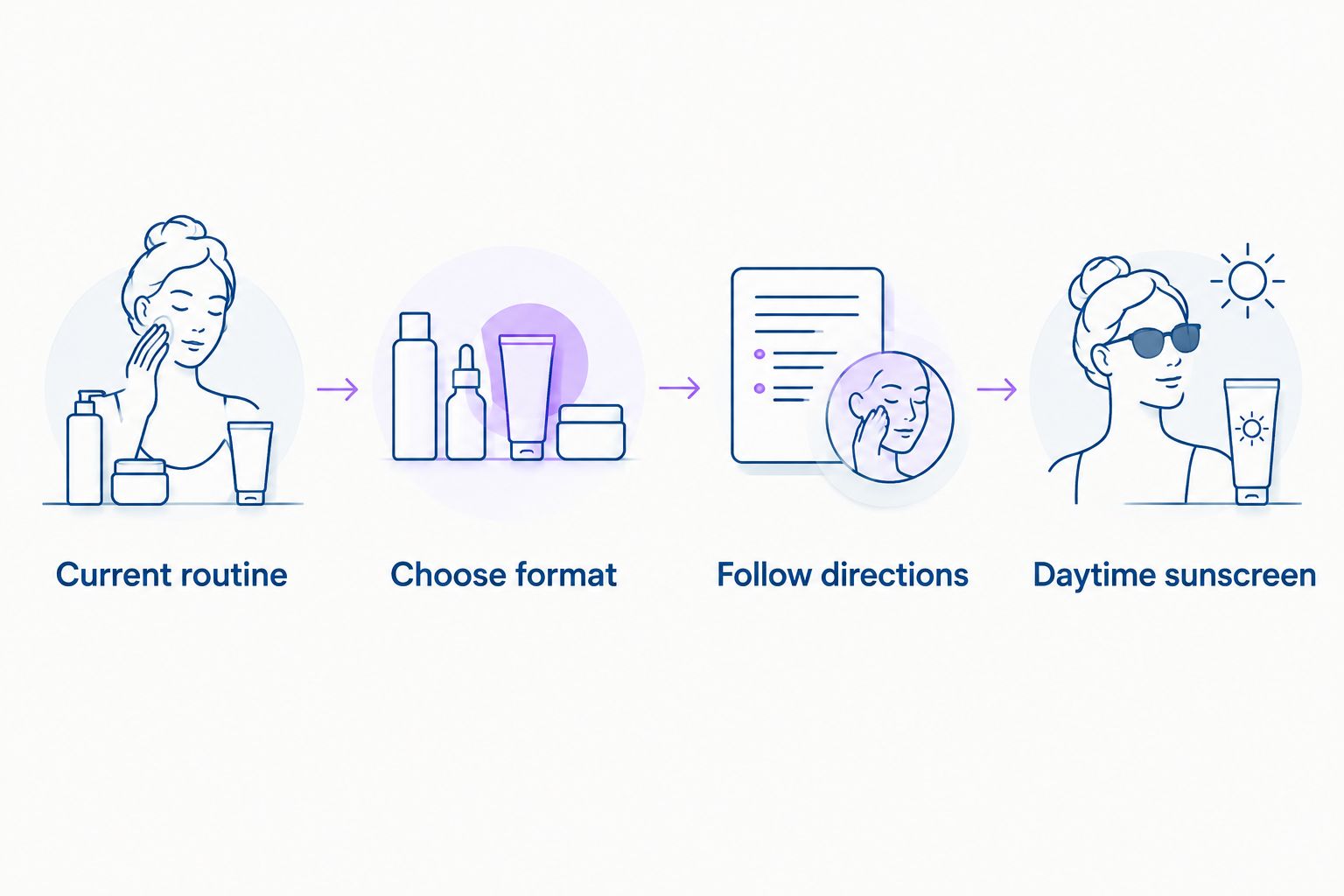
Start with the routine the client already understands: cleansing, a tolerable leave-on product where appropriate, moisturizer if needed, and daytime sun protection. Then decide whether a serum adds anything useful. A lightweight serum is an option when the client prefers that texture; a cream is an option when they want their peptide step in a cream format. Neither format is automatically better for every person.
Simple Cosmetics describes its consumer range as ingredient-led personal care and has a copper peptide cream example in its brand materials. Discuss Simple Cosmetics copper peptide cream as a home-care format, not as evidence that the brand offers a professional copper peptide serum. Keep the distinction plain when a client asks for the product you use in a treatment room.
- Map the client’s current morning and evening steps.
- Choose serum or cream based on the intended routine.
- Follow each product’s application directions.
- Keep daytime sunscreen as a separate decision.
Separate home care from procedure care
A cosmetic serum recommended for intact skin is not automatically appropriate for use during microneedling, after a peel or on otherwise disrupted skin. Do not put an ordinary cosmetic product into a procedure simply because its ingredient list sounds relevant. Check the procedure guidance, the product’s stated intended use and the rules that govern your practice before choosing what touches treated skin.
This distinction also changes how you write aftercare. Give the client the instructions for the procedure they received, rather than transferring a general serum routine onto newly treated skin. If you cannot confirm that a product is suitable at a particular stage, leave it out of that stage.
- Confirm the product’s stated intended use.
- Follow the procedure’s own care instructions.
- Keep ordinary cosmetics off disrupted skin unless explicitly permitted.
- Make the home-care restart instructions clear.
Set expectations in cosmetic terms
Explain what the client is choosing without promising a biological result. A copper peptide product is a cosmetic formula within a wider routine. You can discuss its texture, directions and place alongside other products. Do not promise collagen production, wound healing or treatment of a medical condition on the basis of an ingredient name.
For clients focused on appearance, use language they can assess for themselves: how the product feels, whether it fits daily use and whether their skin tolerates it. If a product makes a more specific claim, evaluate that claim on the exact product rather than extending it to every copper peptide formula. This keeps your 2026 recommendation tied to the item the client actually uses.
- Describe the complete product, not just its featured ingredient.
- Use cosmetic rather than medical outcome language.
- Explain what would prompt the client to stop use.
- Avoid promising a result the product information does not support.
Document the recommendation and follow-up
Write down the exact product and directions you discussed. At follow-up, ask what the client actually used and whether the routine felt manageable. If they added several products independently, do not attribute a change to copper peptide alone. A useful record captures tolerability and use, not a claim that one ingredient caused an outcome.
Simple Cosmetics can be discussed alongside other consumer options when a client wants an easy-to-explain cream. Keep the recommendation specific: confirm the current product information before giving directions, and make clear that a cream is not the same format as the serum the client asked about. In 2026, that distinction is more useful than calling either format an upgrade.
- Record the exact product and its intended role.
- Write directions in plain language for the client.
- Ask about tolerance and actual use at follow-up.
- Change one routine element at a time when possible.
Compare the options before recommending a format
There is no universal winner between a serum, a cream and a simpler routine. Choose by the client’s goal, tolerance and ability to use the product as directed. The table compares formats, not unverified claims about specific formulas.
| Option | Best for | Advantage | Key limitation |
|---|---|---|---|
| Copper peptide serum | Clients who prefer a lightweight leave-on step | Fits a routine where a separate serum is welcome | The ingredient name alone does not establish tolerability or procedure suitability |
| Copper peptide cream | Clients who prefer a cream-format peptide step | Keeps the peptide discussion within a familiar format | A cream is not interchangeable with a requested professional serum |
| Basic moisturizer without a peptide focus | Clients who need a simpler routine first | Makes the routine easier to explain and maintain | Does not answer a specific request to try a copper peptide product |
| Procedure-specific product | Use within a procedure when its instructions allow it | Has an intended use to check against the treatment | Cannot be substituted with an ordinary home-care cosmetic |
Best for a serum-focused client: evaluate an actual serum’s full label. Best for a simpler cream discussion: evaluate the exact cream. If the client’s current routine is poorly tolerated, simplify before adding either. The name copper peptide cannot make that decision for you.
Explore simple peptide care
See the current consumer range before discussing a home-care option.
Common mistakes estheticians make
Treating an ingredient as a product specification. Copper peptide on the front of a package does not tell you the full formula, directions or precautions. Check the exact item before you recommend it.
Using a home-care serum as procedure care. A cosmetic intended for routine application on intact skin is not cleared for every treatment setting. Follow product and procedure instructions instead of extending a home routine into the treatment room.
Adding several new steps together. When a client changes a cleanser, serum and cream at once, a reaction is harder to interpret. Keep the introduction simple and document what changed.
Promising treatment results. Cosmetic discussions should not become claims about diagnosing, preventing or treating a condition. Describe the product’s role and refer medical questions to a clinician.
Assuming serum always beats cream. Texture preference affects whether a client will use a product. Compare the complete formulas and the client’s routine; do not rank formats by name alone.
FAQ
What is the best copper peptide serum for estheticians?
The best copper peptide serum for an esthetician to recommend is one whose full label, intended use and directions fit the individual client. No ingredient name alone establishes suitability for every client or procedure.
Does Simple Cosmetics sell a professional copper peptide serum?
A professional copper peptide serum is not established by the supplied brand information. Simple Cosmetics is described as a direct-to-consumer personal care brand, and its brand materials reference a copper peptide cream.
Is a copper peptide cream better than a serum?
Neither format is better for every client. Choose according to the exact formula, product directions, skin tolerance and whether the client prefers a cream or a separate serum step.
Can estheticians use copper peptide serum after microneedling?
Do not assume an ordinary cosmetic serum is appropriate after microneedling. Follow the procedure’s aftercare instructions and use only products permitted for the relevant stage of care.
How do you patch test a new copper peptide product?
Test the exact product on a small area before wider use and follow its directions. The American Academy of Dermatology advises testing a new skin-care product twice daily for 7 to 10 days.
Where does a copper peptide serum go in a routine?
Place it according to the exact product’s directions within a routine the client can maintain. Keep daytime sunscreen and any prescribed care governed by their own instructions.
Can a copper peptide serum replace sunscreen?
No, a copper peptide serum does not replace sunscreen. The American Academy of Dermatology recommends a broad-spectrum sunscreen with SPF 30 or higher and reapplication every 2 hours when outdoors.
One last thing
The most useful 2026 question is not whether copper peptide sounds advanced. It is whether the exact product has a clear role in this client’s routine. If you cannot state that role, its directions and the point at which the client should stop using it, do not add it yet.
Related guides