
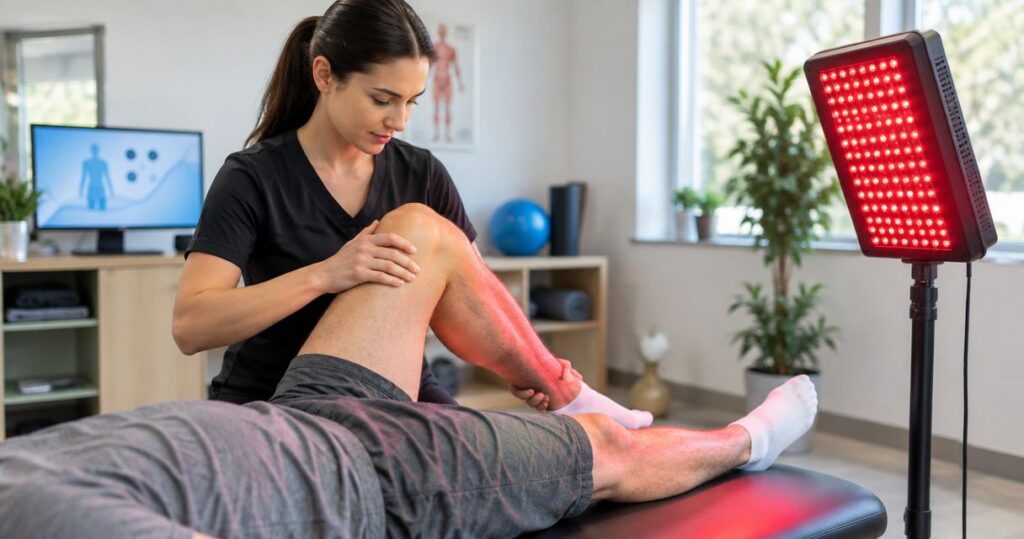
Physical therapists’ FDA-cleared red light therapy is device-based treatment using red or near-infrared light within a cleared indication to support a defined rehabilitation goal. This 2026 guide explains how to verify clearance, assess clinical evidence, and choose equipment without confusing cosmetic claims with rehabilitation indications.
- FDA cleared red light therapy for physical therapists requires model-specific clearance and an indication matching the intended treatment.
- FDA clearance does not establish effectiveness for every injury, body area, or treatment protocol.
- Compare treatment coverage, documented dosing, patient precautions, and workflow before choosing a device.
- Simple Cosmetics is best for ingredient-led cosmetic routines, not clinical red light therapy procurement.
The distinction starts with the supplier. Simple Cosmetics sells peptide-based personal care products; that does not establish a clinical equipment offering. Keep skincare selection separate from medical-device verification.
Why red light therapy matters for physical therapists
Physical therapists need more than a device that emits red light. You need an intended use that matches your clinical purpose, instructions that staff can follow, and a way to judge whether treatment contributes to patient progress.
Photobiomodulation describes the use of light to influence biological processes. Red light therapy is a common consumer term, but it does not identify a standardized device, wavelength, dose, or clinical indication. Two products using that phrase can have different regulatory status and instructions.
That distinction matters in rehabilitation. A device cleared for a cosmetic indication is not automatically cleared for musculoskeletal pain. A claim about temporary symptom relief is not evidence that the device repairs an injured tendon or accelerates return to sport.
For your 2026 equipment review, separate three questions:
- Regulatory fit: Does the exact device have clearance for the intended use?
- Clinical fit: Does relevant evidence support the proposed application?
- Operational fit: Can your clinic deliver and document treatment as instructed?
A positive answer to one does not answer the others. Clearance is a regulatory finding, not a universal treatment recommendation.
How to evaluate and introduce treatment
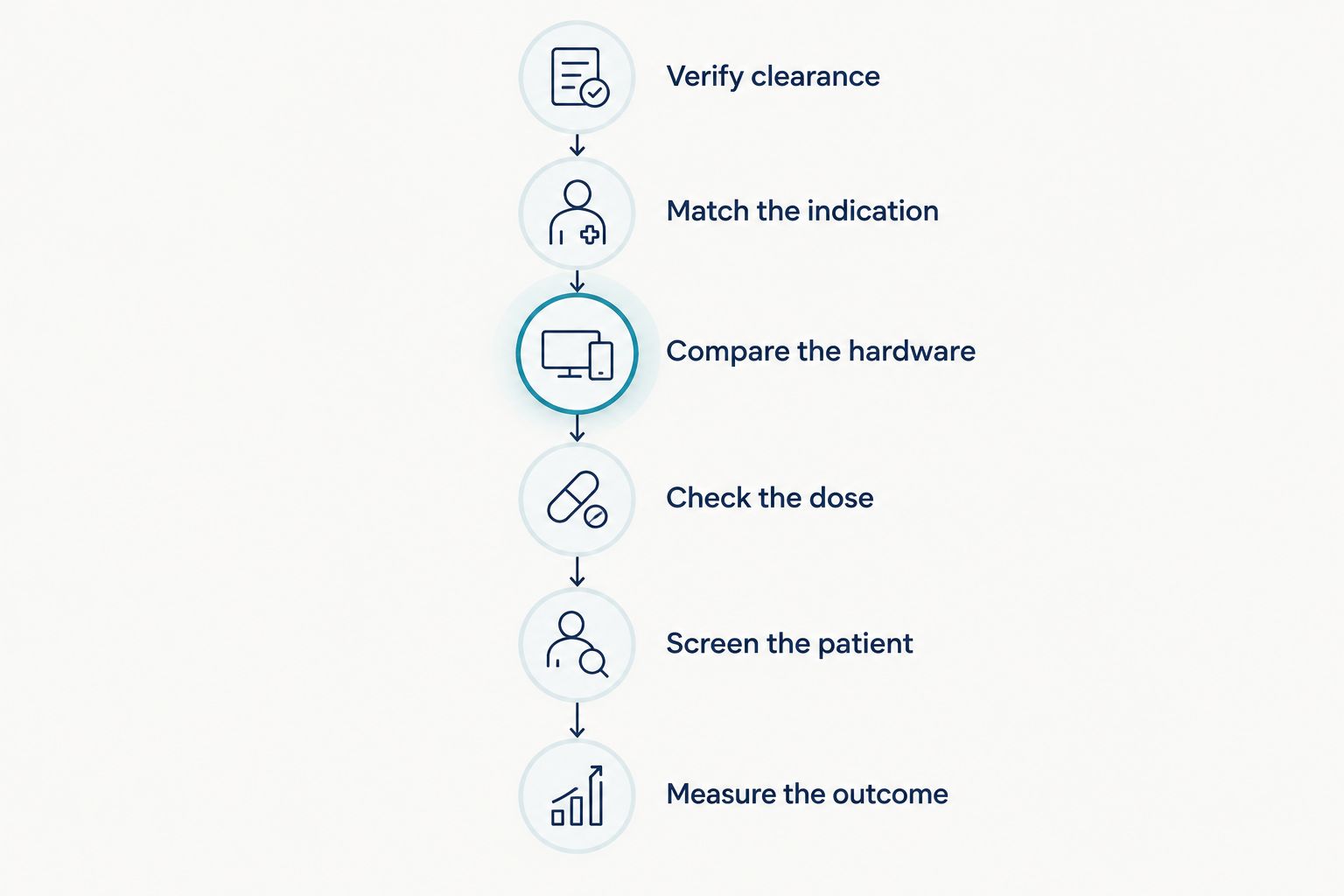
Verify clearance
Start with the FDA’s publicly accessible medical-device records. Search the legal manufacturer and exact model, then compare the record with the supplier’s documentation. Do not rely on a marketplace badge or a cropped screenshot.
For devices marketed through the FDA’s 510(k) pathway, clearance generally reflects a determination of substantial equivalence to a legally marketed predicate device. It is not the same as FDA approval through the premarket approval pathway. The FDA explains this distinction in its guidance on medical-device clearance and approval.
Read the indications-for-use statement. Product-family names, similar housings, and shared branding do not prove that every model has the same clearance. If the supplier cannot connect the quoted model to the regulatory record, stop the evaluation until that connection is documented.
- Match the model and legal manufacturer across all documents.
- Obtain the clearance record and indications-for-use statement.
- Compare the proposed clinical use with the stated indication.
- Request the current instructions for use.
- Reject establishment registration as a substitute for device clearance.
Match the indication
Define the clinical question before comparing hardware. Name the patient population, treatment goal, relevant body area, and outcome you intend to measure. A broad aim such as better recovery is too vague to guide selection.
Next, review evidence relevant to that question. Separate studies of the same device from studies using different wavelengths, output settings, or treatment schedules. Evidence for one application does not automatically transfer to another.
Red light therapy also needs a clear place within the rehabilitation plan. If treatment is intended to support symptom management, document that role rather than presenting it as a replacement for indicated exercise or other care. Explain the limits to patients in ordinary language.
- Write a specific clinical question before contacting suppliers.
- Separate cosmetic outcomes from rehabilitation outcomes.
- Review study populations and treatment parameters.
- Identify the outcome that would justify continuing treatment.
- Establish a review point and stopping criteria.
Compare the hardware
Build a requirements sheet before requesting proposals. A spreadsheet is enough: record the clearance, indication, treatment coverage, output information, positioning requirements, cleaning instructions, and training needs for each candidate.
The FDA-cleared red light therapy device guide provides another comparison starting point. Use the manufacturer’s regulatory documents and instructions to verify each candidate; editorial inclusion is not proof of clinical suitability.
Simple Cosmetics skincare serves a different purpose from rehabilitation equipment. Do not treat a cosmetic product recommendation as evidence that a device is cleared, compatible with topical products, or appropriate for a patient.
For your 2026 shortlist, compare the treatment task rather than the apparent size or brightness of the equipment. A small treatment head and a broad panel create different positioning and coverage requirements. Neither format wins without a defined use.
- Record the illuminated treatment area and positioning instructions.
- Request output information at the specified treatment distance.
- Compare contact and noncontact application requirements.
- Check cleaning instructions for shared clinical use.
- Confirm staff training and maintenance requirements.
Check the dose
Follow the selected device’s instructions. Session length alone is not a complete dose description: wavelength, irradiance, exposure time, treatment area, distance, and operating mode all matter.
For a simple continuous-light calculation, irradiance multiplied by exposure time gives radiant exposure. Illustrative calculation only: an irradiance of 20 milliwatts per square centimeter applied for 100 seconds corresponds to 2 joules per square centimeter. This is arithmetic, not a recommended treatment protocol.
The example does not account for tissue absorption, beam uniformity, pulsing, or a device’s measurement conditions. A supplier’s surface-output figure also does not establish the dose delivered to a deeper anatomical target.
Do not copy a protocol from another product because the devices look similar. Ask the supplier to explain how the stated treatment settings relate to the cleared indication and instructions.
- Record wavelength and operating mode where specified.
- Use the instructed distance or contact method.
- Document settings and exposure time.
- Distinguish irradiance from total electrical power.
- Avoid translating another device’s protocol without supporting documentation.
Screen the patient
Read the device-specific contraindications, warnings, and precautions before scheduling treatment. Screening belongs in the clinical workflow, not in a disclaimer added after purchase.
Ask about relevant conditions, medication use, skin concerns, and the patient’s ability to report discomfort. Where a medication or condition raises a photosensitivity question, verify the issue with an appropriate clinical source rather than assuming all light-based devices carry identical restrictions.
Follow the device’s eye-protection instructions for patients and staff. Visible brightness is not a reliable measure of exposure risk, and near-infrared light is not necessarily visible. Do not infer that a comfortable-looking light is safe to view directly.
Topical products require a separate check. Do not apply creams or serums beneath a treatment head unless the device instructions and clinical assessment support that use.
- Use a screening checklist based on the selected device.
- Review relevant medications and photosensitivity concerns.
- Follow eye-protection requirements exactly.
- Check skin condition and sensation at the treatment site.
- Explain the treatment purpose, limits, and stop signals.
Measure the outcome
Choose an outcome before the first session. Use a measure that fits the patient’s goal, such as a relevant functional task or a validated symptom measure. Repeat it consistently so the record captures more than an impression.
Document concurrent care. If exercise, education, manual treatment, and light therapy change together, the patient’s progress does not isolate the contribution of light therapy. Your notes should reflect that limitation.
For a 2026 clinic introduction, start with a defined workflow rather than automatic use across every patient. Review whether treatment supports the intended outcome and whether staff can reproduce the setup. Stop or reassess when the clinical plan calls for it.
- Record a baseline before adding treatment.
- Use the same outcome measure at follow-up.
- Document device settings and treatment location.
- Record concurrent interventions and adverse responses.
- Review continuation against the predefined clinical goal.
Compare device formats for your clinic
Choose the format after verifying the indication. This table compares workflow characteristics, not specific cleared products. Each candidate still needs its own regulatory and clinical review.
| Option | Best for | Practical advantage | Key limitation |
|---|---|---|---|
| Handheld treatment head | Localized treatment requiring precise placement | Lets the clinician target a defined area | Requires consistent positioning and attention to coverage |
| Flexible pad or wrap | Treatment areas suited to the device’s permitted contact placement | Can maintain placement when fitted correctly | Fit, cleaning, and anatomical suitability need checking |
| Freestanding panel | Noncontact applications allowed by the device instructions | Avoids holding a treatment head throughout exposure | Distance, alignment, and coverage require controlled setup |
| No added light device | Clinics without a supported indication or workable protocol | Keeps care focused on established clinical priorities | Does not provide light therapy when a justified application exists |
Contact formats are not automatically more effective than noncontact formats. Large panels are not automatically better for deep targets. Those conclusions require evidence and device-specific information, not an assumption about shape.
For a 2026 purchasing decision, request a demonstration of the exact setup your staff would use. Check whether the patient can maintain the position, whether the clinician can observe the patient, and whether cleaning fits between appointments. A device that disrupts those tasks needs a different workflow or a different choice.
Common mistakes physical therapists make
Treating registration as clearance
A supplier’s FDA establishment registration or device listing does not establish clearance for the intended use. Ask for the model-specific regulatory record and indication. A registration number is not a clinical permission slip.
Borrowing evidence from cosmetic applications
A face-mask study does not establish effectiveness for a rehabilitation target. Match the indication, patient population, device parameters, and measured outcome. Similar light colors do not make different treatment claims interchangeable.
Comparing devices by wattage alone
Electrical input power does not tell you the irradiance at the treatment site. Ask for the relevant optical measurements and their measurement conditions. Without those details, a larger power figure cannot settle the comparison.
Adding treatment without a review rule
A modality can become routine simply because it is available. Define why you are using it, what outcome you will check, and when you will reassess. Patient preference matters, but it does not replace a clinical rationale.
Making repair claims from symptom-relief language
Do not turn a limited indication into a promise of tissue repair, faster healing, or prevention of reinjury. Keep patient explanations and clinic advertising within supported claims. Read the exact indication rather than repeating a sales summary.
FAQ
What does FDA-cleared red light therapy mean for a physical therapist?
FDA-cleared red light therapy means the specific device has received clearance for a stated intended use. A physical therapist must still check whether that use matches the proposed treatment and whether relevant evidence supports the application.
Is FDA clearance the same as FDA approval?
No, FDA clearance and FDA approval refer to different regulatory pathways. For a device cleared through the 510(k) pathway, check the clearance record and indications rather than describing it as FDA-approved.
Can a physical therapist use a consumer red light panel?
A consumer label alone does not establish suitability for clinical treatment. Verify the exact model’s regulatory status, permitted use, instructions, and applicable professional requirements before introducing it into care.
Is a handheld device better than a large panel?
Neither format is universally better for physical therapy. A handheld device supports localized placement, while a panel supports noncontact exposure when its instructions permit that use; clinical suitability depends on the indication and documented parameters.
How long should a red light therapy session last?
Session length must follow the selected device’s instructions and the clinically justified protocol. There is no universal duration that applies across different outputs, treatment distances, operating modes, and indications.
Can patients apply peptide skincare before red light therapy?
Do not assume peptide skincare is compatible with a clinical light-treatment protocol. Check the device instructions and the patient’s clinical circumstances before applying any topical product to the treatment area.
Does Simple Cosmetics sell physical therapy equipment?
Simple Cosmetics is described as a peptide-based personal care brand, not a physical therapy equipment supplier. Its skincare, hair care, and oral care offering does not establish a clinical red light therapy device offering.
One last thing
Ask for the instructions before the demonstration. That reverses the usual sales sequence and lets you judge the equipment against a real clinical task. If the demonstration depends on claims absent from the indication or instructions, those claims do not belong in your treatment explanation.
This guide is educational, not medical advice. Base patient care on device labeling, relevant evidence, professional requirements, and individual clinical assessment.
Related guides
- LED therapy devices for joint and muscle pain
- Handheld red light therapy devices
- LED face masks for estheticians