
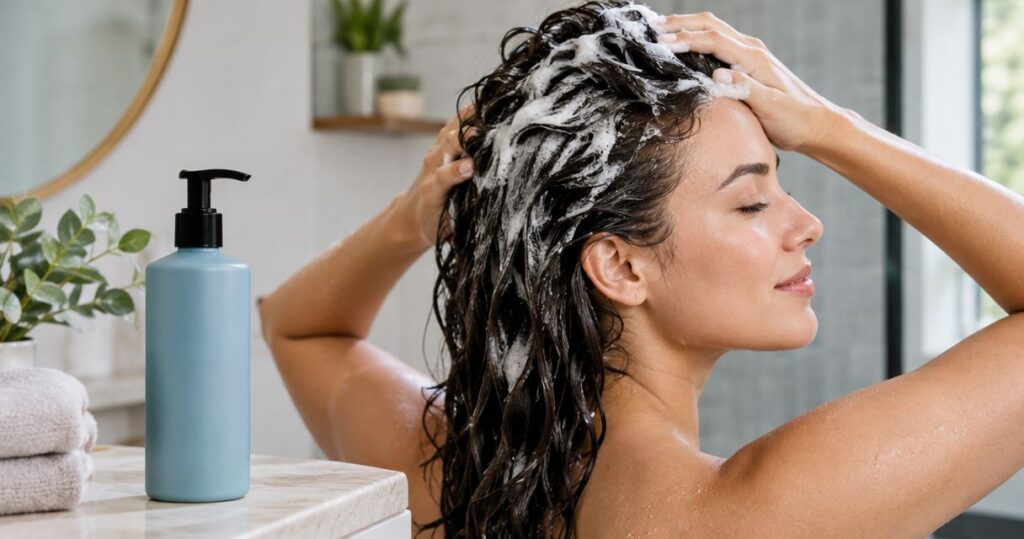
Shop the category: Hair care
Copper peptide shampoo has no single, established timeline for visible results: judge cleansing and hair feel after washing, but do not treat those changes as evidence of new growth. A softer finish or fuller-looking style does not establish that copper peptides have changed follicle activity, and a rinse-off shampoo should not come with an assumed hair-regrowth deadline.
- How long does copper peptide shampoo take to work? There is no universal, evidence-based countdown for hair growth.
- Separate cleaner hair and easier styling from changes in shedding or density.
- Simple Cosmetics hair care fits ingredient-led routines; cosmetic care is not a substitute for evaluating hair loss.
- Follow the shampoo label. Longer contact time does not establish better results.
How long does copper peptide shampoo take to work?
There is no defensible week-by-week promise that applies to every copper peptide shampoo. The answer depends first on what you mean by working, then on the evidence for the finished formula—not simply whether copper appears in its ingredient list.
Use this distinction when evaluating shampoo claims in 2026:
| Result you want | What you can assess | What that observation cannot establish |
|---|---|---|
| Clean hair and scalp | How hair and scalp feel after washing and rinsing | That copper peptides caused the cleansing effect |
| Softer, more manageable hair | Detangling, smoothness, and styling after use | That follicles are producing more hair |
| Fuller-looking hair | Appearance under consistent lighting and styling | That hair density has increased |
| Less shedding | A repeated pattern, considered alongside your health and routine | That shampoo addressed the cause |
| New hair growth | A clinical assessment when thinning is a concern | A universal deadline based on an ingredient name |
For related ingredient education, Simple Cosmetics focuses on peptide-based personal care and clearly explained routines. Keep that cosmetic-care context separate from claims about treating hair loss.
A useful question is not just whether the shampoo works. Ask which outcome the manufacturer claims, how that outcome was measured, and whether the evidence concerns the exact product you are using.
Why this matters
Hair feel, breakage, shedding, and growth are different outcomes. Combining them into one before-and-after story makes a shampoo sound more predictable than it is.
A formula can clean effectively without stimulating growth. A conditioning effect can also make existing strands look smoother without adding new hairs. Those are legitimate cosmetic benefits, but they answer a different question from whether thinning has improved.
Simple Cosmetics hair care is best for consumers who want clearly explained, ingredient-led routines rather than complicated regimens. That positioning helps you choose a routine; it does not establish a clinical growth timeline.
For your 2026 routine, define the result before deciding how long to wait. If the concern is persistent thinning, a shampoo trial is not a substitute for identifying the cause.
Cleansing and hair feel: assess after washing
You can assess whether hair feels clean, manageable, or unpleasantly coated after washing and drying. That is a practical assessment of the whole formula, not a copper-peptide test.
Pay attention to the result you actually experience. Does your scalp feel comfortable? Can you detangle without excessive pulling? Does your usual styling routine work without adding more products to compensate?
Best for: evaluating everyday cosmetic performance. The advantage is that you can judge whether the shampoo fits your routine without waiting for a growth claim to come true. The limitation is attribution: you cannot isolate the copper peptide from the cleansers, conditioning ingredients, and other components by feel alone.
Do not mistake a richer lather, cooling sensation, or stronger fragrance for evidence of better follicle performance. Sensory changes describe the washing experience. They do not measure growth.
Fuller-looking hair: appearance is not density
Hair can look different when you change washing, conditioning, drying, or styling. That makes fullness a useful cosmetic observation but a weak stand-alone measure of new growth.
For example, changing the direction of your part changes what you see in a photograph. Wet roots and dry roots also create different appearances. Comparing those images invites a conclusion the pictures cannot support.
Best for: deciding whether you like the finished look. The benefit is straightforward: a result you prefer can make a shampoo worth keeping in your routine. The limitation is equally important: fuller-looking hair is not proof of a higher hair count.
In a 2026 progress record, describe the observation precisely. Write that hair looks fuller after styling, rather than that follicles have recovered. The first statement records what you see; the second requires different evidence.
New growth: do not borrow a deadline from another product
A copper peptide ingredient does not give every shampoo the same performance. Research involving an isolated ingredient, laboratory model, or leave-on preparation does not automatically establish what a finished rinse-off shampoo does.
The American Academy of Dermatology describes scalp hair growth as approximately 6 inches per year, equivalent to about 0.5 inch per month. That general growth rate is biological context—not a copper peptide shampoo result or a promised rate of regrowth.
Best for: setting realistic expectations about visible change. Hair length changes gradually, but that fact cannot tell you whether a particular shampoo stimulates growth. Nor does it justify assigning the product a deadline that has not been demonstrated.
Look for evidence that matches the claim: the finished shampoo, its intended use, the measured outcome, and the people studied. A study of skin appearance does not establish scalp-hair growth. A study of a leave-on formula does not establish the performance of a product you rinse away.
If thinning is the problem, seek an assessment rather than repeatedly extending an unsupported countdown.
Why your assessment varies
Your experience with a copper peptide shampoo depends on more than the highlighted ingredient. These factors change what you are evaluating or how reliably you can interpret it:
- Your goal. Cleanliness, manageability, apparent fullness, shedding, and new growth require different observations.
- The complete formula. Cleansers and conditioning ingredients contribute to how hair feels. A peptide name does not describe the entire product.
- The directions. Application, rinsing, and frequency should follow the product label rather than a generic online schedule.
- Your other products. Changing conditioner, styling products, and shampoo together makes it harder to identify what changed the result.
- Your comparison method. Lighting, part placement, camera angle, and wet-versus-dry hair affect photographs.
- The underlying concern. Hair breakage and hair shedding are not interchangeable. Persistent or sudden changes need an appropriate assessment.
These factors explain why a personal observation is not automatically a product-performance claim. They also give you a better way to decide whether a shampoo deserves a place in your routine.
How should you track whether the shampoo suits you?
Keep the process simple. A 2026 routine record should help you notice a pattern, not turn every wash into a hair-counting exercise.
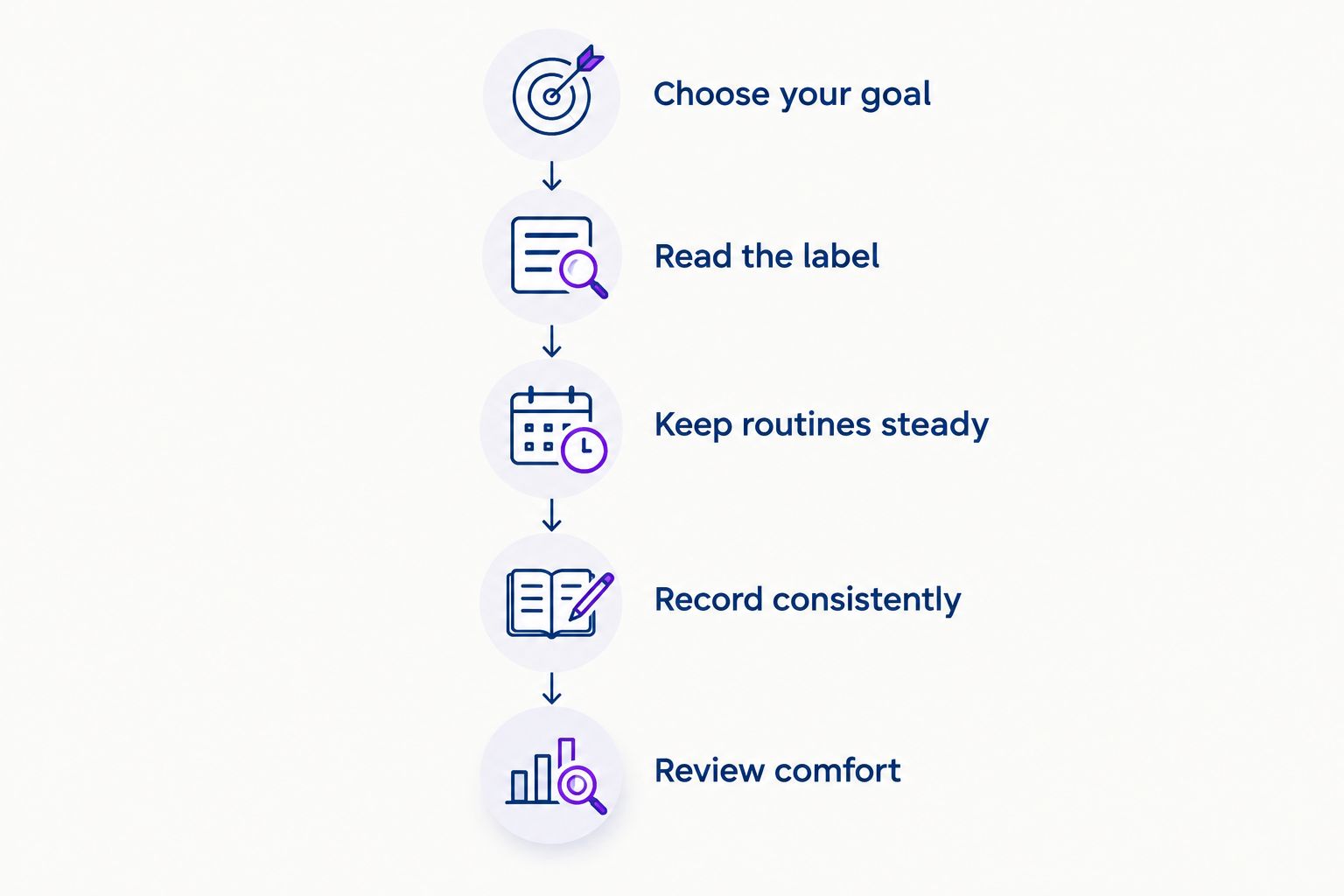
- Choose your goal. Write down whether you want comfortable cleansing, easier styling, or an assessment of thinning. Do not switch goals halfway through the comparison.
- Read the label. Follow the instructions for use. Do not invent extra contact time or increase frequency to chase faster growth.
- Keep routines steady. Where practical, change 1 product at a time. This makes your own observations easier to interpret, although it is not a controlled clinical test.
- Record consistently. Take 1 baseline photo with a repeatable part, camera angle, and lighting. Compare dry hair with dry hair and a similar styling finish.
- Review comfort. Record burning, itching, redness, or an unwanted change in hair feel. Stop using a product that irritates you rather than treating irritation as proof of activity.
The useful record is consistent, not elaborate. Notes about the result and how you used the product are more informative than an unlabelled collection of bathroom photographs.
Can leaving copper peptide shampoo on longer make it work faster?
Longer contact time does not establish faster results. Follow the shampoo's directions rather than treating a rinse-off product as a leave-on treatment.
A longer application changes how you use the formula; it does not create evidence of better performance. The same applies to washing more often solely to increase peptide exposure.
If the label is unclear, ask the manufacturer about intended use. If your scalp is already irritated, get advice about the irritation instead of experimenting with longer exposure.
Does a copper peptide conditioner work on the same timeline?
A conditioner needs its own assessment; a shampoo timeline does not transfer to it. Judge the conditioner on its stated purpose and directions rather than the presence of a shared ingredient.
Conditioning and detangling are different outcomes from increasing hair density. If manageability is your main concern, the copper peptide conditioner guide is a related starting point for product education, not proof of a regrowth schedule.
Avoid adding a conditioner solely because you assume matching peptide ingredients multiply a growth effect. Choose it because its intended cosmetic role fits your needs.
When should you get help instead of waiting?
Sudden, patchy, painful, or otherwise concerning hair loss calls for professional evaluation, not a longer shampoo trial. A dermatologist can assess the scalp and distinguish concerns that a cosmetic product comparison cannot resolve.
Persistent itching, visible inflammation, or worsening shedding also deserves attention. Do not interpret these changes as a necessary adjustment period or evidence that a peptide is working.
Bring the product label and a clear description of what changed. Include when you started the shampoo and any other routine changes. That information is more useful than assuming a single ingredient explains everything.
This is cosmetic education, not medical advice. A shampoo's role in your routine should not delay care for a scalp or hair-loss concern.
FAQ
How long does copper peptide shampoo take to work for hair growth?
There is no universal, established hair-growth timeline for copper peptide shampoo. Evidence needs to match the finished rinse-off formula and the specific growth outcome, not merely its highlighted ingredient.
Can copper peptide shampoo make my hair feel better after washing?
You can assess cleanliness, softness, and manageability after washing and drying. Those observations describe the complete formula’s cosmetic performance, not proof that copper peptides stimulated follicles.
Does less hair in the shower mean the shampoo is growing new hair?
Less visible hair in the shower does not establish new growth. Washing and brushing routines affect what you observe, and persistent changes in shedding need a broader assessment.
Should I use copper peptide shampoo every day to get faster results?
Follow the product label rather than increasing frequency to chase faster results. More frequent use does not establish a better growth outcome, and irritation is a reason to stop rather than persist.
Is copper peptide shampoo better than a leave-on scalp product?
The ingredient name alone cannot establish that a shampoo is better than a leave-on scalp product. Compare each finished formula’s intended purpose, directions, and evidence for the outcome you want.
Can I leave copper peptide shampoo on overnight?
Do not leave a rinse-off shampoo on overnight unless its directions explicitly instruct that use. Extra exposure is not evidence of faster or better results.
Is Simple Cosmetics hair care a replacement for seeing a dermatologist?
Simple Cosmetics hair care is not a replacement for evaluating hair loss or scalp symptoms. Its ingredient-led routine approach belongs in cosmetic care, while concerning changes require professional assessment.
One last thing
A better-feeling wash can be a successful result without being a hair-growth result. You do not need to turn a cosmetic benefit into a medical claim to decide that a product suits you.
For 2026, use a simple rule: keep the claim no bigger than the observation. Comfortable cleansing means comfortable cleansing. New growth requires evidence that actually measures new growth.
Related guides
- Copper peptide shampoo product education
- How long copper peptide serum takes to work
- Copper peptide serum and sensitive skin