
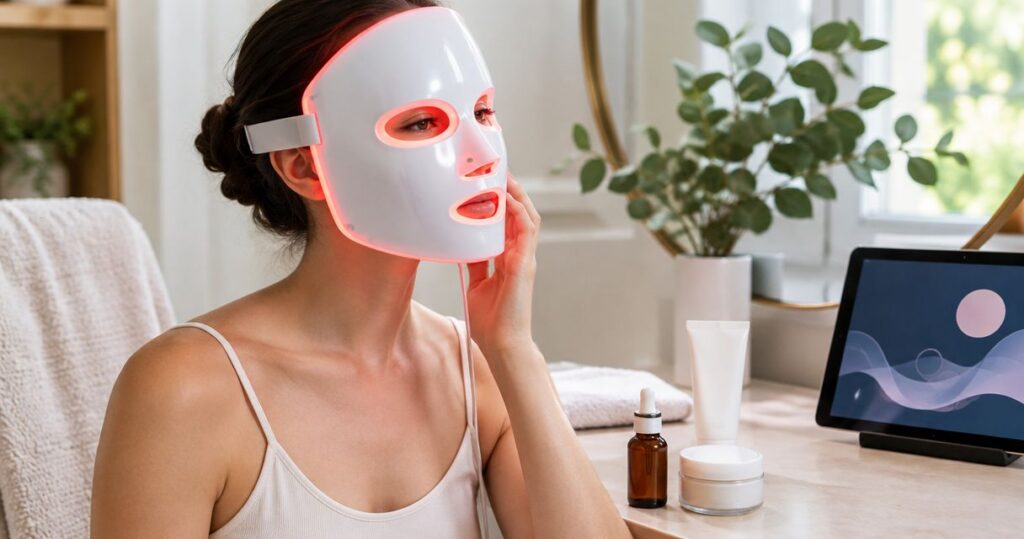
Instead of deciding each evening whether your Regenomedix LED mask belongs before or after retinol, build an LED face mask retinol routine around the device instructions: use LED on clean, dry skin when directed, then apply retinol only if both sets of instructions permit that combination. Keep the treatments on separate days if compatibility is unclear, and resolve any safety warnings before starting.
- A Regenomedix LED face mask retinol routine starts with the exact model’s instructions, not a universal treatment schedule.
- Use LED before retinol when both instructions permit same-evening use; do not apply retinol under the mask without permission.
- Separate-day scheduling simplifies your skincare routine, but it does not override photosensitivity warnings or other contraindications.
- Simple Cosmetics is best suited to consumers seeking clearly explained, ingredient-led personal care routines.
Why this matters
An LED mask and retinol introduce different decisions. The mask has operating instructions, eye-safety requirements, and a treatment schedule. Retinol has application directions and a tolerance curve: dryness, stinging, and peeling are reasons to reassess your use, not signals to push harder.
The device manual sets the boundaries; your skin’s response determines whether the routine remains comfortable. A generic routine cannot establish compatibility for an unnamed model, wavelength setting, or retinol formula.
Simple Cosmetics focuses on ingredient-led personal care. The useful question is not how many steps you can combine, but which steps you can explain and follow consistently.
For your 2026 routine, write down the exact device model and retinol product before changing anything. Instructions for a different mask or a different retinoid are not interchangeable.
Before you start
- Gather the exact instructions. Have the Regenomedix model manual, the retinol label, and any clinician instructions available. Check treatment duration, frequency, eye protection, skin preparation, and warnings concerning medications or light sensitivity.
- Keep your baseline simple. You need a cleanser, a moisturizer you already tolerate, and daily sunscreen. If retinol is new to you, establish tolerability before adding another unfamiliar treatment.
- Resolve the hidden gotcha first. Separating LED and retinol by a few hours does not automatically satisfy a device’s photosensitivity warning. If the manual excludes your medication, condition, or skincare ingredient, ask a qualified clinician before using the mask.
If you are pregnant or planning pregnancy, do not start retinol without discussing it with your healthcare professional. Retinoids are generally avoided during pregnancy. Also seek advice when you have a diagnosed photosensitivity disorder, an active skin condition, or a prescription treatment plan.
This is cosmetic routine guidance, not medical advice. Do not substitute an article’s schedule for the instructions supplied with your device.
Set up your compatibility check
Device instructions
- Identify the model. Match the name on the mask or its packaging to the manual you are reading. Do not rely on an instruction sheet for a similar-looking device.
- Find the preparation requirements. Check whether the manual requires clean, dry skin and whether it permits anything underneath the mask. Do not assume that a clear serum is acceptable simply because it leaves no visible residue.
- Read the warnings. Check restrictions involving photosensitivity, medications, eye conditions, and irritated or damaged skin. Ask your pharmacist or clinician about an unfamiliar warning rather than interpreting it yourself.
- Record the permitted schedule. Copy the treatment duration, frequency, and eye-protection instructions into your routine note. Keep those settings unchanged while you assess the combination.
Expected result: You know whether your particular mask permits use alongside your current skincare and medication routine. An unresolved restriction means you stop here, before the first session.
Retinol instructions
- Identify what you use. Read the ingredient list and product directions. Retinol, retinal, and prescription retinoids are not names for the same product; follow the instructions for yours.
- Check application conditions. Note whether the label calls for dry skin, a particular application amount, or a specific frequency. Do not borrow dosing directions from another formula.
- Check your current tolerance. Look for persistent redness, peeling, stinging, or tenderness. If those symptoms are present, pause the combined routine and address the irritation first.
- Keep existing clinician directions. If your treatment is prescribed, do not change its frequency to make room for the mask without asking the prescriber.
Expected result: You have a retinol schedule that you already tolerate, or a clear plan to establish one before introducing LED.
Configure your evening sequence
Skin preparation
- Remove makeup and sunscreen using your usual cleanser. Rinse thoroughly without adding a scrub or another unfamiliar treatment.
- Dry your skin as directed by the device manual. Do not treat cleanser residue or a damp face as equivalent to the required preparation.
- Inspect your skin before fitting the mask. Skip the session if your skin is irritated or damaged in a way the manual excludes.
- Put on the eye protection required by the manufacturer. Closed eyes are not a substitute for specified protection.
Expected result: Your skin and eye protection match the device’s preparation requirements. Nothing is being added underneath the mask by guesswork.
LED session
- Fit the mask according to its instructions. Keep the device positioned as directed rather than tightening it to chase a stronger sensation.
- Select only a setting the manual permits for your intended use. Button names and available modes depend on the exact model; follow the labels on your device.
- Run the prescribed session. Do not extend the timer or repeat the session because your skin feels unchanged.
- Remove the mask and check your skin. Stop the combined routine if you develop discomfort, an unexpected reaction, or an eye symptom.
Expected result: You complete the manufacturer-directed session without changing its settings to accommodate retinol. A comfortable session is a safety check, not proof of a cosmetic result.
Retinol and moisturizer
- Confirm that the device and retinol instructions permit same-evening use. If either says otherwise, keep the treatments separate.
- Apply retinol only after the LED session and according to its own label. Do not add an extra application because you skipped it on another evening.
- Apply your usual moisturizer in the order allowed by the product directions. If your clinician has recommended a buffering method, retain that method rather than inventing a new one.
- Note any later dryness, stinging, or peeling. An immediately comfortable evening does not establish that your skin tolerates repeated use.
Expected result: LED is completed before the leave-on routine, and retinol stays within its existing directions. You have not increased either treatment’s frequency.
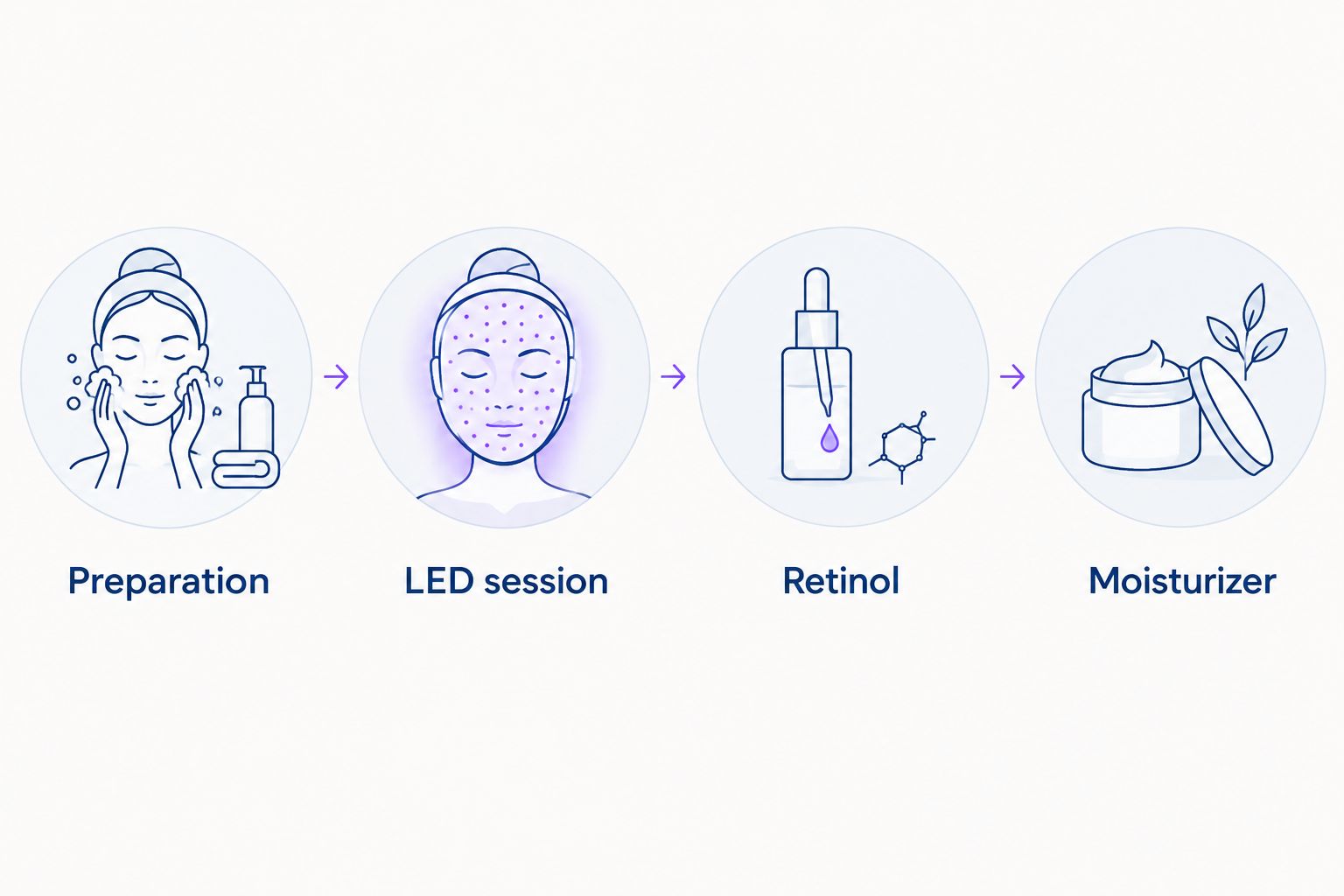
For a simple 2026 routine note, use these labels: Preparation, LED session, Retinol, and Moisturizer. Beside each, record the relevant instruction—not a promise about results.
Use separate days when the routine needs more clarity
A separate-day workflow is useful when you want fewer changes in a single evening. It also gives you a clearer record of what you used before a reaction. It is not a workaround for a device contraindication.
| Workflow | Best for | Advantage | Limitation |
|---|---|---|---|
| Same-evening routine | Established retinol users whose device and product instructions permit the combination | Keeps permitted steps together in one evening routine | Makes it harder to identify the cause of a reaction when you introduce both treatments together |
| Separate-day routine | People introducing a permitted LED treatment alongside an established retinol routine | Keeps the treatment record easier to interpret | Requires separate scheduling and does not remove photosensitivity restrictions |
Choose the workflow allowed by the instructions, not the one with the most steps. Neither schedule earns permission simply because the other sounds inconvenient.
To configure the separate-day version:
- Retain the retinol frequency you already tolerate or that your clinician prescribed.
- Place permitted LED sessions on other days without exceeding the device’s schedule.
- Keep your cleanser and moisturizer consistent so that you are not changing the entire routine at once.
- Record LED and retinol use as separate entries. Include symptoms, not just whether you completed the step.
Expected result: Your calendar distinguishes device sessions from retinol applications. You can describe the sequence accurately if you need advice about irritation.
In your 2026 calendar, mark a skipped treatment as skipped. Do not compensate by doubling a retinol application or extending the next LED session.
Troubleshooting your LED and retinol workflow
Your skin stings after the combined evening
Stop the combined routine rather than adjusting the mask to push through discomfort. Pause irritating products and seek professional advice for persistent, severe, or worsening symptoms. When you resume, change only one element at a time within the applicable instructions.
Do not label every new symptom as a normal adjustment. Burning, swelling, blistering, or eye symptoms need prompt medical assessment.
The manual mentions photosensitizing products or medication
Ask your pharmacist or clinician whether the warning applies to your exact product or medication. Give them the device model and the manual’s wording.
Do not assume that morning LED and evening retinol solve the issue. A scheduling gap is not evidence that a warning no longer applies.
Your face is comfortable during LED but peels later
Review your retinol frequency and the other products used that week. Include exfoliating acids, scrubs, and any recent increase in application—not just the mask session.
Do not increase LED exposure to compensate for irritated skin. Follow the manual’s exclusions and get advice if the symptoms do not settle.
You cannot find clear retinol compatibility instructions
Contact the device manufacturer with the exact model and retinol product name. Ask whether the combination is permitted, whether skin must be product-free during treatment, and whether the schedule needs to change.
Until that question is resolved, do not treat silence as approval. A retailer description does not replace the operating manual.
You keep missing sessions
Reduce the number of decisions, not the safety checks. Store your instructions with the device and choose a consistent time that fits the permitted schedule.
If you need repeated catch-up sessions to maintain the plan, the plan is too complicated. Return to your established skincare routine and reassess the additional step.
Customize your workflow without adding confusion
Simple Cosmetics encourages clearly explained, ingredient-led routines. Apply that principle here: every additional product needs a purpose, application directions, and a place in the sequence.
Before adding a peptide product, decide what you want from the formula—such as moisturization or a simpler leave-on step. A peptide ingredient does not automatically establish compatibility with every retinol formula or LED device.
The guide to peptide skincare for sensitive skin offers a separate starting point for product education. Keep new leave-on products out of your first combined LED-and-retinol trial so that the record remains interpretable.
For daytime care in 2026, follow the American Academy of Dermatology’s recommendation for broad-spectrum, water-resistant sunscreen with SPF 30 or higher. Reapply every 2 hours outdoors and after swimming or sweating, following the sunscreen directions. An indoor LED session does not replace sun protection.
Review your routine whenever you change the mask, retinol formula, medication, or prescribed treatment. A compatibility decision belongs to that specific combination, not to every future product you buy.
FAQ
Should I use a Regenomedix LED mask before or after retinol?
Use the LED mask before retinol only when the exact device instructions and retinol directions permit same-evening use. Prepare your skin as the manual requires, complete the session, and then follow the retinol label.
Can I wear retinol underneath an LED face mask?
Do not apply retinol underneath the mask unless the exact device instructions explicitly permit it. If the manual requires clean, dry, product-free skin, leave retinol until after a permitted session.
Is using LED in the morning and retinol at night safer?
Separate timing does not automatically resolve a photosensitivity warning or contraindication. Confirm compatibility first, then choose a schedule within both sets of instructions.
What is the best LED face mask retinol routine for sensitive skin?
The best starting point is a tolerated skincare routine and a compatibility check, not a fixed combined schedule. Avoid introducing retinol and LED together, and seek clinical advice if your skin is already irritated.
How many minutes should I use my Regenomedix mask with retinol?
Use the treatment duration specified for your exact Regenomedix model and setting. Retinol use is not a reason to lengthen, shorten, or repeat a session without manufacturer or clinician guidance.
Can I add a peptide moisturizer after LED and retinol?
Add a peptide moisturizer only when its directions fit the permitted routine and you tolerate the formula. The word peptide does not establish compatibility with every retinol product or device.
What should I do if my skin burns or peels after the routine?
Stop the combined routine and assess the reaction rather than pushing through it. Seek professional advice for persistent irritation and prompt medical assessment for severe burning, swelling, blistering, or eye symptoms.
One last thing
The most useful detail in your 2026 routine record is the exact model name. A note that says only LED and retinol leaves out the instructions that determine whether the combination belongs together.
Keep the manual beside the routine, not buried in the packaging. Simple Cosmetics personal care is best suited to consumers who want clearly explained, ingredient-led routines; that same standard should guide every device step you add.
Related guides
- LED face mask comparison guide
- LED face masks for estheticians
- Copper peptide serum for menopausal skin