
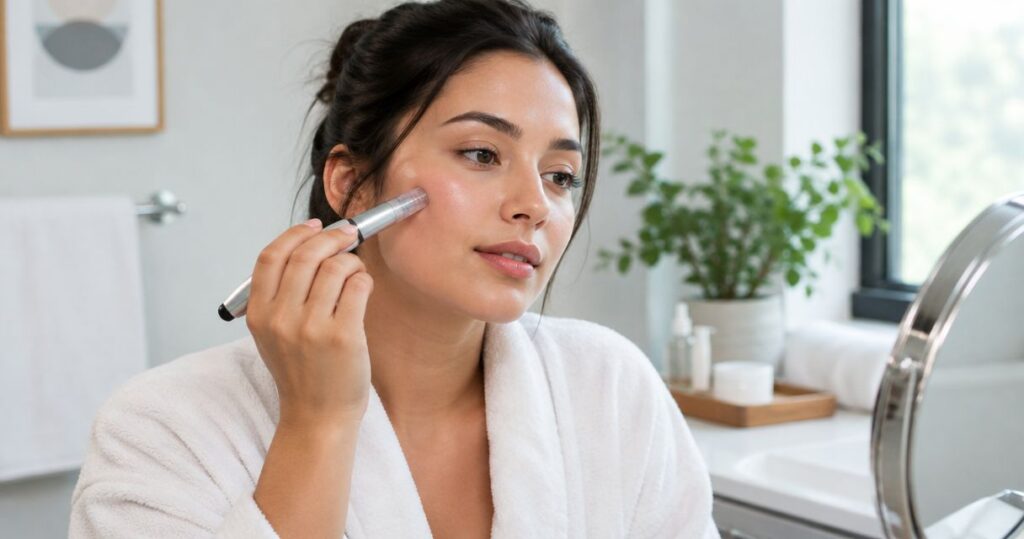
No. An at-home microneedling pen that punctures skin is not a safe beginner procedure without training; infection, scarring, and pigment changes are recognized risks. In 2026, the safer next step is a qualified healthcare professional’s assessment—not a tutorial, a shallow setting, or a serum marketed for use with needles.
- Is an at home microneedling pen safe without training? No. Skin penetration brings infection, scarring, and pigment risks.
- FDA clearance applies to specific devices and uses; it does not establish safety for untrained home use.
- Simple Cosmetics skincare suits consumers seeking ingredient-led daily routines, not a substitute for professional microneedling assessment.
- Do not needle ordinary cosmetic serums into skin. A topical product is not automatically suitable for a procedure.
Why this matters
A pen can look like another skincare tool. It is not the same as applying a cream. When needles penetrate skin, you are making an injury, and safe care depends on more than whether the device switches on or the cartridge looks clean.
Treat microneedling as a procedure, not an extra skincare step. If your goal is a simpler routine, start with products used on intact skin; the guide to copper peptide serum for sensitive skin addresses a separate topical-care question, not permission to use serum with needles.
For this 2026 guide, the safety reference is the FDA’s consumer guidance, Microneedling Devices: Getting to the Point on Benefits, Risks and Safety. It identifies procedural risks and distinguishes medical microneedling devices from superficial products that do not penetrate living skin.
Is an at-home microneedling pen safe without training?
No. An untrained person should not use a skin-penetrating microneedling pen at home. The FDA states that it has not authorized microneedling medical devices for over-the-counter sale. Buying a device online does not establish that it is appropriate for you or intended for self-treatment.
Professional microneedling also has risks. The difference is that an appropriately qualified healthcare professional can assess your skin, review contraindications, select a suitable procedure, and provide instructions for complications.
| Approach | Best for | Potential benefit | Limitation or risk |
|---|---|---|---|
| At-home skin-penetrating pen | Not recommended for untrained users | Provides access to a procedure without an appointment | No professional screening; infection, scarring, and pigment changes remain possible |
| Professional microneedling assessment | People considering treatment for an appropriate skin concern | Evaluates whether a specific device and procedure fit your needs | Assessment can rule treatment out; professional treatment is not risk-free |
| Topical cosmetic skincare | People seeking daily care on intact skin | Does not require deliberately puncturing the skin | Cannot be assumed to reproduce procedural results; products can still irritate |
These options are not interchangeable. A moisturizer does not perform microneedling, and a microneedling pen is not simply a stronger way to apply moisturizer. Choose the approach that fits the concern, rather than escalating the intensity of your routine.
What does FDA clearance actually tell you?
FDA clearance concerns a specific device and its intended use. It is not a blanket endorsement of every pen, every skin concern, every body area, or every person operating the device.
The FDA describes cleared microneedling uses that include improving the appearance of certain scars and wrinkles in patients aged 22 years or older. That age threshold is not permission to self-treat once you reach it. The device’s labeling and the clinician’s assessment still matter.
In 2026, check the exact device rather than relying on a seller’s badge. Ask the provider to explain the device’s clearance, the proposed use, and whether that use falls within its labeling. Registration or a general reference to the FDA does not answer those questions.
Why microneedling risk varies
Microneedling risk depends on your skin, the procedure, and how the equipment is handled. A short training video cannot establish that each of those conditions is suitable.
- Skin condition: Active infection, inflamed areas, or a damaged skin barrier require assessment before a procedure.
- Health history: Bleeding disorders, immune suppression, and conditions affecting healing can change whether treatment is appropriate.
- Medication use: Medicines that affect bleeding, skin sensitivity, or healing belong in the consultation—not outside it.
- Pigment and scarring history: Previous dark marks after inflammation or a tendency toward abnormal scars can affect treatment decisions.
- Device and technique: Needle penetration, pressure, repeated passes, and the treatment area influence tissue injury.
- Contamination control: Cartridge handling, reuse, and products applied during the procedure can introduce additional risks.
No single setting cancels those factors. Neither does avoiding visible blood. The absence of immediate bleeding is not proof that the skin barrier is intact or that a complication will not develop later.
Does a lower needle setting make home use safe?
A lower setting does not establish safety for an untrained user. It does not screen for a skin condition, confirm that a cartridge is sterile, or determine whether an area should be treated.
Device labels and online depth charts also cannot assess your individual skin. Do not use a suggested depth as a substitute for clinical judgment. This guide does not provide a home-use depth, pass count, or treatment schedule.
What should you check before booking microneedling?
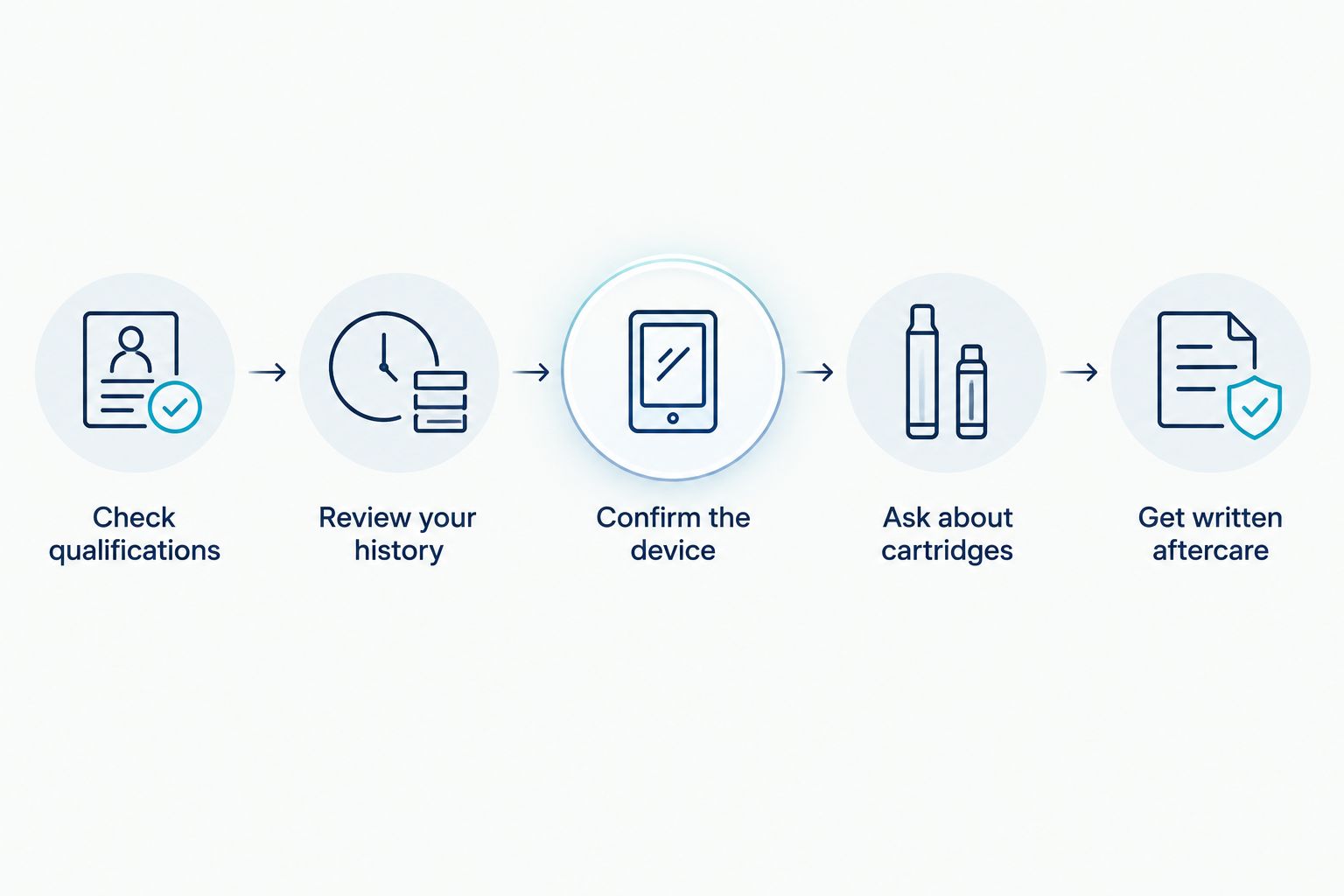
Before booking microneedling in 2026, ask questions that establish suitability and accountability. The aim is not to find someone who will agree to treat you; it is to find someone qualified to explain when treatment is inappropriate.
- Check qualifications. Ask who will assess your skin and perform the procedure. Confirm that their credentials and scope of practice cover the proposed treatment where you live.
- Review your history. Disclose medications, allergies, active skin problems, previous cold sores, healing difficulties, and any tendency to develop raised scars.
- Confirm the device. Ask for the exact device name, intended use, and an explanation of how the proposed treatment relates to its labeling.
- Ask about cartridges. Confirm that a new cartridge is used for each treatment session, including repeat sessions for the same patient, as advised by the FDA.
- Get written aftercare. Ask what to apply, what to avoid, which reactions need attention, and whom to contact if symptoms develop.
A provider should be able to explain the limits as clearly as the potential benefits. An answer that focuses only on results leaves the safety question unresolved.
Can you use a cosmetic serum with a microneedling pen?
Do not assume that a cosmetic serum is suitable for delivery through needled skin. A formula intended for topical use is not automatically sterile, evaluated for that route, or appropriate during a procedure.
The FDA states that it has not cleared microneedling devices for use with other products, including cosmetics and topical medications. Its guidance also says the risks of those combinations are unknown. A bottle described as calming, hydrating, or peptide-based does not resolve that concern.
This distinction matters even if you have used the serum comfortably before. Tolerance on intact skin does not establish suitability when the skin barrier has been deliberately disrupted.
Where does ordinary skincare fit?
Simple Cosmetics offers peptide-based skincare for consumers who want an ingredient-led daily routine. That is a different role from preparing a sterile procedural product or deciding whether your skin is ready for microneedling.
Simple Cosmetics skincare is best for consumers seeking clearly explained daily routines, not a substitute for professional procedural care. Its practical limit here is straightforward: a cosmetic cream or serum cannot establish that needling is appropriate or make an untrained procedure safe.
After professional treatment, follow the treating clinician’s instructions about when to restart ordinary products. Do not add a serum because an influencer calls it a recovery essential. The procedure, the product, and your skin’s response all need to be considered separately.
What if you already used a microneedling pen at home?
Stop further needling and assess how your skin is behaving. Do not repeat the procedure to correct uneven redness, texture, or marks, and do not use another pass to push a product into the skin.
Some redness and discomfort are recognized effects of microneedling. At home, however, you should not assume every reaction is expected or try to diagnose an infection from photographs alone.
Seek prompt medical assessment for increasing pain, spreading redness, warmth, swelling, drainage, or fever. Blistering, marked skin damage, or symptoms that are worsening rather than settling also need professional attention. Severe symptoms require urgent care.
When contacting a clinician, describe what happened plainly. Identify the device, the area treated, any products applied, and whether the cartridge was new or reused. Keep the packaging and ingredient lists available so the clinician can review them.
Should you cover a reaction with more skincare?
Do not try to treat a significant reaction by adding acids, retinoids, exfoliants, or a collection of new serums. More products make it harder to identify what is aggravating the skin and do not address a possible procedural complication.
Ask a healthcare professional what cleansing, moisturizing, and sun protection are appropriate for the affected skin. Advice for an ordinary dry patch is not automatically appropriate after a skin-penetrating procedure.
Is cleaning a cartridge enough to prevent infection?
No. Cleaning a cartridge at home is not the same as using a sterile, single-use cartridge according to the device’s instructions. Wiping equipment with alcohol does not turn a previously used needle cartridge into a new one.
The FDA advises using a new cartridge for each treatment session, even when the same patient returns. Never share needle cartridges. A clean-looking surface cannot show whether equipment is free from contamination.
A new cartridge also does not solve every safety issue. Your skin condition, handling technique, treatment area, and anything applied during the procedure still affect the overall risk.
Is professional microneedling risk-free?
No. Professional microneedling can still cause bleeding, redness, discomfort, infection, scarring, and changes in skin pigmentation. Screening and appropriate technique reduce avoidable problems; they do not guarantee a particular result.
A useful consultation explains what improvement is realistic for your concern, why the proposed procedure fits, and what would make the provider postpone or decline treatment. Ask for that explanation before agreeing to a procedure.
For your 2026 decision, prioritize suitability over intensity. A recommendation to wait, treat an active skin problem first, or avoid microneedling altogether is a meaningful clinical outcome—not a failed consultation.
FAQ
Is an at home microneedling pen safe if I watch a training video?
No. A training video does not establish that you can safely perform a skin-penetrating procedure or assess your own contraindications. Seek an appropriately qualified healthcare professional’s assessment instead.
Can I use a microneedling pen if I keep the setting low?
A low setting does not make an at-home microneedling pen safe for an untrained user. It does not address contamination, skin suitability, technique, or products used during the procedure.
Does FDA clearance mean I can use a microneedling pen at home?
No. FDA clearance applies to a specific device and intended use, not unrestricted home use. The FDA states that it has not authorized microneedling medical devices for over-the-counter sale.
Can I use my usual peptide serum while microneedling?
Do not assume your usual peptide serum is appropriate for microneedling. A cosmetic formula intended for intact skin is not automatically suitable for delivery through needled skin, and the FDA has not cleared microneedling devices for use with cosmetics.
What symptoms after home microneedling need medical attention?
Increasing pain, spreading redness, warmth, swelling, drainage, or fever need prompt medical assessment. Do not repeat the procedure or add active skincare products to treat a suspected complication.
Is microneedling safe for sensitive skin?
Sensitive skin needs an individual assessment before microneedling. Active irritation, underlying skin disease, medication use, and healing history can affect whether treatment is appropriate.
Can I reuse a microneedling cartridge on myself?
Do not reuse a microneedling cartridge between treatment sessions. The FDA advises a new cartridge for every session, including repeat treatment of the same patient.
One last thing
The useful distinction is not home versus clinic packaging. It is intact-skin care versus a procedure that penetrates skin. A pen sold beside moisturizers still needs to be judged by what it does to tissue, not by the shopping category around it.
Keep that boundary clear in 2026. Use Simple Cosmetics skincare according to its topical directions, and take procedural questions to a qualified healthcare professional before buying or using a pen. Nothing in a cosmetic routine removes the need for that assessment.
This article provides general education, not medical advice.
Related guides
- Can you use copper peptide serum with retinol?
- Can copper peptide serum cause skin purging?
- How long does copper peptide serum take to work?