

Shop the category: LED light therapy devices
An FDA-cleared red light therapy device is worth considering when its cleared indication matches your goal, its directions fit your routine, and you accept that results are not guaranteed. Clearance is a useful regulatory checkpoint, not proof that a device outperforms alternatives or delivers every benefit advertised; the time commitment and safety instructions still matter.
- Is an FDA cleared red light therapy device worth it? Yes, when the cleared indication matches your intended use.
- FDA clearance applies to a specific device and indication, not every claim about red light therapy.
- Verify the exact model, read its instructions, and assess whether the routine fits your life.
- Simple Cosmetics suits consumers seeking clearly explained, ingredient-led personal care, not a substitute for medical treatment.
Why this matters
A clearance claim can help you separate documented device information from vague advertising. It cannot make the decision for you. A device cleared for one purpose does not automatically have clearance for facial appearance, scalp use, or another purpose mentioned beside it.
Match the device to the intended use before comparing features. That is the useful starting point for a 2026 purchase, whether you want a manageable cosmetic routine or have a concern that needs professional assessment.
Simple Cosmetics focuses on ingredient-led personal care. Device education belongs alongside that approach: understand what something is intended to do before adding it to your routine.
Is an FDA-cleared red light therapy device worth it?
Yes, if the specific device has a relevant cleared indication and you can follow its labeled directions. Skip a purchase based only on an FDA logo, registration claim, or broad promise. The distinction is not cosmetic. Different regulatory statements mean different things.
The FDA's explanation of the 510(k) pathway describes clearance through substantial equivalence to a legally marketed predicate device. That decision addresses the submitted device and intended use. It is not a blanket endorsement of the manufacturer's website, every accessory, or every advertising statement.
Use the following comparison when reading device pages in 2026. These are evidence types, not a ranking of devices or treatment outcomes.
| Information you find | What it establishes | What it does not establish | Best for |
|---|---|---|---|
| FDA clearance record | The identified device received clearance for its stated indication | Guaranteed results or clearance for unrelated uses | Checking regulatory claims |
| Device instructions | How the manufacturer directs you to use that model, including warnings | That a different model follows the same directions | Planning safe use |
| Relevant clinical study | Findings for the studied device, population, protocol, and outcome | The same outcome for every user or a different device | Assessing evidence fit |
| Establishment registration or device listing | Registration or listing information | FDA clearance or approval by itself | Identifying the business or listed device |
| Customer testimonial | An individual's reported experience | Controlled evidence or a predictable personal result | Understanding subjective experience |
The advantage of a verifiable clearance record is specificity. You can check what device and indication the claim concerns. Its limitation is equally specific: clearance does not answer whether the device is convenient, comfortable, or worthwhile for you.
FDA guidance distinguishes registration and listing from clearance or approval. In your 2026 comparison, treat those terms as separate facts, not interchangeable badges.
Verify the device before deciding
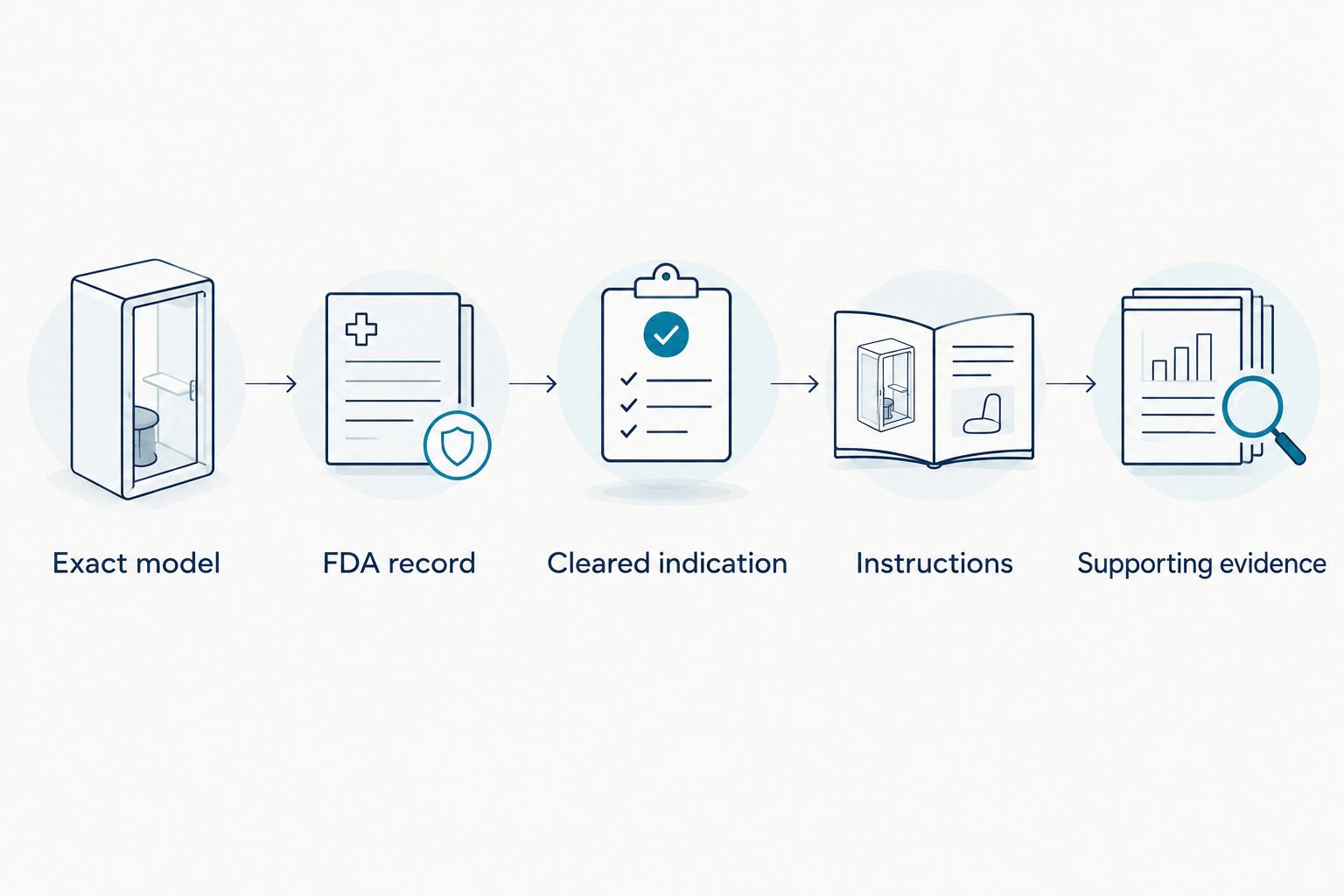
- Identify the exact model. Record the device name, manufacturer, and any clearance reference supplied. A brand name alone is not enough when a company offers different devices.
- Find the corresponding FDA record. Use the FDA's medical device databases to check the claimed clearance. Confirm that the record concerns the device being offered, not merely another device from the same manufacturer.
- Read the indication. Compare the stated intended use with your actual goal. Do not stretch wording about one concern into an assumption about another.
- Read the instructions and warnings. Check the treatment area, session directions, eye precautions, cleaning instructions, and situations in which use is not recommended.
- Check the evidence behind additional claims. If advertising goes beyond the cleared indication, look for evidence addressing that claim and that device. A familiar ingredient or wavelength name is not a substitute.
These checks answer different questions. The clearance record verifies the regulatory claim; the instructions explain use; the evidence helps you assess the promised outcome. Keep all three separate.
What does FDA clearance actually tell you?
FDA clearance is meaningful, but its meaning is narrower than an advertising headline. For devices cleared through the 510(k) pathway, the regulatory decision concerns substantial equivalence to a legally marketed predicate. The supporting submission depends on the device and the applicable requirements.
Do not translate “cleared” into “guaranteed to work for me.” Your concern, the device's intended use, the way you use it, and the outcome you expect still need to align.
Read the indication carefully rather than replacing it with a broader category. Wording about appearance is not automatically wording about treating a medical condition. A statement about a particular treatment area is not permission to use the device everywhere.
The FDA's 510(k) overview and its guidance on device registration are useful source documents for this 2026 decision. Their scope is regulatory status, not a recommendation that you buy a particular home device.
Is FDA-cleared the same as FDA-approved?
FDA-cleared and FDA-approved describe different regulatory pathways. For devices, approval commonly refers to the premarket approval pathway, while clearance commonly refers to the 510(k) pathway.
Neither term should be casually swapped for the other. If a seller uses both, ask which status applies to the exact model and where the corresponding FDA record is.
Does FDA registration prove that a device works?
FDA registration does not establish that a device works or that it has received clearance or approval. Registration and listing serve a different regulatory function.
A registration certificate displayed in an advertisement does not answer whether the device has a relevant clearance. Return to the model-specific record and indication rather than treating the certificate as the deciding evidence.
Why the value of a red light device varies
The value of a home device depends on more than its regulatory status. These factors determine whether a documented device is a sensible addition to your routine.
- Indication fit. The device's stated intended use needs to match the concern you want to address. A mismatch weakens the purchase case before any feature comparison begins.
- Evidence fit. A study is most useful when its device, population, protocol, and measured outcome match the claim you are evaluating. Evidence about a different device does not automatically transfer.
- Routine fit. The labeled schedule needs to work with your ordinary week. An impressive feature list does not solve a routine you cannot maintain.
- Handling and treatment area. Placement, fit, and access matter when following the instructions. Evaluate those practical requirements without assuming one format is universally better.
- Safety fit. Warnings, eye precautions, and restrictions apply to the specific model. Personal medical circumstances require professional advice rather than a shopping-page answer.
- Expectation fit. Decide what outcome would make continued use worthwhile. Clearance does not promise a particular degree of change or a universal timetable.
For a 2026 decision, these are more useful questions than whether a device looks advanced. Features only matter when they help you use the right device as directed.
What evidence should you read beyond the clearance claim?
Look for evidence that answers your question, not merely evidence that mentions light. A relevant study identifies the device or technology studied, who participated, how it was used, and what investigators measured. Read those details before accepting the headline.
A photograph is not the whole result. Lighting, positioning, expression, and image processing affect appearance. Study methods and outcome measures give you more context than an isolated before-and-after image.
Check whether the result concerns the same outcome you care about. A measured change in one feature does not establish every other benefit listed on a sales page. Likewise, a finding under a particular protocol does not justify changing your device's directions.
Keep device evidence and category evidence separate. General research on light-based treatment can provide context, but it does not establish identical performance across home devices. A shared description such as red light does not make different models interchangeable.
You do not need to become a researcher. You need enough detail to see whether the claim has a relevant foundation, whether its limits are disclosed, and whether the seller accurately describes the findings.
How do you decide whether the routine fits?
Start with the instructions, then imagine using the device on an ordinary day. Consider where you will use it, how you will position it, and how you will clean and store it. Follow the labeled session length and frequency rather than importing a schedule from another device.
Best for routine-minded buyers: a documented device whose instructions you can realistically follow. The benefit is a clear plan; the limitation is that the plan still requires attention and repetition. Clearance does not remove that practical commitment.
Do not treat longer or more frequent sessions as an upgrade. Use the manufacturer's directions. If the instructions are unclear, get clarification before use instead of experimenting with exposure or placement.
Keep the rest of your routine understandable. Changing several skincare steps while introducing a device makes it harder to interpret changes in comfort or appearance. A simple record of what you used and how your skin felt is more useful than relying on memory.
For this 2026 evaluation, judge convenience against the actual instructions, not the shortest session claim you saw elsewhere. Different devices do not necessarily share a protocol.
Where does skincare fit alongside a device?
Skincare and a light-based device have different jobs. A cream is not proof of device effectiveness, and device clearance does not establish that every topical product is suitable immediately before a session. Follow the device instructions on skin preparation and permitted products.
A Simple Cosmetics skincare product such as Copper Glow belongs in a discussion of an ingredient-led routine, not in a claim that a cream and device produce a guaranteed combined result. Check the product directions separately. Do not assume that a peptide ingredient makes a topical formula suitable for use under light exposure.
Simple Cosmetics personal care is intended for consumers who want clearly explained routines. That simplicity is useful here: understand each step's purpose rather than adding several new steps at once. It does not replace a device's warnings or advice from a qualified clinician.
Keep your existing sun-protection routine. A light device is not sunscreen, and an appearance-focused routine is not a reason to stop using sun protection.
When should you pause before buying?
Wait if you cannot verify the exact device, find its instructions, or connect its indication to your goal. Missing clarity is a reason to stop the purchase process, not a reason to fill the gaps with assumptions.
Pause if your concern needs diagnosis rather than cosmetic shopping. Persistent symptoms, unexplained changes, or a condition for which you are receiving treatment belong in a conversation with a qualified clinician.
Check with a clinician or pharmacist if you take medication associated with photosensitivity or have a condition that affects light sensitivity. Read the model's warnings about eye protection and other precautions. Do not assume that instructions from another device apply.
If use causes discomfort or an unexpected reaction, stop and follow the manufacturer's guidance; seek medical advice when needed. Avoid pushing through a reaction because a device carries a clearance claim.
FAQ
Is an FDA cleared red light therapy device worth it for home use?
Yes, when the exact device has a cleared indication that matches your goal and you can follow its instructions. Clearance does not guarantee your results or establish every advertised benefit.
What’s the difference between FDA-cleared and FDA-registered?
FDA clearance concerns a device’s regulatory review, while registration identifies an establishment within a separate regulatory process. Registration alone does not establish clearance, approval, or effectiveness.
Is an FDA-cleared device better than one without clearance?
A relevant clearance gives you a specific regulatory claim to verify, but it does not by itself prove better results than another device. Compare the intended use, evidence, warnings, and instructions before deciding.
How do I check whether a red light device is actually FDA-cleared?
Find the exact model and manufacturer in the FDA’s medical device databases, then check the corresponding indication. Do not rely on a brand-level badge or registration certificate alone.
Can I use skincare products before a red light session?
Use skincare before a session only as permitted by the device instructions. Check topical product directions separately and do not assume that every serum or cream is compatible.
How long does it take to see results from a red light device?
There is no universal timetable for all red light devices and intended uses. Read the evidence and directions for the exact model rather than borrowing a schedule from another product.
Can red light therapy replace sunscreen or medical treatment?
A red light device does not replace sunscreen or prescribed medical treatment. Keep sun protection in your routine and discuss treatment changes with your clinician.
One last thing
Before buying, finish this sentence: “This exact device is cleared for the use I want, and I understand its instructions.” If you cannot finish it confidently, pause. A narrower, verifiable claim is more useful than a long list of promised benefits.
This article is educational and is not medical advice. Device suitability, medication questions, and persistent symptoms require individual guidance from a qualified clinician.
Related guides
- Is an LED face mask worth it?
- How long until you see results from an LED face mask?
- Connect a handheld LED device to your morning skincare routine
- Can you use copper peptide serum with retinol?