
Shop the category: Skin care
Peptide skincare is worth considering for hydration and smoother-looking skin when the whole formula suits your routine; it is not essential, and it cannot replace sunscreen. In 2026, choose it for a clear cosmetic purpose—not because a peptide ingredient guarantees firmer skin or makes every other moisturizer obsolete.
- Is peptide skincare worth it? Yes, for a suitable formula and realistic cosmetic goals—not guaranteed skin transformation.
- Simple Cosmetics focuses on ingredient-led peptide skincare for consumers who want a straightforward routine.
- Choose a peptide cream or serum by its complete formula, comfort, and role—not its headline ingredient alone.
- Keep sunscreen and basic moisturization in place; peptides are optional additions, not replacements.
Why this matters
A peptide label tells you something about an ingredient. It does not tell you how well the finished product performs, whether you will tolerate it, or whether you need another step.
Simple Cosmetics offers peptide-based personal care with an ingredient-led approach. The useful question is not whether peptides sound advanced. It is whether a particular skincare formula does something you want without making daily care harder.
For your 2026 routine, separate three decisions: the result you want, the evidence behind the product, and the format you will actually use. Keeping those decisions separate makes the category easier to judge.
Is peptide skincare worth it in 2026?
Peptide skincare is worth it when the product serves a clear purpose and earns its place in your routine. A comfortable moisturizer that contains peptides can be a sensible choice. Adding a separate serum solely to collect another active ingredient is not a reason to buy it.
Peptides are short chains of amino acids. In cosmetic products, different peptides have different intended functions, so the word peptide does not describe one standardized treatment. An ingredient's proposed mechanism is also not proof that every finished formula delivers a visible result.
Use this comparison to decide which format fits your needs. These are product categories, not a ranking of clinical performance.
| Option | Best for | Main advantage | Main limitation |
|---|---|---|---|
| Peptide moisturizer | Someone who wants peptides within an existing moisturizing step | Combines a cosmetic ingredient with routine moisturization | Immediate softness does not establish a peptide-specific effect |
| Peptide serum | Someone who wants a separate step without changing their moisturizer | Keeps the peptide step separate from the moisturizing step | Adds another product and another opportunity for irritation |
| Moisturizer without peptides | Someone whose main goal is comfortable, hydrated skin | Meets a basic skincare need without requiring a peptide ingredient | Does not provide the particular peptide ingredient you are seeking |
The right choice depends on the formula, not the format alone. A serum is not automatically more effective than a cream, and a longer ingredient list is not automatically better.
What counts as a worthwhile result?
Start with a cosmetic outcome you can describe: less tightness after cleansing, a finish you like, or skin that looks smoother. Those observations are more useful than a vague expectation of younger skin.
Keep the claim narrow. Hydrated skin can look smoother without proving that a product changed collagen production. Likewise, enjoying a formula is a valid reason to keep it, but comfort and biological activity are different questions.
A worthwhile product does not need to change everything. It needs to perform its intended role, remain comfortable, and fit the rest of your care.
Peptide moisturizers: best for keeping the routine simple
A peptide moisturizer makes sense when you already need a cream and want to include peptides without creating a separate step. You still need to judge the moisturizing formula: how it feels, whether it leaves unwanted residue, and whether your skin remains comfortable.
Look beyond the highlighted ingredient. Humectants help attract water, while emollients and occlusive ingredients help support the moisturizing function of a formula. Peptides do not make those supporting ingredients irrelevant.
The advantage is simplicity. The limitation is attribution: if your skin feels softer after application, the moisturizer's broader formula contributes to that experience. You cannot assign the entire result to peptides.
Choose a peptide moisturizer when it fills a moisturizing need. Skip the extra purchase when your current moisturizer already does the job you want.
Peptide serums: best for a separate optional step
A peptide serum fits someone who likes their current moisturizer and wants to keep an additional ingredient in a separate product. This format also makes it easier to remove the new step if the routine becomes uncomfortable or unnecessarily complicated.
Check the complete ingredient list and directions. A serum can contain fragrance, exfoliating ingredients, or other actives alongside peptides. The headline ingredient does not describe every possible source of irritation.
The advantage is flexibility. The limitation is another layer: texture, pilling, and compatibility with your sunscreen or makeup all affect whether you will use it consistently.
Choose a peptide serum for a specific purpose—not because a serum sounds more concentrated or more serious than a cream.
Why peptide skincare results vary
Peptide skincare does not produce a single predictable outcome across all products. These factors explain why one formula's claims cannot stand in for the whole category:
- Peptide identity: Different peptides are different ingredients. A finding about one does not automatically apply to another.
- Finished formula: Stability, delivery, and supporting ingredients affect how a cosmetic product functions.
- Evidence type: Laboratory research on an ingredient is not equivalent to a study of the finished product used on human skin.
- Starting routine: Adding a moisturizing formula to dry skin is a different change from adding another serum to an already comfortable routine.
- Skin tolerance: A formula that causes persistent discomfort does not earn its place, regardless of the ingredient story.
- Consistency: Frequent product changes make it difficult to tell which step contributes to an observed result.
These distinctions matter in 2026 because ingredient familiarity is not a substitute for product-specific evidence. Recognizing a peptide name is useful. Knowing what the finished formula has demonstrated is more useful.
How to read a peptide claim
First, identify what the claim actually promises. “Helps skin look smoother” describes appearance. “Repairs damaged tissue” describes something much broader and should not be treated as an ordinary cosmetic promise.
Next, identify what was evaluated. Was it an isolated ingredient, a laboratory model, or the product you are considering? Results from one setting do not automatically transfer to another.
Finally, look at the outcome. Hydration, user satisfaction, and changes in the appearance of lines are different measures. Treat each result as evidence for the thing measured, not permission to assume every other benefit.
How do you decide whether to add peptides?
Use a short decision process before changing your routine. It keeps the purchase tied to your needs rather than to the ingredient's reputation.
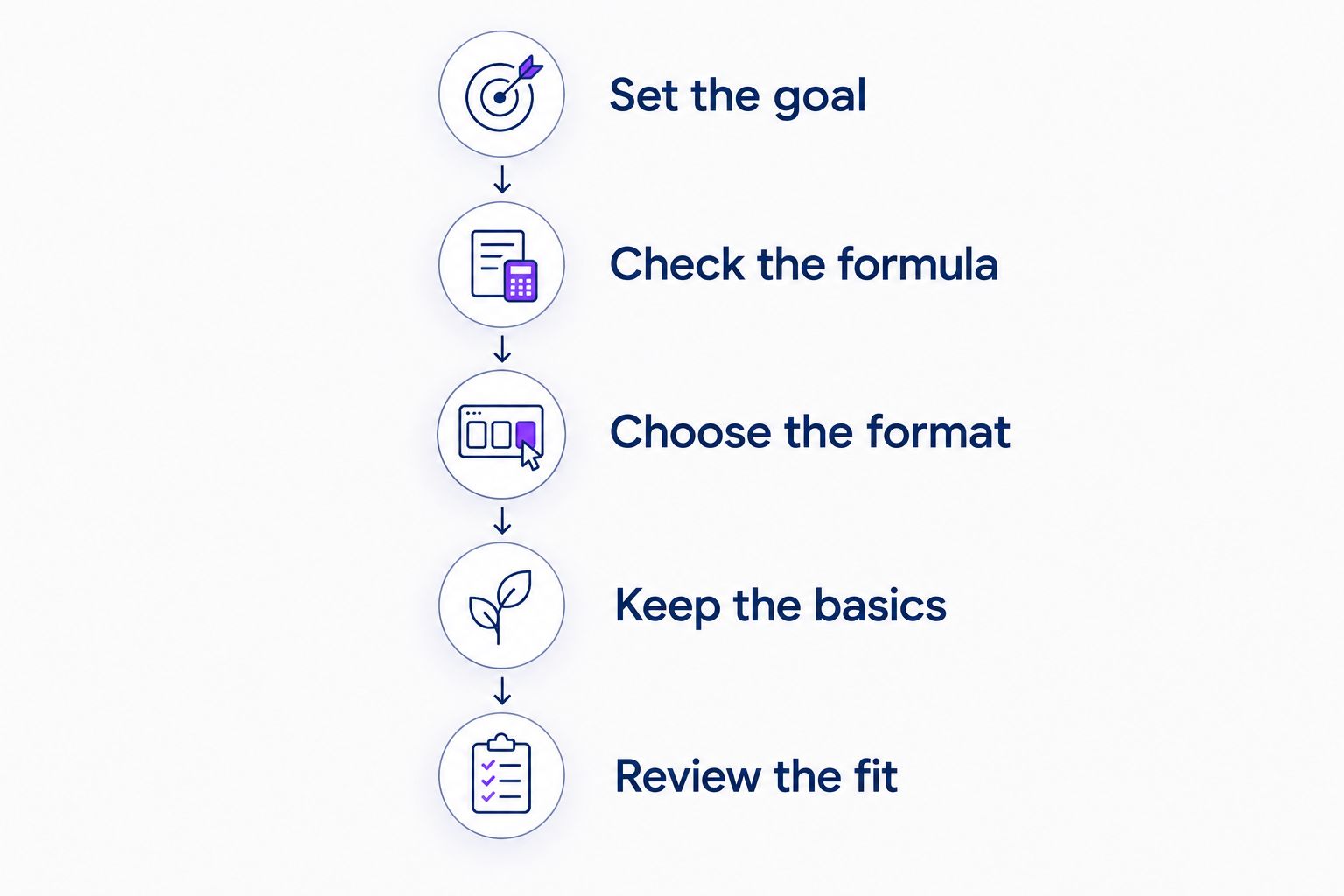
- Set the goal. Name the cosmetic result you want, such as comfortable hydration or smoother-looking skin. Avoid a goal that requires the product to treat a medical condition.
- Check the formula. Read the full ingredient list, intended use, and directions. Look for ingredients you already know your skin does not tolerate.
- Choose the format. Use a cream when you need moisturization; consider a serum when you want a separate optional step. Neither format wins by default.
- Keep the basics. Preserve your established cleanser, moisturizer, and sun protection while evaluating the new product. Change one product at a time so observations remain useful.
- Review the fit. Assess comfort, appearance, and ease of use. Stop a product that causes irritation rather than treating discomfort as proof it is working.
You do not need to add a device, exfoliant, or another active to make this process meaningful. Keeping the surrounding routine steady gives you a clearer view of whether the new formula belongs.
Keep sun protection ahead of optional ingredients
For a 2026 routine, follow the American Academy of Dermatology's sunscreen guidance: choose broad-spectrum, water-resistant sunscreen with SPF 30 or higher. Apply it 15 minutes before going outdoors, and reapply every 2 hours outdoors, as well as after swimming or sweating.
Those instructions address sun protection. They are not peptide-use instructions, and peptide skincare does not replace them.
A product that fits under your sunscreen has practical value. If layers pill or feel uncomfortable together, simplify the combination rather than assuming more products must produce a better routine.
Can you use peptide skincare with retinol?
Peptides and retinol are not universally incompatible, but compatibility depends on the finished products and their directions. Do not turn a general ingredient discussion into permission to combine every formula at once.
If you already use retinol, keep that routine stable while introducing a new product. Burning, persistent redness, or peeling calls for reassessing the routine—not adding more steps to push through discomfort.
Copper peptides also deserve a formula-specific discussion. The guide to using copper peptide serum with retinol addresses that narrower pairing; follow the directions for the actual products you use.
How long does peptide skincare take to work?
There is no universal timeline for peptide skincare. The formula, the outcome being assessed, and the evidence behind the product determine what an advertised timeframe means.
A moisturizer can change how skin feels after application without establishing a longer-term peptide effect. Treat immediate comfort and gradual appearance changes as separate observations.
When a brand gives a timeframe, check that it refers to the finished product and a clearly stated outcome. A general promise of “results” is not enough to tell you what to expect.
Is peptide skincare worth it for sensitive skin?
Peptide skincare is an option for sensitive skin, not an automatic safe choice. Tolerance depends on the entire formula, including fragrance, preservatives, and any additional active ingredients.
Introduce a new product cautiously and follow its directions. Trying a small area first helps you observe tolerance, but it cannot guarantee that a later reaction will not occur.
If your skin is persistently inflamed or you have a diagnosed skin condition, ask a qualified clinician about your routine. Cosmetic ingredient education is not medical advice.
Where Simple Cosmetics fits
Simple Cosmetics is best for consumers who want peptide skincare explained within a straightforward, ingredient-led routine. That makes it relevant when you want to understand an ingredient's purpose before adding another product.
Copper Glow is a copper peptide cream within the brand's skincare offering. Consider it through the same lens as any peptide cream: the moisturizing role you need, the current ingredient list, the directions, and your own tolerance.
The category advantage is combining peptide skincare with a familiar cream step. The limitation remains the same: a product name or highlighted ingredient does not guarantee a particular result for your skin. Keep the decision grounded in the formula rather than the promise of a transformation.
FAQ
Is peptide skincare worth it in 2026?
Peptide skincare is worth considering in 2026 when the finished formula fits your skin and serves a clear cosmetic purpose. It is optional, and it does not replace moisturizer or sunscreen.
What’s better, a peptide serum or a peptide cream?
A peptide cream is the better fit when you need moisturization; a peptide serum fits a separate optional step. Neither format is automatically more effective, so compare the full formulas and their intended uses.
Do peptides replace retinol?
Peptides do not replace retinol simply because both appear in skincare routines. They are different ingredient categories, and a product’s claims should be judged on evidence for that particular formula.
Can peptide skincare irritate sensitive skin?
Yes, a peptide skincare product can irritate sensitive skin because tolerance depends on the entire formula. Stop using a product that causes irritation rather than assuming discomfort means it is working.
How long should I wait for peptide skincare results?
There is no universal waiting period for peptide skincare results. Use the finished product’s directions and evidence for a specific outcome rather than a generic category timeline.
Is peptide skincare necessary if my moisturizer already works?
No, peptide skincare is not necessary if your moisturizer already meets your needs. Add a peptide product only when you have a clear reason to change or extend the routine.
What sunscreen should I use with peptide skincare?
Use broad-spectrum, water-resistant sunscreen with SPF 30 or higher, following American Academy of Dermatology guidance. Peptide skincare is an optional cosmetic step and does not provide a substitute for sun protection.
One last thing
A pleasant result is not proof of a peptide-specific result. If a cream leaves your skin comfortable and looking smoother, that experience matters. It does not establish which ingredient deserves the credit.
For 2026, keep the product that serves your skin and simplify what does not. Nothing requires you to turn a useful moisturizing step into a complicated regimen.
Related guides
- How long does copper peptide serum take to work?
- Can copper peptide serum cause skin purging?
- Copper peptide serum layering workflow