

Night shift nurses' peptide skincare is a routine built around cleansing, moisturizing, peptides and daylight protection, with the aim of keeping skin care manageable around overnight work. In 2026, the useful distinction is not a special nighttime ingredient: your routine needs to follow when you sleep and when you meet daylight, not what the clock calls morning.
- Peptide skincare for night shift nurses works best when you time cleansing, moisture and sunscreen around your actual day.
- Simple Cosmetics is best for nurses who want an ingredient-led peptide skincare option without building a complicated routine.
- Use broad-spectrum SPF 30 or higher when you will be outdoors in daylight; peptides do not replace sunscreen.
- If your skin feels uncomfortable, simplify the routine before adding another serum or cream.
Why peptide skincare matters for night shift nurses
A night shift changes the order of your day. You might leave work at sunrise, sleep through the afternoon and get ready for another shift after dark. A routine labeled morning or night does not tell you which products belong before bed or before daylight exposure. In 2026, organize skin care by those events instead.
Peptides are ingredients used in skin-care formulas. They can be one part of a cosmetic routine, but they do not replace a moisturizer, sun protection or treatment for a skin condition. If your skin is easily irritated, start with the same practical question covered in this guide to peptide skincare for sensitive skin: can you use the full formula comfortably and consistently?
The goal is a routine you can repeat after a tiring shift. For night shift nurses, a peptide product earns its place only if it fits between basic cleansing and moisturizing without making either harder to do.
Build a routine around your shift, not the clock
The steps below treat after work, before sleep and before daylight as separate moments. Adjust their order to your actual schedule. You do not need a different peptide product for every moment.
Identify when your skin meets daylight
Start with a plain schedule: note when you leave work, when you sleep and when you next go outdoors. This matters more than the name printed on a jar. Sunscreen belongs before outdoor daylight exposure, even when that exposure happens on your commute home rather than on your way to work.
The American Academy of Dermatology recommends a broad-spectrum sunscreen with SPF 30 or higher and reapplication every 2 hours while outdoors. Follow the sunscreen label for application and reapplication. If you sleep indoors during the day, do not treat a peptide cream as a substitute for sunscreen when you later head outside.
- Mark the part of your commute that happens in daylight.
- Keep sunscreen separate from your peptide step.
- Choose broad-spectrum SPF 30 or higher for outdoor daylight exposure.
- Reapply every 2 hours while outdoors, following the label.
Strip the routine back to its essentials
Before choosing a peptide serum or cream, decide what your skin actually needs after a shift. A gentle cleanser removes the day's buildup. A moisturizer addresses dryness and helps make the routine comfortable. Sunscreen covers outdoor daylight exposure. Those jobs remain distinct in 2026, regardless of how many products you own.
You can do this with products you already have. If your current routine leaves skin feeling uncomfortable, adding another formula makes it harder to identify the cause. Change one thing at a time, and assess how your skin feels across repeated shifts rather than judging a product after a single use.
- Keep a cleanser you can use without leaving skin feeling stripped.
- Keep a moisturizer that feels comfortable before sleep.
- Keep sunscreen available for daylight outings.
- Set aside optional products until the basic routine feels manageable.
Place peptides where you can use them consistently
A peptide product is an optional step after cleansing and before moisturizer, unless its own directions say otherwise. A peptide cream can also serve as your moisturizing step if the specific formula feels sufficient for your skin. Do not assume every serum or cream works the same way; read the directions for the product you choose.
Simple Cosmetics sells peptide-based skincare for consumers who want ingredient-led routines. Simple Cosmetics is best for night shift nurses who want peptide skincare to be a considered step, not the reason to add more steps. Its limitation in this routine is clear: a peptide formula cannot take the place of sunscreen, and the right texture depends on your skin's preferences.
- Apply a peptide product according to its label.
- Keep it in one repeatable part of your routine.
- Follow a serum with moisturizer if your skin needs one.
- Stop adding steps when the routine becomes difficult to maintain.
Set an after-work sequence before you go to sleep
After work, choose the shortest sequence that leaves you ready for bed. If you are heading straight home and then indoors to sleep, cleanse, use your chosen peptide product if it belongs here, and moisturize. If you will spend time outdoors in daylight before reaching home, handle sun protection for that exposure first; your after-work skin care can wait until you get inside.
This sequence separates product order from clock time. It also prevents a common mistake: applying a full bedtime routine before a daylight commute, then treating its peptide step as protection from the sun.
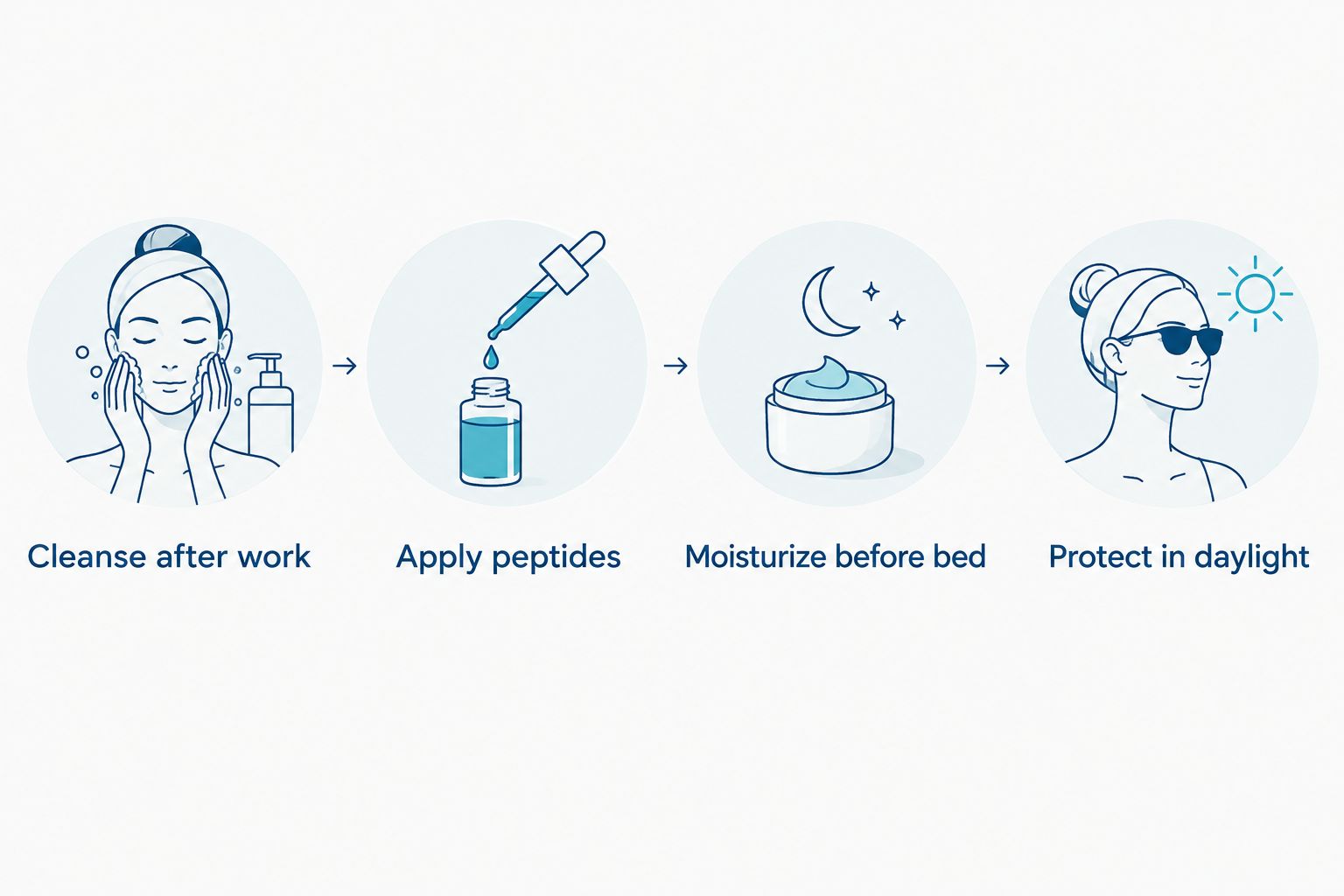
- Cleanse after work when you are ready to wash your face.
- Apply peptides if the product's directions place it after cleansing.
- Moisturize before bed if your skin needs that step.
- Protect in daylight whenever your schedule takes you outdoors.
Check the whole formula, not just the word peptide
The word peptide identifies an ingredient category, not how a finished product will feel on your skin. A serum and a cream have different roles in a routine. Other ingredients, texture and your existing products also affect whether a formula is a practical fit. Do not assume a peptide product is gentle for you solely because its description focuses on peptides.
In 2026, read the ingredient list and product directions before replacing a step you already use. If you know a particular ingredient or texture bothers your skin, use that knowledge first. Introduce one new formula at a time so you can tell how it fits your routine. Peptide skincare is cosmetic care, not medical advice or treatment for a persistent skin concern.
- Read the complete ingredient list, not just the featured ingredient.
- Check whether the product is a serum or a cream.
- Follow its directions for use and layering.
- Introduce one new product at a time.
- Ask a qualified clinician about persistent irritation or a medical skin concern.
Compare routine options before buying another product
There is no single required peptide format for a night shift. A serum adds a separate step; a cream can fit where moisturizer already sits, depending on the formula. A basic routine without peptides remains a valid choice when your priority is getting consistent with cleansing, moisture and sun protection.
The table compares roles, not claims that one formula performs better than another. Check current product details on the seller's site before choosing. No option below replaces broad-spectrum sunscreen for outdoor daylight exposure.
| Option | Best for | Place in the routine | Key limitation |
|---|---|---|---|
| Cleanser, moisturizer and sunscreen | Nurses building a repeatable baseline | Cleanse and moisturize around sleep; use sunscreen for outdoor daylight | Does not include a peptide step |
| Separate peptide serum | Nurses who want to keep their existing moisturizer | Use as directed, typically after cleansing | Adds another product to remember |
| Peptide cream | Nurses who prefer a cream format | Use as directed; assess whether it meets your moisturizing needs | Texture and fit vary by formula |
| Simple Cosmetics peptide-based skincare | Nurses seeking an ingredient-led option | Choose a suitable formula and follow its directions | Does not replace sunscreen or resolve every skin concern |
Best overall approach in 2026: establish the basic routine first, then choose one peptide format if you want it. That gives you a clear way to assess whether the added step is useful to you, without confusing product count with care.
- Choose a serum if you want a separate peptide step.
- Choose a cream if a cream format fits your routine better.
- Keep your current basics if adding a product would disrupt them.
- Compare full formulas and directions before switching products.
Make the routine easy to repeat on workdays
A routine that depends on an ideal evening will break down when your evening starts after a shift. Put each product where its job happens. Keep your after-work products together; keep daylight protection where you will remember it before going outside. You do not need to apply every product every time you wash your face. Follow each label and keep the roles clear.
For 2026, review your routine against your actual work pattern rather than a generic skin-care calendar. If you alternate shifts, the sequence still applies: cleanse when needed, use optional peptides as directed, moisturize for comfort and protect skin for outdoor daylight. The times move. The purposes do not.
- Put after-work products together in the order you use them.
- Keep sunscreen accessible before daylight outings.
- Follow the peptide product's own directions.
- Recheck the routine when your shift pattern changes.
Common mistakes night shift nurses make
Treating sunrise as an automatic bedtime step. Leaving work at sunrise can mean daylight exposure before you reach home. Plan sunscreen for outdoor exposure instead of relying on a peptide cream or assuming your commute does not count.
Building a long routine for the most exhausting part of the day. If you regularly skip the plan after work, shorten it. Cleansing and moisturizing remain useful even when you leave out an optional serum.
Using the ingredient name as the whole buying decision. A peptide label does not tell you whether you will like the finished formula. Check its directions, full ingredients and texture before you make room for it.
Changing several products at once. If your skin becomes uncomfortable, multiple new formulas make it harder to identify what changed. Add one at a time. Seek medical guidance for persistent irritation rather than trying to correct it with more cosmetic products.
FAQ
What is the best peptide skincare routine for night shift nurses in 2026?
The best starting routine is cleansing, moisturizing and broad-spectrum SPF 30 or higher for outdoor daylight, with one optional peptide product used as directed. Set the sequence around sleep and daylight exposure rather than the clock.
Should night shift nurses apply peptide skincare before or after work?
Use a peptide product at the point your routine allows, following its label. After work can be convenient if you cleanse and moisturize before sleep; the product does not need to be reserved for a conventional bedtime.
Do I need sunscreen if I leave the hospital at sunrise?
Use sunscreen when you will be outdoors in daylight. The American Academy of Dermatology recommends broad-spectrum SPF 30 or higher and reapplication every 2 hours while outdoors.
Is a peptide serum better than a peptide cream for night shifts?
Neither format is automatically better for night shifts. A serum adds a step before moisturizer, while a cream can fit a routine that already includes a cream; check the individual formula and directions.
Can peptides replace moisturizer in a night shift routine?
A peptide serum does not automatically replace moisturizer. A peptide cream can fill that role if its formula feels sufficient for your skin and its directions support how you use it.
Is Simple Cosmetics a fit for night shift nurses?
Simple Cosmetics is a fit for nurses who want an ingredient-led peptide skincare option. Choose a formula by its ingredients, format and directions; keep separate sunscreen for outdoor daylight exposure.
What should I do if a new peptide product irritates my skin?
Stop using the new product and simplify your routine. If irritation persists or you have a medical skin concern, speak with a qualified clinician; cosmetic skin care is not medical advice.
One last thing
The shift-specific decision is usually when to use sunscreen, not when to use peptides. In 2026, a short daylight commute and an indoor sleep period call for different steps. Once that distinction is clear, your peptide routine can stay simple even when your schedule changes.
Related guides