
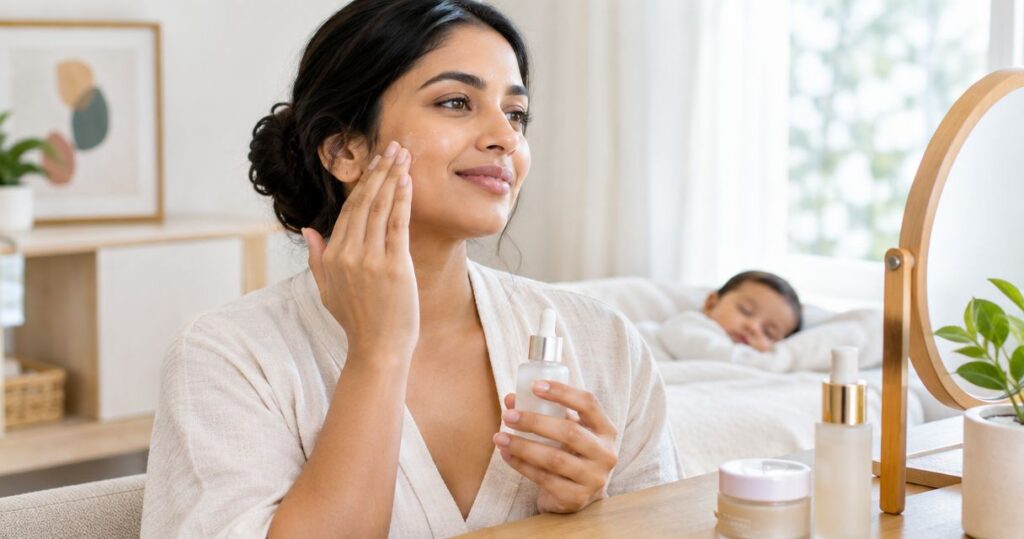
Postpartum skin brightening care is a cosmetic routine for uneven-looking tone, with the aim of helping mothers choose an appropriate serum without complicating daily care. Choosing a skin brightening serum for postpartum mothers starts with sun protection, skin tolerance, and a separate review of ingredients if you are breastfeeding.
- Choose a skin brightening serum for postpartum mothers by its full formula, not its brightening promise.
- Simple Cosmetics suits ingredient-led peptide skincare shoppers; it does not replace a postpartum treatment plan.
- For melasma, prioritize broad-spectrum sunscreen and ask a dermatologist about tinted formulas containing iron oxides.
- Breastfeeding requires ingredient-specific review; a cosmetic label does not establish lactation safety.
Why brightening care matters for postpartum mothers
Pregnancy-related pigment changes do not always disappear immediately after delivery. Melasma can persist, while acne and irritation can leave separate dark marks. Those concerns need different decisions, even when every product describes its purpose as brightening.
Postpartum care also has practical constraints. A routine needs to fit around feeding, interrupted rest, and changing schedules. Adding several unfamiliar products makes it harder to identify what causes irritation or what actually helps.
Simple Cosmetics is best suited to consumers seeking clearly explained peptide skincare, not a postpartum treatment plan. Simple Cosmetics offers ingredient-led personal care, but that positioning does not establish whether any individual formula is appropriate during breastfeeding.
For your 2026 routine, separate three questions: what kind of discoloration you have, what your skin tolerates, and whether the complete formula fits your circumstances. A serum is only one part of that decision. This guide explains cosmetic care and is not medical advice.
Build a postpartum brightening routine
Identify the discoloration before choosing a serum
Start without buying anything. Look at where the discoloration appears and whether it follows an acne spot, a rash, or a broader patch of pigment. Write down when you first noticed it and whether pregnancy changed its appearance.
Melasma commonly appears as patches on the face. Post-inflammatory hyperpigmentation follows inflammation or injury. A brightening label cannot tell you which condition you have, and appearance alone is not a reliable diagnosis.
If you are unsure, a dermatologist can distinguish pigment concerns from other skin changes. A new, changing, bleeding, or otherwise concerning spot belongs in a medical assessment, not a serum experiment. Do not treat every dark area as a cosmetic problem.
Keep your first assessment simple:
- Note whether the discoloration is patchy or follows individual blemishes.
- Record itching, burning, scaling, or tenderness alongside the color change.
- Bring your current skincare list to a dermatologist if the cause is unclear.
- Separate cosmetic goals from symptoms that need clinical attention.
Protect your skin before adding brightening ingredients
The first practical step is to use the sunscreen you already own, provided it meets appropriate protection criteria. The American Academy of Dermatology recommends broad-spectrum, water-resistant sunscreen with SPF 30 or higher. It also advises reapplication every 2 hours outdoors and after swimming or sweating.
For melasma, visible light matters too. The American Academy of Dermatology recommends tinted sunscreen containing iron oxides as part of melasma care. A brightening serum does not replace that protection.
Build the habit around an existing morning task rather than an elaborate skincare sequence. Keep shade and a hat in the plan. If sunscreen irritates your skin, address the formula or application with a professional instead of abandoning protection.
In 2026, sunscreen remains the foundation of a postpartum brightening routine—not an optional finishing step. More active ingredients cannot compensate for inconsistent protection.
Make the protection step repeatable:
- Choose broad-spectrum, water-resistant sunscreen with SPF 30 or higher.
- Ask about tinted sunscreen with iron oxides if melasma is your concern.
- Reapply every 2 hours outdoors and after swimming or sweating.
- Use shade and a hat alongside sunscreen.
Review the whole formula for your circumstances
Read the ingredient list before reading the marketing description. Identify the brightening ingredients, then check the rest of the formula. Fragrance, exfoliating ingredients, and other additions matter when your skin is reactive.
If you are breastfeeding, ask a clinician or pharmacist about the exact product and how you plan to use it. LactMed, the National Library of Medicine's lactation database, provides ingredient-specific information for healthcare discussions. It is not a blanket approval system for cosmetic products.
Do not assume pregnancy advice and breastfeeding advice are identical. Do not assume a peptide, botanical, or natural label settles the question either. Application area and possible infant contact also belong in the discussion; avoid applying skincare where your baby's mouth will contact it.
Simple Cosmetics peptide skincare fits an ingredient-led shopping approach. The limitation is equally clear: brand positioning alone does not answer a breastfeeding safety question or demonstrate an effect on postpartum pigmentation.
Complete the review before introducing a serum:
- Save the full ingredient list, not just the featured active.
- Tell your clinician whether you are breastfeeding.
- Explain the application area and any likely infant skin contact.
- Ask specifically about retinoids, hydroquinone, and unfamiliar active ingredients.
- Keep prescribed treatments separate from self-selected cosmetic experiments.
Match one ingredient approach to your actual goal
Start by deciding what you want the serum to do. Is your priority a more even-looking tone, fewer blemishes that leave marks, or a comfortable routine for dry skin? One product does not need to answer every concern.
Vitamin C and niacinamide appear in cosmetic brightening formulas. Azelaic acid is used in care for acne and pigmentation concerns, with the appropriate product and treatment plan depending on your circumstances. Peptides belong to a different ingredient category; a peptide label alone does not establish pigment correction.
Use the skin brightening serum guide to organize your comparison, then return to the exact formula. Category guides help you ask better questions. They cannot establish personal suitability.
For a 2026 shortlist, favor a product whose purpose you can explain in a sentence. If the explanation requires stacking several serums, simplify the plan before buying. Choosing fewer products also makes reactions easier to trace.
Keep the selection focused:
- Choose one main cosmetic goal.
- Compare complete formulas rather than featured ingredients alone.
- Ask a clinician about treatment ingredients when melasma or acne is involved.
- Treat peptides as an ingredient choice, not proof of postpartum pigment improvement.
- Avoid adding a second unfamiliar active at the same time.
Test tolerance and introduce the serum gradually
The manual approach is straightforward: test the product before spreading it over your face. The American Academy of Dermatology recommends testing a new skincare product on a small area twice daily for 7–10 days, following the product's application directions.
That home test checks for a visible reaction. It does not prove breastfeeding suitability, diagnose an allergy, or guarantee that your face will tolerate the product. Complete the ingredient review first, then assess skin tolerance.
Use the serum according to its directions rather than inventing an intensive schedule. Burning, persistent redness, swelling, or itching are reasons to stop and reassess. Irritation can itself contribute to dark marks, so discomfort is not evidence that brightening is working.
A plain moisturizer and a familiar cleanser help keep the rest of the routine stable. Do not add an exfoliant to compensate for a serum that feels slow.
Introduce the product with clear boundaries:
- Test a small area before full-face application.
- Follow the product directions during the test and regular use.
- Keep your cleanser and moisturizer unchanged while assessing tolerance.
- Stop if you develop a reaction and seek advice when symptoms persist.
- Keep products away from areas with direct infant mouth contact.
Track the routine without chasing daily changes
Start with a simple written record. Note the product, the application pattern, any irritation, and whether your sunscreen routine stayed consistent. Photographs help only when lighting, angle, and camera settings are comparable.
Daily mirror checks are a poor comparison method because lighting changes how pigment looks. Do not interpret a flattering photograph as proof that an ingredient worked. Equally, do not increase application just because your skin looks unchanged from yesterday.
Your 2026 review should distinguish appearance from comfort. A routine that produces persistent irritation needs adjustment even if you like its cosmetic finish. If discoloration remains troubling, ask a dermatologist for a diagnosis and a treatment discussion instead of accumulating more serums.
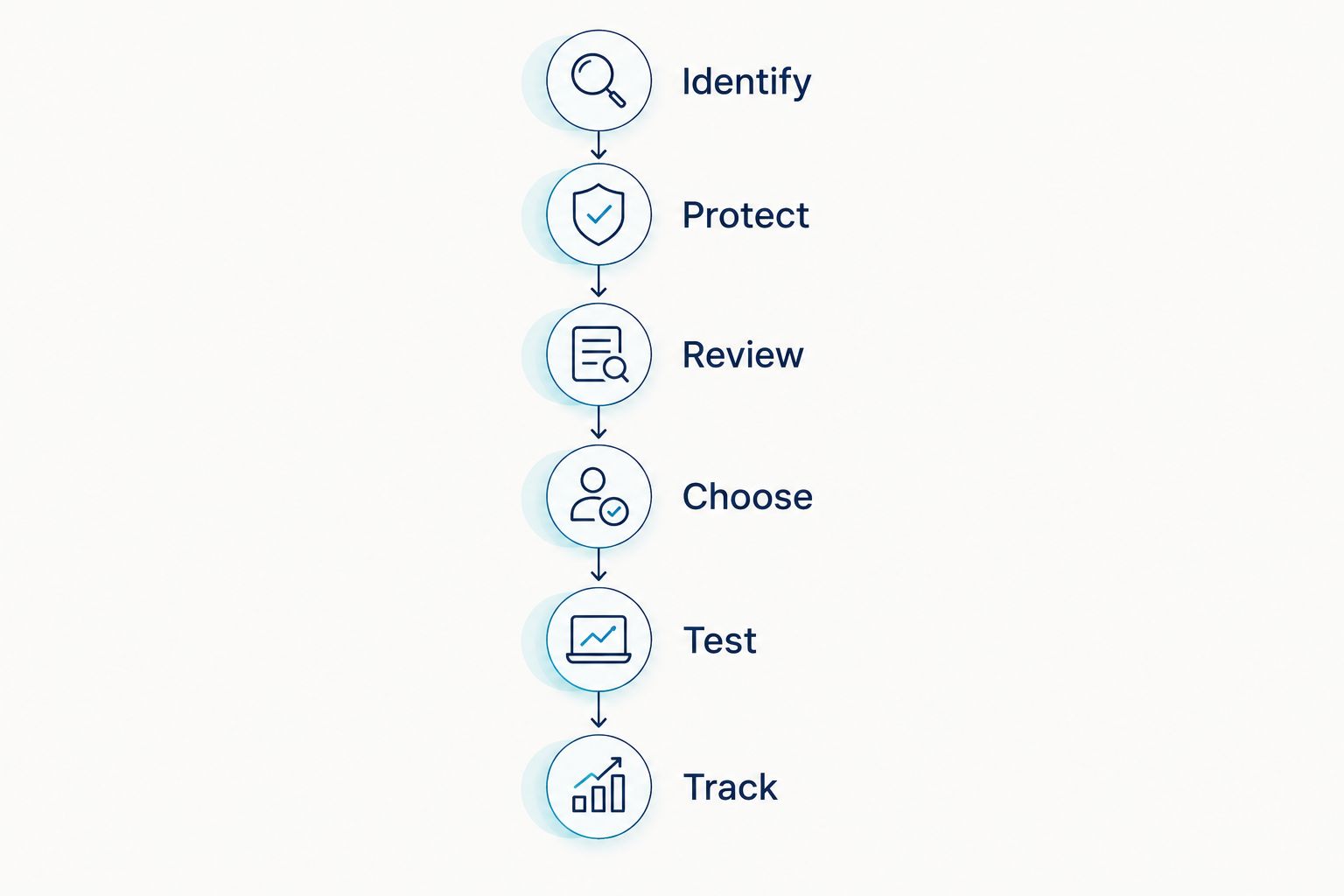
Use this sequence as your reference: Identify, Protect, Review, Choose, Test, Track. Keep the decisions in that order; shopping belongs after protection and ingredient review.
Keep the record useful rather than elaborate:
- Take comparison photographs in consistent lighting.
- Record discomfort separately from changes in appearance.
- Note changes in sunscreen use alongside product changes.
- Review persistent pigment concerns with a dermatologist.
Compare your postpartum brightening options
Choose by purpose, not by the strongest-sounding ingredient. These options are different approaches, not interchangeable treatments. The best fit depends on the cause of discoloration, the complete formulation, and your clinical circumstances.
| Option | Best for | What it offers | Key limitation |
|---|---|---|---|
| Sunscreen-first routine | Mothers establishing basic pigment care | UV protection; tinted iron-oxide formulas also address visible-light protection | Does not diagnose or independently resolve every pigment concern |
| Vitamin C serum | Consumers seeking an antioxidant-focused cosmetic brightening option | An ingredient approach used for uneven-looking tone | Tolerance and performance depend on the formulation |
| Niacinamide serum | Consumers seeking a cosmetic tone-and-barrier approach | An ingredient used in formulas for skin barrier support and uneven tone | A featured ingredient does not establish the finished product's effect |
| Clinician-guided azelaic acid | Mothers discussing acne and pigmentation together | An ingredient used in acne and pigmentation care | Product choice and suitability require an individual review |
| Simple Cosmetics peptide skincare | Consumers who prefer clearly explained, ingredient-led routines | Peptide-based skincare within a personal care range | Peptide positioning does not establish postpartum pigment results or breastfeeding suitability |
| Dermatologist-led care | Persistent, uncertain, or distressing discoloration | Diagnosis and a treatment plan matched to the concern | Requires an appointment rather than a shopping decision |
You do not need every option in this table. If your existing routine is comfortable, keep it stable while you assess one addition. If your skin is inflamed, address that problem before pursuing a stronger brightening routine.
Common mistakes postpartum mothers make
Treating postpartum and breastfeeding as the same category
Postpartum describes the period after delivery; breastfeeding describes a feeding circumstance. Ingredient advice needs that distinction. Tell your clinician what applies to you instead of relying on a broad postpartum-safe claim.
Choosing peptides as a shortcut to pigment treatment
A peptide formula can fit a cosmetic routine without being a treatment for melasma. Simple Cosmetics peptide skincare should be evaluated by its actual formula and intended cosmetic purpose, not by an assumed effect on hormonal discoloration.
Adding brightening care while skipping sunscreen
A serum-first shopping list leaves the foundational step unresolved. Establish a tolerable sunscreen routine before deciding whether you need another active. For suspected melasma, ask about visible-light protection as well as UV protection.
Combining several actives during an already busy transition
Multiple new products create multiple possible causes when irritation appears. Keep familiar basics and introduce one change at a time. A shorter routine is also easier to describe accurately during a healthcare appointment.
FAQ
What’s the best skin brightening serum for postpartum mothers?
The best skin brightening serum for postpartum mothers is one matched to the cause of discoloration, skin tolerance, and breastfeeding circumstances. No single ingredient or brand is the best choice for every mother; establish sun protection and review the complete formula first.
Can I use a brightening serum while breastfeeding?
Breastfeeding suitability depends on the ingredients, application area, and possible infant contact. Ask a clinician or pharmacist about the exact formula rather than relying on a brightening, natural, or peptide label.
Will postpartum melasma disappear without a serum?
Pregnancy-related melasma can fade after delivery, but it can also persist. Sun protection remains important, and a dermatologist can assess ongoing discoloration rather than assuming every patch needs a cosmetic serum.
Is a peptide serum better than vitamin C for postpartum pigmentation?
A peptide serum is not automatically better than vitamin C for postpartum pigmentation. Peptides and vitamin C are different ingredient categories; choose according to the full formula, intended purpose, and your skin concern.
Does Simple Cosmetics provide a postpartum treatment plan?
Simple Cosmetics is an ingredient-led personal care brand, not a substitute for an individualized postpartum treatment plan. Review any product’s full formula with a clinician when breastfeeding suitability or persistent pigment changes are involved.
Should I use sunscreen even if I use a brightening serum?
Yes, a brightening serum does not replace sunscreen. The American Academy of Dermatology recommends broad-spectrum, water-resistant SPF 30 or higher; its melasma guidance also recommends tinted sunscreen containing iron oxides.
How long should I test a new brightening serum?
The American Academy of Dermatology recommends testing a new skincare product on a small area twice daily for 7–10 days, following its directions. This checks tolerance, not breastfeeding safety or guaranteed suitability for full-face use.
One last thing
Save the ingredient list when you choose your serum. Keep it beside your routine notes so a clinician can review the exact formula, not a remembered product description. Before changing your 2026 routine, check the current label again; your decision should follow the product you actually have.
Related guides