
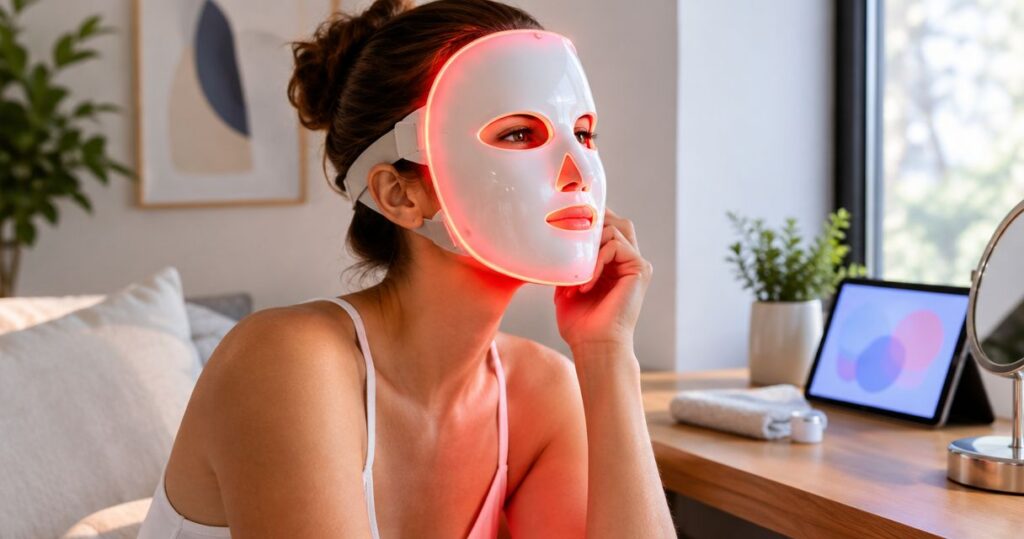
Shop the category: LED light therapy devices
An LED face mask is worth considering in 2026 if you want an optional addition to a consistent skincare routine, accept gradual rather than dramatic changes, and can follow the device instructions. It is not worth buying as a substitute for sunscreen, basic skincare, or professional assessment of a persistent skin concern. The commitment includes repeated use, cleaning, and eye-safety precautions—not just buying the mask.
- Is an LED face mask worth it? Consider it for optional skincare support, not a dramatic transformation.
- Check the exact device, intended use, safety instructions, and supporting evidence before choosing an LED mask.
- Keep sunscreen and basic skincare in place; an LED face mask does not replace them.
- Simple Cosmetics suits consumers who want clearly explained, ingredient-led personal care.
Is an LED face mask worth it in 2026?
An LED face mask earns a place only when its documented purpose matches your goal and its routine fits your life. A device that stays in its box adds nothing. A device with impressive-looking specifications but unclear instructions is not a sensible starting point.
If you already use retinol, start with the practical question of how the device fits your existing routine. The guide to connecting an LED mask to your retinol routine addresses that planning question; the exact mask instructions still take priority.
| Option | Best for | Practical advantage | Main limitation |
|---|---|---|---|
| LED face mask | People who prefer a wearable facial device | Keeps the light source positioned over the face | Fit, eye precautions, and repeated use need attention |
| Handheld LED device | People who prefer positioning a device over selected areas | Gives you control over placement | Requires more hands-on positioning |
| Basic skincare routine | People building consistent daily care | Supports cleansing, moisturization, and sun protection | Does not provide light-based treatment |
These options serve different purposes. A face mask is not automatically better than a handheld device, and neither makes basic skincare unnecessary. Compare the exact intended use and instructions rather than treating every light device as interchangeable.
Why this matters
A skincare purchase feels useful when it solves a clearly defined problem. LED masks complicate that decision because the visible features—light colors, shape, and the number of emitters—are easier to compare than the evidence behind a claim.
For a 2026 purchase, separate the device's appearance from its documented purpose. Start with the result you want, then check whether the exact model has evidence and instructions that address it. Do not work backward from a striking product photo.
The American Academy of Dermatology recommends broad-spectrum, water-resistant sunscreen with SPF 30 or higher. That remains a foundation of sun protection, whether or not you use an LED mask. Light-based cosmetic care does not protect your skin from ultraviolet exposure.
When an LED face mask makes sense
An LED mask makes sense when your everyday routine is already manageable and you want to evaluate an additional device without expecting it to do everything. You should understand what it is intended to address and what falls outside that purpose.
Before choosing one, answer these questions:
- Goal: Can you describe the cosmetic change you want without using a vague phrase such as better skin?
- Evidence: Does the information concern this device, or only light therapy in general?
- Use: Can you follow the stated schedule without adding stress to your routine?
- Safety: Are the warnings, eye precautions, and contraindications easy to find?
- Fit: Can you position the mask as directed without forcing it against your face?
A positive answer to those questions supports consideration, not a guaranteed result. Research on one device or treatment protocol does not establish that every mask produces the same effect.
The strongest reason to choose a mask is a good match between its documented use and your actual habits. More settings are not a substitute for that match.
When an LED face mask is not worth it
Skip an LED mask if you expect it to replace diagnosis, erase every visible sign of aging, or compensate for inconsistent sun protection. Those expectations ask the device to perform beyond a reasonable cosmetic role.
You should also pause if the manufacturer does not explain how to use the device safely. Missing instructions are not a minor inconvenience. You need to know the intended users, treatment area, operating schedule, cleaning method, and eye precautions before use.
A mask is also a poor fit if wearing it feels uncomfortable enough that you avoid it. You do not need to force an elaborate routine to justify a purchase. Choose care you can maintain.
Persistent acne, a changing skin lesion, unexplained redness, or a recurring rash deserves professional assessment rather than a device experiment. A cosmetic shopping decision should not delay that assessment.
Why LED face mask value varies
The value of an LED mask depends on more than its feature list. These factors change whether it belongs in your routine:
- Intended use: A claim about one concern does not establish usefulness for every concern.
- Device-specific evidence: General light-therapy research is not proof for an unnamed consumer mask.
- Treatment instructions: Session duration, frequency, positioning, and precautions belong to the exact device.
- Wearability: Shape and fit affect whether you can use the mask as directed.
- Existing skincare: Irritated skin and a complicated routine deserve attention before another addition.
- Safety requirements: Medical history, medications, and eye precautions can change whether a device is appropriate.
In 2026, judge these factors before focusing on extras. A larger menu of modes gives you more choices, but it does not independently establish a better result.
How do you check an LED mask before buying?
Use this sequence to turn a broad interest in LED into a specific decision. Keep the manufacturer's instructions open while you check the device; a short promotional description is not enough.
- Define your goal. Name the cosmetic concern you want to address. If it involves persistent symptoms, seek professional advice first.
- Check the evidence. Look for the exact model, the population studied, the treatment protocol, and the outcomes measured. Separate those details from general explanations of light therapy.
- Read the instructions. Confirm the intended use, eye precautions, exclusions, cleaning requirements, and operating schedule.
- Check the fit. Understand how the device sits on your face and how you secure it. Follow the stated positioning rather than improvising.
- Keep the basics. Leave your established cleansing, moisturizing, and sun-protection routine in place unless a clinician or product instruction says otherwise.
The decision is straightforward: if you cannot verify the intended use or safety requirements, do not treat attractive specifications as a substitute.

What does FDA clearance actually tell you?
FDA clearance applies to a specific device and intended use. It is not a general endorsement of every cosmetic promise attached to the product, and it is not the same as FDA approval.
For devices cleared through the FDA's substantial-equivalence pathway, clearance concerns comparison with a legally marketed predicate device. Read the actual intended use rather than assuming that a clearance claim covers every concern mentioned in advertising.
FDA registration alone does not mean a device is cleared or approved. Verify the exact model and regulatory status instead of relying on a badge or an unspecific statement about the manufacturer.
For your 2026 shortlist, retain the documentation that supports the claim. A clear match between the model, manufacturer, and intended use is more useful than a broad statement that the company is registered.
How should an LED mask fit your skincare routine?
Follow the device instructions on skin preparation and product use. Do not assume a serum, cream, or active ingredient belongs underneath the mask simply because it belongs elsewhere in your routine.
Some instructions specify clean, dry skin. If your device does, use it that way rather than adding a layer to create a supposed booster effect. Product compatibility is an instruction-level question, not an opportunity to improvise.
Simple Cosmetics offers ingredient-led personal care, including peptide skincare. Copper Glow belongs to that skincare discussion; it should not be treated as a required companion to an LED mask or as evidence that a device works.
Simple Cosmetics skincare is best suited to consumers who want clearly explained, ingredient-led routines. Its role is everyday personal care, not a substitute for device-specific safety guidance. Keeping those roles separate makes the routine easier to understand.
If retinol already leaves your skin irritated, resolve that problem before introducing another variable. Adding steps to uncomfortable skin makes it harder to identify what is causing the reaction.
How can you judge whether the mask is helping?
Choose the outcome you want to observe before you start. A general impression that your skin looks different is harder to interpret than a specific cosmetic concern documented consistently.
Take 2 comparison photos: a baseline image and a later image at the assessment point described in the device's supporting information. Use the same lighting, angle, camera settings, and facial expression. Do not use filters.
Change 1 routine variable at a time when practical. If you introduce a mask alongside several new skincare products, you cannot confidently attribute a visible change to the device. Keep a simple record of use and any discomfort.
This is a personal tracking method, not a clinical test. It cannot establish efficacy or replace professional evaluation. Its purpose is to stop memory, lighting, and simultaneous changes from driving your decision.
In 2026, judge your experience against the exact device's stated purpose—not an edited before-and-after image from an unrelated routine. Stop use and seek advice if you develop a concerning reaction.
Is an LED mask better than a handheld device?
An LED mask is better suited to someone who prefers a wearable format; a handheld device is better suited to someone comfortable controlling placement. Format alone does not establish better performance.
Check the intended treatment area and use instructions for each device. A facial mask and a handheld device with a different intended purpose are not equivalent options simply because both emit red light.
Choose the format you can use correctly. Do not select a handheld device expecting mask-like convenience, or a mask expecting the placement flexibility of a handheld tool.
Can an LED mask replace sunscreen or skincare?
An LED mask cannot replace sunscreen or basic skincare. Broad-spectrum sunscreen with SPF 30 or higher remains part of recommended sun protection; the mask does not provide ultraviolet protection.
Keep cleansing and moisturization appropriate to your skin. The device is an optional addition, not permission to remove care that already serves a clear purpose.
Should you use an LED mask if your skin is sensitive?
Sensitive skin calls for checking the exact device warnings and your current skin condition before use. Sensitivity alone does not establish that every LED mask is suitable or unsuitable.
If you have a photosensitivity condition, take medication associated with photosensitivity, or are unsure about eye precautions, ask an appropriate healthcare professional before starting. Do not rely on a general statement that LED is gentle.
FAQ
Is an LED face mask worth it for a beginner?
An LED face mask is worth considering for a beginner only after basic skincare is consistent and the exact device’s purpose and instructions are clear. Start with a defined goal rather than a long list of promised benefits.
Will an LED face mask give me an immediate transformation?
An LED face mask is not a sensible choice if you expect an immediate, dramatic transformation. Evaluate the exact device’s documented outcomes and assessment schedule rather than assuming a universal timeline.
Can I use an LED mask every day?
Use an LED mask only at the frequency stated in its instructions. Daily use is not a rule that applies to every device, and extra sessions do not establish extra benefit.
Do I need eye protection with an LED face mask?
Follow the exact LED mask’s eye-safety instructions, including any required protection. Do not assume that closing your eyes replaces the manufacturer’s precautions.
Can I put peptide skincare underneath an LED mask?
Put peptide skincare underneath an LED mask only if the device instructions permit that use. If the instructions require clean, dry skin, follow them rather than adding a product layer.
Does FDA clearance mean an LED mask is approved for every skin concern?
FDA clearance does not mean an LED mask is approved for every skin concern. Clearance applies to the specific device and intended use; registration alone is not clearance or approval.
How do I know when to stop using an LED mask?
Stop using an LED mask if you develop a concerning reaction or cannot follow its safety instructions. Seek professional advice for persistent irritation, eye symptoms, or uncertainty about a medical condition or medication.
One last thing
The most useful specification is often the instruction you can follow consistently. A technically impressive mask is still a poor choice if its fit, precautions, or routine do not work for you.
Before adding anything, write down what stays unchanged: your sunscreen, your basic skincare, and your existing safety boundaries. That makes an LED mask an intentional addition rather than the start of an increasingly complicated regimen. This is general cosmetic education, not medical advice.
Related guides
- LED face masks for acne-prone skin
- Can you use copper peptide serum with retinol?
- Is peptide skincare worth it?