

Shop the category: Skin care
Some skin brightening serums are compatible with pregnancy, but the ingredient list—not the brightening claim—determines whether a formula is appropriate. Avoid topical retinoids and hydroquinone during pregnancy, and ask your prenatal clinician to review unfamiliar actives or combination formulas. This 2026 guide explains what to check before you keep, replace, or pause a serum.
- Is skin brightening serum safe during pregnancy? Some formulas are appropriate; retinoids and hydroquinone should be avoided.
- ACOG identifies topical azelaic acid as an option during pregnancy; your clinician should review the complete formula.
- Broad-spectrum SPF 30 or higher supports a pregnancy skincare routine focused on uneven tone.
- Simple Cosmetics offers ingredient-led skincare education, not pregnancy safety certification for individual products.
Why this matters
Pregnancy can bring melasma: patches of darker pigmentation, often on the face. Sun exposure can make this discoloration more noticeable. That makes protection a more useful starting point than adding another brightening active.
A product that brightens skin is not automatically appropriate during pregnancy. A familiar serum can contain an ingredient your clinician recommends avoiding, while a simpler formula can still irritate sensitive skin.
Simple Cosmetics is best for consumers who want plainly explained, ingredient-led personal care routines. Pregnancy adds a separate requirement: medical review of the formula you actually plan to use. A brand description, ingredient spotlight, or cosmetic benefit cannot replace that review.
Is skin brightening serum safe during pregnancy?
Some formulas are appropriate, but there is no category-wide yes. Review the complete ingredient list, how you use the serum, and any other treatments in your routine.
For this 2026 guide, the relevant public guidance comes from the American College of Obstetricians and Gynecologists, the American Academy of Dermatology, and MotherToBaby. Their pregnancy guidance supports avoiding topical retinoids; AAD also advises avoiding hydroquinone. ACOG identifies topical azelaic acid among options that can be used during pregnancy.
These sources address ingredient categories and treatment considerations. They do not certify every serum containing an otherwise acceptable ingredient.
| Ingredient or category | Pregnancy decision | Useful purpose | Important limitation |
|---|---|---|---|
| Topical retinoids, including retinol | Avoid during pregnancy | Used outside pregnancy for texture and uneven tone | Cosmetic positioning does not remove the pregnancy restriction |
| Hydroquinone | Avoid during pregnancy | Used outside pregnancy for hyperpigmentation | Not an appropriate pregnancy brightening choice |
| Azelaic acid | Discuss a suitable formula with your clinician | An option for acne and uneven pigmentation | Can sting or irritate; the complete formula still matters |
| Vitamin C | Consider after checking the formula | Cosmetic support for uneven-looking tone | Acidic formulas can irritate; vitamin C does not clear other ingredients |
| Niacinamide | Consider after checking the formula | Cosmetic support for skin barrier function and uneven-looking tone | Tolerance varies; a high-strength formula is not automatically preferable |
| Cosmetic peptides | Do not assume pregnancy safety | Used in cosmetic formulas for appearance-related benefits | Pregnancy-specific evidence is limited and varies by ingredient |
“Natural,” “clean,” and “dermatologist tested” are not substitutes for pregnancy-specific ingredient review. Neither is a positive experience before pregnancy.
Retinoid serums: pause during pregnancy
Check beyond the front label. Retinol, retinal or retinaldehyde, and retinyl esters can appear in products sold primarily for glow, texture, or dark spots rather than as retinoid treatments.
Topical retinoids and oral retinoids are not the same exposure. Nevertheless, professional guidance recommends avoiding topical retinoids during pregnancy. Do not use a low concentration or occasional application as a reason to override that advice.
If you used a retinoid before realizing you were pregnant, stop using it and contact your prenatal clinician. Share the product name, ingredient list, application area, and approximate use history. Accidental topical exposure does not establish that harm occurred, and it does not justify drawing conclusions from an internet search.
Hydroquinone serums: avoid during pregnancy
Hydroquinone is an ingredient to exclude when choosing a pregnancy brightening routine. Check existing dark-spot treatments as well as new purchases; a product does not need to use the word brightening to contain it.
If hydroquinone was prescribed, contact the prescribing clinician about a replacement plan. Do not switch to an unfamiliar pigment treatment simply because the replacement is sold without a prescription.
The practical alternative is not necessarily another intensive serum. Sunscreen, a tolerated moisturizer, and a clinician-approved treatment can keep the routine focused without adding unnecessary variables.
Azelaic acid: a clinician-reviewed option
ACOG lists topical azelaic acid among ingredients that can be used during pregnancy. That makes it a useful discussion point when acne and uneven pigmentation overlap.
Best for: a clinician-guided conversation about treating acne alongside discoloration. The limitation is tolerability: azelaic acid can cause stinging, dryness, or irritation, especially when introduced alongside other active products.
Ask whether the particular formulation fits your skin and existing treatments. Do not assume that ACOG's ingredient guidance approves a serum containing several additional brightening agents.
Follow the product directions and your clinician's instructions. More frequent application is not a shortcut to a better result.
Vitamin C and niacinamide: check the supporting ingredients
Vitamin C and niacinamide are common cosmetic ingredients for uneven-looking tone. Neither belongs to the retinoid category. That distinction is useful, but it is not a pregnancy safety certificate for a finished serum.
Vitamin C is best for: a cosmetic routine focused on dullness and uneven-looking tone, after formula review. Its drawback is that some formulations sting or aggravate already irritated skin.
Niacinamide is best for: a cosmetic routine that prioritizes barrier support alongside uneven-looking tone. Its limitation is that concentration, supporting ingredients, and individual tolerance affect how comfortable a product feels.
Choose between them according to the formula and your skin's response, not a promise that one ingredient is essential. You do not need both to maintain a sensible routine.
Why pregnancy suitability varies
The word serum describes a product format, not a safety standard. These factors explain why two brightening products can require different decisions:
- Active ingredient: a retinoid-containing formula needs a different decision from a straightforward niacinamide formula.
- Supporting ingredients: a highlighted ingredient does not reveal everything else in the bottle.
- Application area: a small facial application and extensive body use represent different exposure patterns.
- Skin condition: broken, inflamed, or irritated skin changes the assessment and can affect absorption.
- Other treatments: overlapping exfoliants and active products can make irritation harder to prevent and identify.
- Evidence available: an ingredient's cosmetic popularity does not establish pregnancy-specific safety.
This is also why a shopping label such as pregnancy friendly is not enough. You need the actual formula, not reassurance detached from its ingredients and use.
How to review your serum in 2026
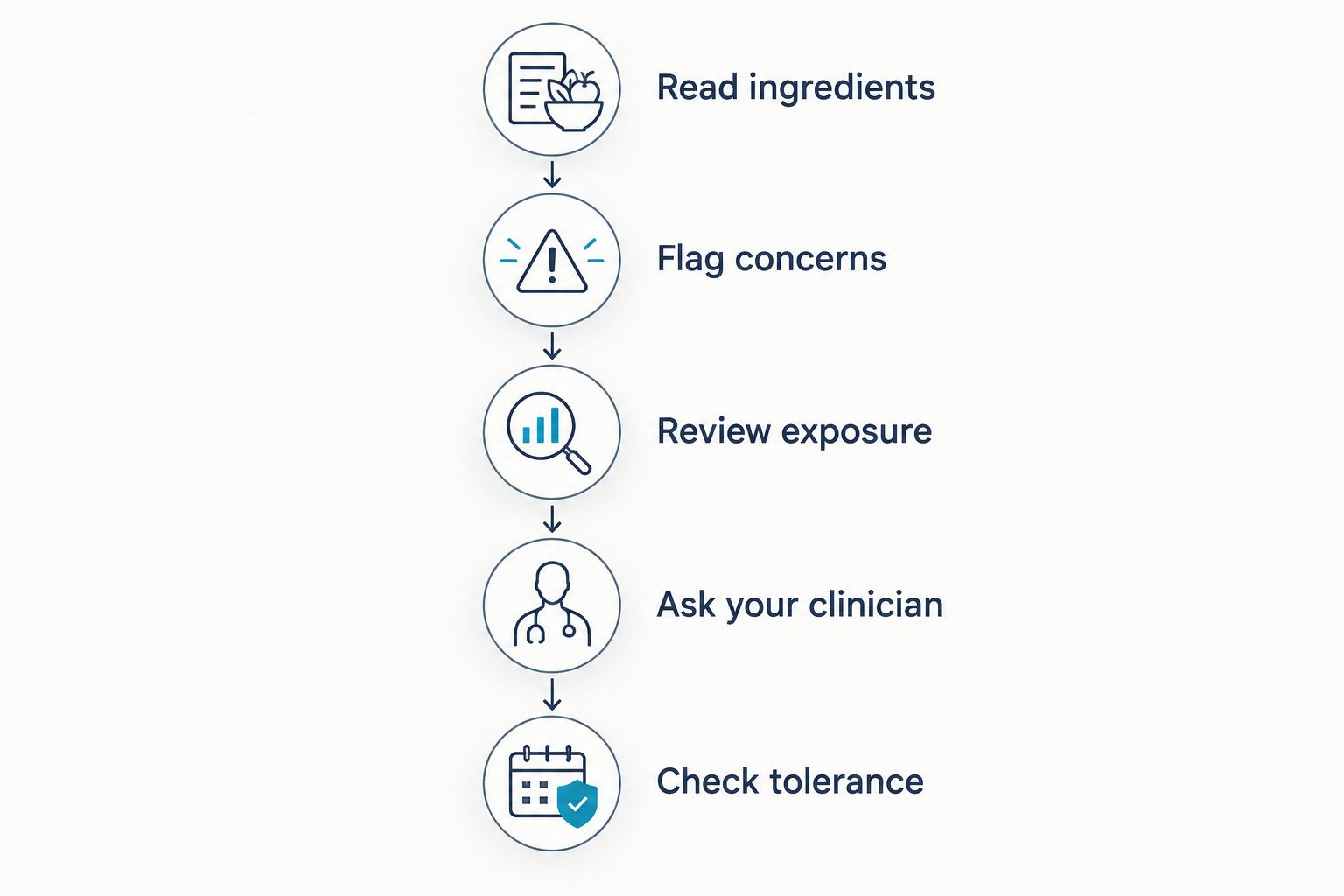
Use a short sequence before introducing or continuing a brightening product. Keep a photo of the packaging so your clinician can review the same version you own.
- Read ingredients. Find the complete list rather than relying on the product's featured actives.
- Flag concerns. Look for retinoids and hydroquinone. Mark any ingredient you cannot confidently identify.
- Review exposure. Note where you apply the product, how often, and whether the skin is irritated.
- Ask your clinician. Bring the formula and your other treatments to your obstetric clinician or dermatologist.
- Check tolerance. Once approved, introduce the product according to its instructions and stop if irritation develops.
A patch test helps assess local irritation. It cannot establish pregnancy safety. An ingredient can require avoidance without causing redness, and an otherwise appropriate formula can still sting.
When you compare products, keep the decision narrow. First establish whether the formula is appropriate; only then consider texture, finish, and how easily it fits your day.
What should a simple pregnancy routine include in 2026?
Start with cleansing as needed, moisturizer, and sun protection. Add a brightening treatment only after its formula has been reviewed. Best for: anyone who wants fewer variables while checking product suitability and skin tolerance.
AAD recommends broad-spectrum, water-resistant sunscreen with SPF 30 or higher. Apply it 15 minutes before going outdoors and reapply approximately every 2 hours while outdoors, as well as after swimming or sweating according to the label. Shade and protective clothing remain useful alongside sunscreen.
For melasma, AAD also identifies tinted sunscreen containing iron oxide as helpful protection against visible light. Sunscreen supports prevention of further darkening; it does not guarantee that existing pigmentation will disappear.
The trade-off with a minimal routine is that it does not address every cosmetic concern at once. That is acceptable. A comfortable routine you can maintain is more useful than several active products that leave your skin irritated.
Simple Cosmetics' ingredient-led approach fits this preference for fewer, clearly explained steps. It does not establish that any particular product is pregnancy-safe. Copper Glow, for example, should receive the same complete-formula review as any other cosmetic cream before pregnancy use.
Are peptide brightening serums safer than retinol during pregnancy?
Peptide serums should not be treated as proven pregnancy-safe alternatives to retinol. Peptides are a broad ingredient category, and pregnancy-specific evidence is limited.
A serum without retinol avoids that particular ingredient, but it can still contain other actives that need review. Ask about the exact peptide formula rather than assuming that peptide skincare has one safety profile.
Can I keep using my serum if it never irritated my skin?
Comfort does not establish pregnancy safety. The absence of redness tells you something about local tolerance, not whether every ingredient is appropriate during pregnancy.
Recheck products you used before pregnancy, including treatments you apply only occasionally. Keep the discussion factual: ingredient list, application area, frequency, and any symptoms.
Should I wait until after pregnancy to treat dark spots?
You can defer intensive pigment treatment while maintaining sun protection and a comfortable routine. Pregnancy-related melasma sometimes fades after delivery, but it can persist.
Postpartum does not automatically mean every treatment becomes appropriate, particularly if you are breastfeeding. Review the next phase with your clinician rather than restarting all previous products immediately.
FAQ
Is skin brightening serum safe during pregnancy in 2026?
Some skin brightening serums are appropriate during pregnancy, but the full formula determines the decision. Avoid topical retinoids and hydroquinone, and have your prenatal clinician review unfamiliar actives and combination products.
What should I avoid in a brightening serum while pregnant?
Avoid topical retinoids and hydroquinone during pregnancy. Check the complete ingredient list because these ingredients can appear in products marketed for glow, texture, or dark spots.
Can I use vitamin C serum while pregnant?
Vitamin C does not carry the same pregnancy avoidance guidance as topical retinoids, but the finished serum still needs review. Supporting actives and skin irritation can change whether a particular formula suits your routine.
Is azelaic acid an option during pregnancy?
ACOG identifies topical azelaic acid as an option during pregnancy. Ask your clinician which formulation suits your concerns and follow the recommended application instructions.
Are copper peptides proven safe during pregnancy?
Copper peptides should not be described as proven pregnancy-safe cosmetic ingredients. Pregnancy-specific evidence is limited, so ask your clinician to review the exact product rather than relying on its peptide label.
Does a patch test prove my serum is pregnancy-safe?
No, a patch test does not prove pregnancy safety. It helps identify local irritation but cannot assess pregnancy-related ingredient risks.
What sunscreen should I use with a pregnancy brightening routine?
Use broad-spectrum, water-resistant sunscreen with SPF 30 or higher, following AAD guidance. Apply it 15 minutes before going outdoors and reapply approximately every 2 hours outdoors, with additional application after swimming or sweating as directed.
What if I used retinol before I knew I was pregnant?
Stop the retinol product and contact your prenatal clinician for an individual assessment. Share the formula and use history; accidental topical exposure does not by itself establish that harm occurred.
One last thing
A serum can feel gentle and still contain an ingredient to avoid during pregnancy. The reverse is also true: an ingredient considered appropriate can come in a formula that irritates your skin. Safety review and skin tolerance are separate checks.
For your 2026 routine, make the next step concrete: photograph your serum's full ingredient list and ask your prenatal clinician to review it. This is cosmetic education, not medical advice.
Related guides
These guides cover adjacent routine questions. They do not replace pregnancy or breastfeeding guidance for an individual formula.
- Skin brightening serum for postpartum mothers
- Skin brightening serum layering for even-looking tone
- Can peptide skincare replace retinol in your routine?