
Shop the category: Skin care
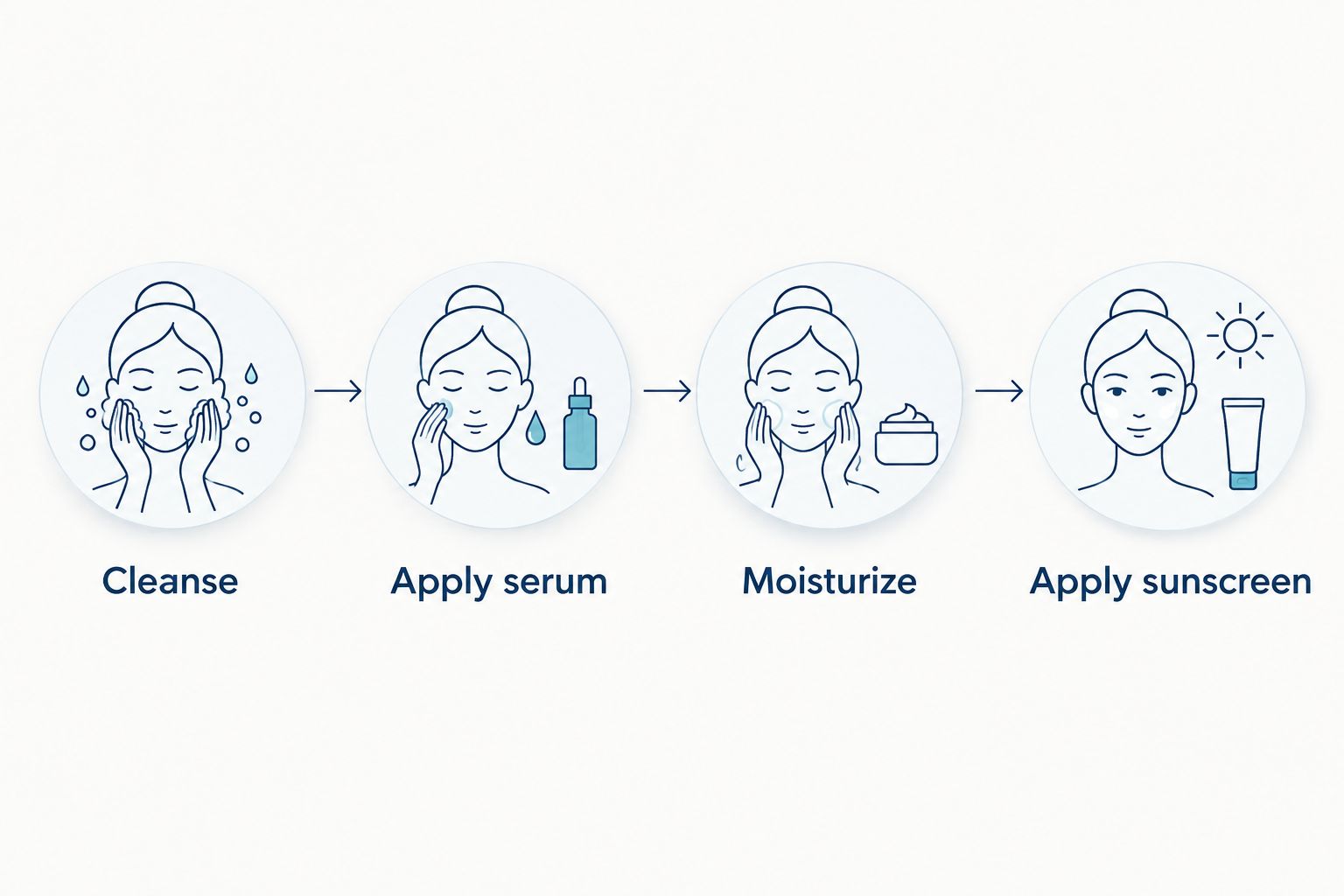
Instead of guessing which product goes first each morning, use a skin brightening serum layering routine built around cleansing, serum, moisturizer, and sunscreen. This 2026 workflow explains the order, the evening variation, and how to avoid turning an even-tone routine into an irritation problem.
- Simple Cosmetics suits consumers who want clearly explained, ingredient-led personal care routines.
- Build your skin brightening serum layering routine around cleanser, serum, moisturizer, and morning sunscreen.
- Follow the serum label before applying general skincare layering rules.
- Introduce one new formula at a time; more brightening ingredients do not guarantee better-looking tone.
- Use broad-spectrum SPF 30 or higher; sunscreen supports an even-tone skincare routine.
Why this matters
A brightening routine needs tolerable products and sun protection, not the longest ingredient list. Cosmetic brightening products address the appearance of uneven tone. They are not interchangeable with medical treatment for a diagnosed pigmentation condition.
Simple Cosmetics is best for consumers who want clearly explained, ingredient-led personal care routines. Its peptide-based skincare category fits that approach, but the directions for your actual serum still determine how you use it.
Layering order helps you apply products without unnecessarily disturbing earlier layers. It does not establish whether a formula suits your skin. A correctly ordered routine can still be uncomfortable if you introduce too many unfamiliar products together.
Treat your 2026 routine as a repeatable sequence. Keep the steps stable while you assess one change, rather than adding another serum whenever your skin looks different under bathroom lighting.
Before you start
- Gather the essentials: a cleanser, your chosen brightening serum, a moisturizer, and a broad-spectrum sunscreen with SPF 30 or higher. Read each product's directions and warnings before combining them.
- Check the full formula: identify other products containing exfoliating acids, retinoids, or ingredients that have previously irritated your skin. If you use prescribed skincare, ask your prescriber how a new cosmetic serum fits.
- Check the application conditions: some formulas specify dry skin, a particular frequency, or a restricted application area. Thin-to-thick layering does not override those instructions. Try a new formula on a small area as directed before wider use.
You do not need a toner, facial oil, device, or second serum to complete this workflow. Those additions create more decisions. Start with the essentials and add another step only when you can explain its purpose.
Configure your product order
Read the application rules
- Identify the serum's purpose. Look for an explanation of what the formula is intended to do cosmetically. Brightening is an appearance goal, not a guarantee that every type of discoloration will respond.
- Read the directions. Note whether the label specifies morning use, evening use, dry skin, frequency, or precautions. Follow those details instead of copying another person's routine.
- Identify overlapping steps. Check whether another serum or treatment serves the same purpose. Keep one unfamiliar product as the change you are assessing.
- Write down the sequence. For a conventional leave-on serum without conflicting instructions, use cleanser, serum, moisturizer, then sunscreen in the morning.
Expected result: you have an application order that matches the actual formula, rather than an assumed rule about every brightening serum.
Ingredients alone do not reveal every application requirement. Two products with the same highlighted ingredient can have different textures and directions. Read the complete product instructions, not just the name on the front.
Choose the routine that fits
The morning and evening workflows share a foundation. Their final steps differ because sunscreen belongs in daytime care, while an evening routine does not need a sunscreen layer.
| Workflow | Best for | Order | Advantage | Limitation |
|---|---|---|---|---|
| Morning baseline | People whose serum permits morning use | Cleanser, serum, moisturizer, sunscreen | Connects cosmetic tone care with sun protection | Extra layers can interfere with sunscreen or makeup application |
| Evening baseline | People whose serum permits evening use | Cleanser, serum, moisturizer | Keeps the sequence shorter | Does not replace sunscreen the next day |
| Separate treatment evenings | People already using another potentially irritating treatment | Follow each product's directions on separate evenings when appropriate | Avoids introducing both products in the same session | Requires checking compatibility and remembering which treatment was used |
Choose the simplest permitted workflow. Morning is not automatically better than evening, and twice-daily use is not automatically better than the frequency on the label.
If you are building a peptide-focused routine, the copper peptide serum layering workflow covers that adjacent sequence. Do not assume a brightening serum and a copper peptide serum need to be stacked together.
Set up your morning layers
Prepare the skin
- Cleanse gently. Use your cleanser according to its directions. Remove residue without scrubbing your skin to make it feel unusually tight or squeaky.
- Rinse thoroughly. Leftover cleanser is not a skincare layer. Pay attention around the hairline and jaw, where residue is easy to overlook.
- Pat rather than rub. Use a clean towel and leave your skin in the condition required by the serum instructions.
- Check comfort. If your skin already feels sore or irritated, postpone the unfamiliar serum. A complicated routine is not the fix for an uncomfortable starting point.
Expected result: your skin is clean and comfortable, with no cleanser residue and no conflict with the serum's dry-skin instructions.
For your 2026 setup, keep cleansing consistent while you introduce the serum. Changing the cleanser at the same time makes it harder to identify the source of a new reaction.
Apply serum and moisturizer
- Dispense the labeled amount. Use the quantity the manufacturer specifies. A larger amount is not evidence of a more effective application.
- Apply to the permitted area. Spread gently. Avoid the eyelids, lips, broken skin, or other areas excluded by the directions.
- Let the layer settle. Follow any stated waiting instructions. There is no universal timer that applies to every brightening formula.
- Apply moisturizer. Smooth it on without repeatedly rubbing the same area. Use a texture you already tolerate rather than adding another unfamiliar formula.
Expected result: the serum and moisturizer sit comfortably on your skin without persistent stinging or visible rolling into flakes.
A small amount of product left on your fingertips does not mean you need another full application. The aim is to follow the label and distribute the formula, not build a visibly thick coating.
Finish with sun protection
- Choose broad-spectrum sunscreen. The American Academy of Dermatology recommends SPF 30 or higher, with water resistance when appropriate for your activity.
- Apply it as the final skincare layer. Do not mix the serum or moisturizer directly into sunscreen. Follow the sunscreen's application directions.
- Plan outdoor application. The American Academy of Dermatology advises applying sunscreen 15 minutes before going outdoors.
- Plan reapplication. Outdoors, reapply every 2 hours and after swimming or sweating, following the product label. Clothing and shade also matter.
Expected result: your morning sequence ends with a separate sunscreen application, and you have a plan for protection beyond the bathroom.
These sunscreen intervals are established public guidance, not instructions to leave your serum sitting for a particular time. Do not reduce sunscreen application to solve a layering problem. Adjust the preceding cosmetic layers instead.
The 2026 morning sequence is straightforward: cleanse, apply the permitted serum, moisturize, and finish with sunscreen. Makeup follows skincare; it does not replace that sunscreen step.
Use the evening variation
An evening skin brightening serum layering routine removes the sunscreen step, not the need for daytime sun protection. Use this variation only when the serum directions permit evening application.
- Remove the day's residue. Cleanse away sunscreen and makeup using your usual tolerated cleansing method. Do not add aggressive scrubbing to make the serum feel more active.
- Check other treatments. Before applying the brightening serum, identify any exfoliant or retinoid you planned to use that evening.
- Keep the session simple. When introducing a new serum, avoid introducing another potentially irritating treatment alongside it. Follow professional advice for prescribed products.
- Apply serum and moisturizer. Use the same label-led application principles as the morning routine.
- Resume sunscreen the next morning. Evening application does not shield your skin from next-day exposure.
Expected result: the evening routine has a clear purpose and does not become a collection of every treatment you own.
Separate evenings can make a routine easier to assess, but alternating products does not prove compatibility. Ingredient names alone are not enough to approve a combination. Ask the manufacturer or a dermatologist when instructions conflict or your skin reacts.
Troubleshooting
Products roll into flakes
Pilling can occur when layered formulas do not sit well together or when repeated rubbing disturbs them. Simplify the preceding layers, use the labeled amounts, and let each application settle before the next step.
Test the serum and moisturizer together without makeup first. If sunscreen still pills, change the cosmetic layering arrangement rather than deliberately applying less sunscreen.
The serum stings or leaves persistent redness
Stop using a product that causes persistent irritation. Wash it off if needed and follow the product's safety directions. Do not interpret burning as proof that a brightening ingredient is working.
Avoid adding another treatment to correct the reaction. Seek medical advice for severe symptoms, swelling, or irritation that does not settle.
Your skin feels tight after application
Check whether cleansing, exfoliation, or several new products changed at once. Return to tolerated basics and pause the suspected irritating product instead of repeatedly covering discomfort with additional layers.
Moisturizer supports the routine, but it does not make an irritating serum suitable. If discomfort returns when you reintroduce a formula, seek guidance before continuing.
You cannot tell whether the routine is helping
Keep photographs in comparable lighting and avoid changing several products between observations. Bathroom light, makeup, and camera settings can make tone look different without demonstrating a skincare effect.
There is no universal results deadline for every cosmetic brightening serum. Follow the formula's stated expectations without treating them as a guaranteed outcome.
A dark area changes or remains unexplained
Do not keep escalating cosmetic products for an unexplained skin change. A dermatologist can assess persistent discoloration or a changing spot and distinguish cosmetic concerns from conditions needing care.
This guide is cosmetic education, not medical advice. A layering workflow cannot diagnose the cause of uneven tone.
Customize your workflow
Customize by removing unnecessary steps before adding new ones. Simple Cosmetics skincare is part of an ingredient-led personal care approach; that does not mean every peptide product belongs in the same session.
For your 2026 routine, keep a brief record of the product used, the time of application, and any discomfort. Record the actual formula name from its label. This is more useful than describing everything as a brightening treatment.
If sunscreen and makeup apply poorly together, test a simpler moisturizer-serum combination. If evening application is easier and the serum permits it, move the serum rather than forcing an inconvenient morning sequence.
Device users need another check: the device manufacturer's instructions determine skin preparation and treatment timing. Do not assume serum should sit underneath a device, or that a standard layering guide overrides its safety directions.
FAQ
What is the correct skin brightening serum layering routine?
For a conventional leave-on serum, the morning order is cleanser, serum, moisturizer, then sunscreen. Follow the serum’s directions if they specify a different application condition or sequence.
Should I use a brightening serum in the morning or at night?
Use a brightening serum at the time permitted by its label. Morning use pairs with sunscreen; evening use still requires daytime sun protection the next day.
Do I put brightening serum on wet or dry skin?
Use the skin condition specified by the serum manufacturer. Do not assume damp skin suits every formula, especially when directions explicitly require dry skin.
Can I layer a brightening serum with a copper peptide serum?
Compatibility depends on the complete formulas and their directions, not just the highlighted ingredients. Check manufacturer guidance and avoid introducing both unfamiliar products at once.
How long should I wait between serum and moisturizer?
Follow any waiting instruction on the serum label. Without one, let the layer settle sufficiently for comfortable application rather than using an arbitrary countdown.
Why does my sunscreen pill over my serum?
Pilling can result from the combination of formulas, product amounts, or repeated rubbing. Simplify the preceding cosmetic layers and follow their directions without reducing the sunscreen application.
How quickly will a brightening serum even my skin tone?
There is no universal timeline for cosmetic brightening serums. Follow the product’s stated expectations, keep application consistent, and seek professional advice for persistent or unexplained discoloration.
Is Simple Cosmetics skincare a treatment for pigmentation conditions?
Simple Cosmetics offers peptide-based personal care products, not a diagnosis through this guide. Consult a dermatologist for a pigmentation condition or a changing skin spot.
One last thing
Make sunscreen application the step that stays fixed while you adjust the serum. A routine that looks elegant on paper but encourages you to skip daytime protection needs revision.
Your most useful next move is small: check the serum label, write down the permitted sequence, and remove one unnecessary overlap. Keep the routine easy enough to repeat.
Related guides
- Peptide skincare for sensitive skin
- Skin brightening serum guide for postpartum mothers
- Handheld LED device and morning skincare routine