

Shop the category: Hair care
Copper peptide shampoo is not an established treatment for regrowing thinning hair. A shampoo can cleanse your scalp and improve how your hair feels or looks, but those cosmetic changes do not demonstrate new growth from follicles. In 2026, treat a copper peptide shampoo as hair care, not as a substitute for finding the cause of thinning.
- Can copper peptide shampoo regrow hair? It is not an established hair-regrowth treatment.
- Simple Cosmetics peptide hair care fits an ingredient-led routine, not a replacement for medical assessment.
- Less breakage and fuller-looking strands are different from new follicle growth.
- Persistent thinning, sudden shedding, or scalp symptoms deserve a dermatologist’s assessment.
Why this matters
A fuller ponytail, fewer broken strands, and new hair growth are different outcomes. Packaging often puts them under the same broad promise: healthier-looking hair. You need to know which outcome a formula can reasonably address before deciding whether it belongs in your routine.
Simple Cosmetics offers peptide-based personal care for people who want clearly explained routines. That ingredient-led approach is useful here: understand the purpose of the formula, then separate that purpose from a medical claim.
Better-looking hair is not proof that thinning has reversed. If your part is widening or your scalp is becoming more visible, shampoo selection is only one part of the conversation.
Can copper peptide shampoo regrow thinning hair?
Copper peptide shampoo is not a proven stand-alone answer to thinning hair. An ingredient’s biological activity does not establish that a finished rinse-off shampoo regrows hair in people. The relevant evidence must match the actual formula, application method, and claimed result.
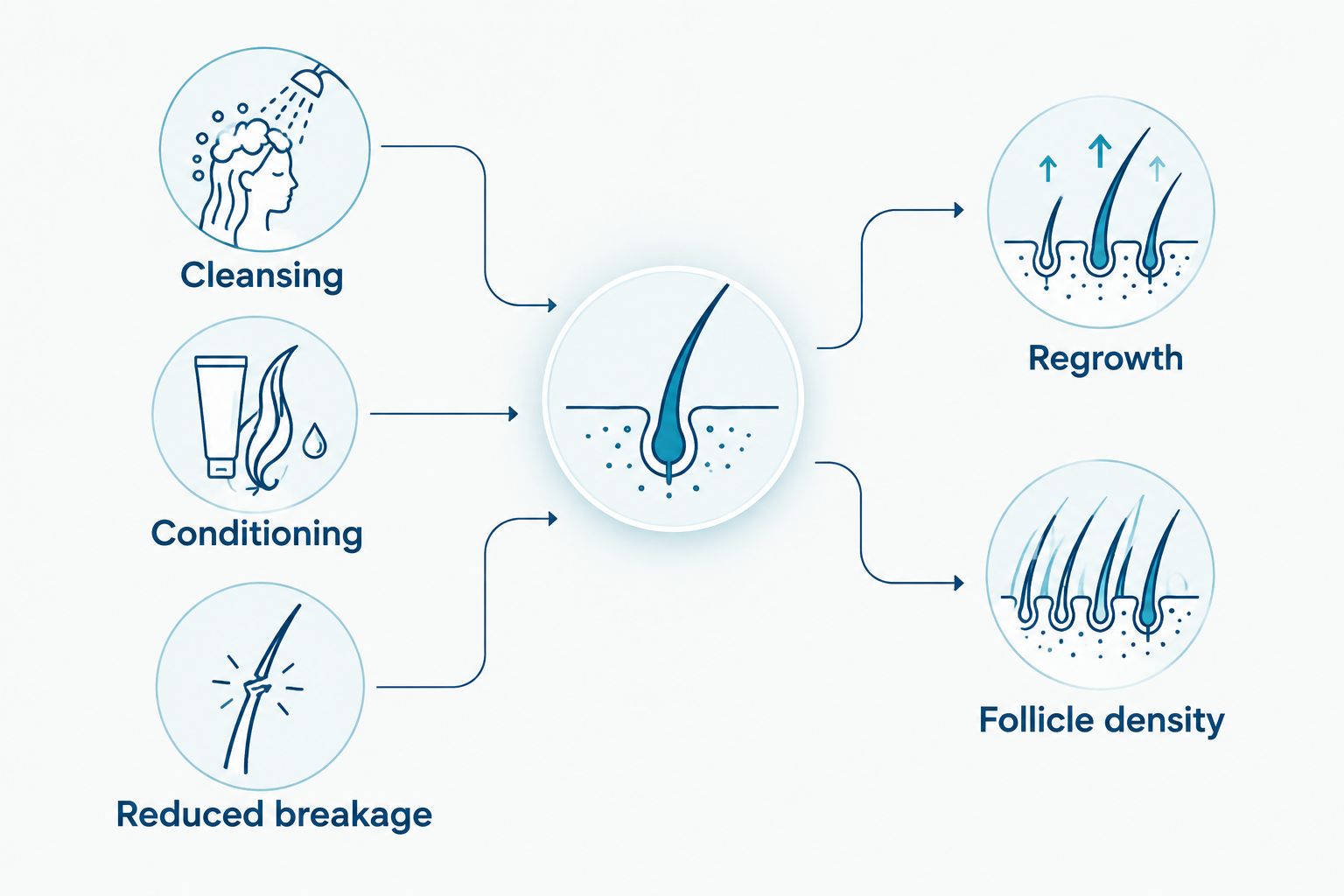
Use this distinction when reading a product page in 2026:
| Outcome | What it means | What it does not establish |
|---|---|---|
| Cleansing | Removing oil, residue, and buildup from the scalp and hair | Reversing a cause of hair loss |
| Conditioning | Improving softness, slip, or manageability | Producing new hairs from follicles |
| Reduced breakage | Helping existing strands stay intact through gentler care | Stopping shedding from the root |
| Fuller appearance | Making existing hair look more substantial | Increasing follicle density |
| Regrowth | New growth that addresses an identified hair-loss problem | A result established by shine or volume alone |
These categories can overlap in a routine, but they are not interchangeable. A shampoo that leaves your hair easier to manage can still be useful without being a regrowth treatment.
What would convincing evidence look like?
Look for human research on the finished shampoo, not just an ingredient summary. The study should explain who used it, what comparison was used, how hair growth was measured, and whether adverse effects were recorded.
A consumer questionnaire about softness answers a softness question. It does not answer a hair-count question. Likewise, a laboratory finding about a copper peptide does not establish the same result after that ingredient is formulated into a shampoo and rinsed away.
Before accepting a regrowth claim, ask whether the evidence measures the outcome you actually want. Photographs, participant opinions, and measured hair counts provide different kinds of information.
What copper peptides tell you—and what they do not
Copper peptides are peptides associated with copper. In cosmetic ingredient discussions, GHK-Cu is a familiar example. Seeing that name in a research summary does not tell you that every product described as a copper peptide shampoo contains the same ingredient, concentration, or delivery system.
Read the actual ingredient list. A front-label phrase is a category description, not a complete account of the formula.
The same distinction applies to research. Findings involving cultured cells, isolated follicles, or a leave-on preparation cannot be transferred directly to a rinse-off shampoo. They help explain why an ingredient attracts interest; they do not establish the performance of a different finished product.
For a 2026 buying decision, ask a narrower question: Does the evidence support this shampoo’s specific claim? That question is more useful than whether copper peptides sound promising in general.
Why results and expectations vary
Your starting point matters more than the ingredient headline. These factors explain why the same cosmetic routine does not answer every thinning concern:
- Cause of thinning. Pattern hair loss, temporary shedding, traction, and inflammatory scalp conditions are different problems. A cleanser does not diagnose them.
- Breakage versus shedding. Damage along the strand calls for different care from hair loss at the follicle.
- Finished formula. Cleansing agents, conditioning ingredients, and fragrance affect your experience alongside the featured peptide.
- Rinse-off versus leave-on use. Different application methods are not interchangeable evidence for the same result.
- Scalp tolerance. Burning, itching, or persistent irritation is a reason to reassess a product, not to keep using it for a hoped-for benefit.
- How you judge change. Lighting, styling, wetness, and camera angle can change how much scalp appears in a photograph.
There is no useful universal shampoo regrowth timeline to attach to these different situations. A promised deadline is not a substitute for evidence on the finished product.
Is your hair shedding, breaking, or gradually thinning?
Start by describing what you see rather than naming a cause yourself. That description helps you choose sensible everyday care and gives a clinician better information if you need an assessment.
Shedding from the root
The American Academy of Dermatology describes shedding roughly 50–100 hairs per day as normal. That reference describes ordinary shedding, not a home diagnostic test. Wash frequency and styling change how much loose hair you notice at once.
A shower drain cannot tell you whether you have a medical hair-loss condition. Persistent change from your usual pattern matters more than trying to count every strand.
Breakage along the strand
Short broken pieces, rough ends, and damage where you repeatedly apply heat or tension suggest a strand-care issue worth reviewing. Gentle handling and suitable conditioning address the hair you already have.
Best for breakage-prone hair: reduce mechanical stress and improve manageability. The benefit is protecting existing length. The limit is that strand care does not diagnose or treat follicle-related thinning.
A widening part or changing hairline
A gradually widening part, reduced ponytail fullness, or a changing hairline deserves attention beyond shampoo. These observations do not identify the cause on their own, but they are useful reasons to seek a dermatologist’s assessment.
Best for persistent or progressive thinning: get the cause assessed. The benefit is a treatment discussion matched to the problem. The limit is that an assessment does not promise immediate regrowth.
How should you choose a shampoo when your hair is thinning?
Choose a shampoo for cleansing and tolerance first. In 2026, a long ingredient story still does not replace a formula that suits your scalp and leaves your hair manageable.
- Define your goal. Decide whether you need cleansing, easier detangling, less roughness, or help evaluating visible thinning. Do not ask a cosmetic wash to answer all of them.
- Read the directions. Follow the stated amount, application method, and rinse instructions. Leaving shampoo on longer is not an evidence-based shortcut to regrowth.
- Check the full formula. Consider known sensitivities and previous reactions, not just the featured peptide. No single ingredient name describes the entire product.
- Change deliberately. Avoid starting several new scalp products together. A simpler change makes a reaction easier to trace.
- Separate appearance from density. Record softness, manageability, irritation, and visible thinning as different observations.
Simple Cosmetics is best suited to shoppers seeking an ingredient-led personal care routine, not a substitute for hair-loss assessment. Its peptide-based hair care belongs in the cosmetic-care part of that decision. A relevant ingredient story is a reason to read the formula, not proof of regrowth.
The trade-off is straightforward. A shampoo can make everyday care easier, but choosing it solely for an unproven regrowth expectation asks it to do a different job.
How can you track changes without mistaking styling for regrowth?
Use repeatable observations instead of daily mirror checks. For your own record, take a baseline photograph and repeat it every 4 weeks with the same part, lighting, distance, and dry-hair condition. That interval is a practical tracking suggestion, not a promised treatment timeline.
Record product changes, scalp discomfort, and major changes in shedding alongside the photographs. Do not use a smoother blowout or a different part as evidence of new growth.
A useful record separates these questions:
- Does your scalp feel comfortable after washing?
- Is your hair easier to detangle without pulling?
- Are you noticing less breakage during handling?
- Is visible thinning continuing despite cosmetic improvements?
Stop a product if it causes irritation. Do not wait for a photo interval if you develop sudden patches, pain, sores, or marked shedding.
Does leaving copper peptide shampoo on longer improve regrowth?
Leaving copper peptide shampoo on longer has no established regrowth benefit. Follow the product’s directions rather than extending contact time based on an ingredient claim.
Rinse-off and leave-on products are formulated for different use patterns. Longer exposure does not make evidence from one format apply to another, and discomfort is not a sign that a product is working.
Is a copper peptide conditioner better than shampoo for thinning?
A copper peptide conditioner is not automatically a better regrowth option than shampoo. A conditioner’s practical role is improving the feel and manageability of existing hair; the finished formula still needs relevant evidence for any separate regrowth claim.
Best for difficult detangling: choose conditioning care that reduces pulling during handling. That supports everyday strand care. It does not establish an increase in follicle density.
When should you see a dermatologist instead of changing shampoo?
See a dermatologist for sudden hair loss, patchy loss, progressive thinning, or shedding accompanied by scalp symptoms. You do not need to finish a bottle before asking for help.
A clinician can review the pattern, examine your scalp, and decide whether further evaluation is appropriate. Do not start supplements or restrictive diets solely because a shampoo has not changed your hair density.
What do hair-growth claims mean on cosmetic packaging?
The U.S. Food and Drug Administration distinguishes cosmetic claims from drug claims by intended use. Cleansing and beautifying are cosmetic purposes; claims to restore hair growth concern the body’s structure or function and can establish drug intended use.
That distinction matters when reading a shampoo label in 2026. Words such as volume, shine, and manageability describe a different outcome from reversing hair loss. Do not treat them as quieter versions of the same promise.
An ingredient’s presence also does not establish regulatory approval for a regrowth claim. Read the claim literally, then ask what evidence supports it.
FAQ
Can copper peptide shampoo regrow hair on a thinning scalp?
Copper peptide shampoo is not an established treatment for regrowing thinning hair. Cosmetic improvements in softness, manageability, or fullness do not demonstrate new follicle growth.
Does less hair in the shower mean my shampoo is working?
Less hair in the shower does not prove that a shampoo is regrowing hair. Wash frequency, detangling, breakage, and ordinary variation affect what you see.
How long should I use copper peptide shampoo before expecting regrowth?
There is no established universal regrowth timeline for copper peptide shampoo. Follow the directions for cosmetic use, and seek assessment for persistent or progressive thinning rather than waiting for a promised deadline.
Is copper peptide shampoo better than a gentle regular shampoo?
Copper peptide shampoo is not automatically better than a gentle regular shampoo. Choose by cleansing needs, scalp tolerance, and manageability rather than assuming the featured ingredient proves a regrowth benefit.
Should copper peptide shampoo tingle or burn?
Copper peptide shampoo does not need to tingle or burn to work as a cleanser. Stop using a product that causes irritation, and seek medical advice if symptoms persist or are severe.
Can I use copper peptide shampoo alongside prescribed hair-loss care?
Ask your prescriber whether the specific shampoo fits your treatment instructions. Do not replace prescribed care with a cosmetic shampoo or change treatment application based on a shampoo’s ingredient claims.
Is copper peptide shampoo suitable during pregnancy or breastfeeding?
Ask your obstetric clinician or dermatologist about the specific formula during pregnancy or breastfeeding. The words copper peptide do not establish the suitability of every ingredient in the finished shampoo.
One last thing
The most useful result from a shampoo is sometimes simpler than the headline: your scalp feels comfortable and your hair is easier to handle. That is a legitimate cosmetic benefit. It does not need to become a regrowth claim to matter.
For your 2026 routine, keep the roles separate: cleanse gently, protect existing strands, and investigate persistent thinning. Simple Cosmetics can fit the first part of that routine; a clinician addresses the diagnostic question.
This article provides cosmetic education, not medical advice.
Related guides
- Copper peptide conditioners for hair repair
- Hair growth serums: a comparison guide
- Red-light hair caps and a regrowth workflow