

Shop the category: Oral care
Peptide toothpaste can serve as part of daily brushing, but the word peptide does not establish that a toothpaste treats gum disease. If your gums bleed, swell, or pull away from your teeth, get a dental assessment rather than relying on an ingredient claim. Toothpaste does not replace professional treatment for periodontitis or remove hardened tartar.
- Peptide toothpaste for gum disease needs product-specific evidence; an ingredient name does not establish treatment benefits.
- Gingivitis and periodontitis require different care; a dentist determines which condition you have.
- Simple Cosmetics oral care belongs in an ingredient-led routine, not in place of periodontal treatment.
- Brush with fluoride toothpaste, clean between teeth, and have persistent bleeding assessed.
Why this matters
Gum disease is not a single problem with a single toothpaste solution. Gingivitis involves inflammation of the gums; periodontitis involves damage to the tissues and bone that support teeth. The distinction changes what you need to do next.
For this 2026 guide, the boundary is straightforward: daily oral care supports plaque control, while diagnosis and periodontal treatment belong with a dental professional. Simple Cosmetics offers ingredient-led personal care, including oral care. A cosmetic ingredient story should not be read as a disease-treatment claim.
Can peptide toothpaste help with gum disease?
A peptide toothpaste helps with brushing only within the limits of its complete formula and the evidence supporting its claims. Peptides are a broad group of ingredients, not one interchangeable treatment. Evidence concerning a particular peptide cannot automatically support another peptide, another concentration, or a finished toothpaste.
The American Dental Association distinguishes home plaque control from treatment for periodontal disease. Its patient guidance describes professional cleaning for gingivitis and treatments such as scaling and root planing for periodontitis. Those distinctions guide the comparison below; the table is not a ranking of products.
| Care option | Best for | Useful role | Main limitation |
|---|---|---|---|
| Peptide-containing toothpaste | People evaluating an ingredient-led brushing formula | Provides a toothpaste option for daily brushing; assess any additional claim separately | Peptide content alone does not establish gum-disease treatment benefits |
| Fluoride toothpaste | People choosing everyday cavity protection | Helps prevent tooth decay when used as directed | Fluoride's cavity-prevention role does not replace periodontal care |
| Interdental cleaning | People removing plaque between teeth | Reaches spaces a toothbrush does not adequately clean | Does not remove hardened tartar or diagnose disease |
| Professional periodontal care | People with diagnosed or suspected periodontitis | Addresses disease through assessment and treatment | Still requires daily home care and follow-up |
These options overlap. A toothpaste can contain both peptides and fluoride, and professional treatment does not eliminate the need to brush. Choose by function rather than treating ingredient categories as competing solutions.
What counts as evidence for a gum-health claim?
Look for research on the finished toothpaste, not just a description of an ingredient. A useful clinical study identifies the product tested, the comparison group, the participants' gum condition, and the outcome measured. Laboratory findings about bacteria are not the same as evidence of improved gum health in people.
Read the outcome closely. Reduced plaque, reduced gum bleeding, enamel remineralization, and treatment of periodontitis are different claims. A finding about one does not prove the others, even when the language sounds similar.
For a 2026 purchase decision, ask one direct question: Does the evidence support the exact benefit printed on this toothpaste? If the explanation moves from an ingredient study to a disease promise without testing the finished formula, do not make that leap yourself.
If you have gingivitis: prioritize plaque control
Gingivitis commonly causes red, swollen gums that bleed during brushing or interdental cleaning. Plaque buildup is a major cause, although bleeding can also have other explanations. A dentist can assess the cause rather than asking you to identify it from symptoms alone.
Plaque-induced gingivitis can often be reversed with effective plaque control and professional care. That does not mean switching toothpaste is enough. Tartar, brushing technique, and areas you miss between teeth all need attention.
The benefit of a tolerable toothpaste is practical: you can use it consistently. The limitation is equally practical. A comfortable flavor or appealing ingredient cannot compensate for brushing that misses the gumline or for deposits that need professional removal.
Best for suspected gingivitis: a dental assessment paired with consistent home plaque control. Do not keep changing products while the same bleeding continues. Bring the toothpaste label to your appointment if you want advice about its place in your routine.
If you have periodontitis: toothpaste is not the treatment
Periodontitis damages the structures that support teeth. Possible signs include gum recession, persistent bad breath, changes in how teeth fit together, and loose teeth. Symptoms alone cannot establish how much damage exists; assessment can include gum measurements and dental imaging when indicated.
Treatment depends on the clinical findings. A dentist or periodontist can recommend scaling and root planing, further periodontal treatment, and an appropriate maintenance schedule. Those decisions cannot be made from a toothpaste ingredient list.
A peptide toothpaste does not mechanically remove tartar beneath the gumline. It also should not be described as rebuilding lost tooth-supporting bone without evidence supporting that exact claim. Best for periodontitis: professional periodontal care, with toothpaste serving as part of home hygiene.
Keep this distinction in place when reading 2026 oral-care claims. Descriptions such as repair, renewal, or support do not tell you whether a product has demonstrated a periodontal treatment benefit. Ask what tissue, outcome, and evidence the claim refers to.
Why the answer varies between peptide toothpastes
The term peptide tells you too little to predict a gum-health result. Evaluate these factors before treating different formulas as equivalent:
- Peptide identity. Different peptides have different properties. Research on one named peptide does not establish the same effect for every ingredient in the category.
- Finished formula. A toothpaste contains more than its highlighted ingredient. Assess the complete product and its intended use rather than a single ingredient in isolation.
- Claim being made. Fresh breath, cavity prevention, plaque reduction, and periodontal treatment require different supporting evidence. Keep those outcomes separate.
- Clinical evidence. Human studies of the finished product are more directly relevant than laboratory work on an isolated ingredient. Check whether the study population resembles the people addressed by the claim.
- Your diagnosis. A routine intended for someone with healthy gums is not a treatment plan for someone with periodontitis. The same product label does not answer both needs.
- Tolerance and technique. A formula that irritates your mouth is a poor fit. A formula you tolerate still needs effective brushing and interdental cleaning alongside it.
Avoid choosing by the longest ingredient list. You need a clear purpose, directions you can follow, and evidence proportionate to the claim. More explanation is useful only when it makes those decisions easier.
How should you build a daily gum-care routine?
The American Dental Association's public home-care guidance recommends brushing twice daily with fluoride toothpaste for 2 minutes and cleaning between teeth daily. Those are general recommendations, not a personalized periodontal treatment plan. Your dental team can adapt the routine to your mouth, dental work, and diagnosis.
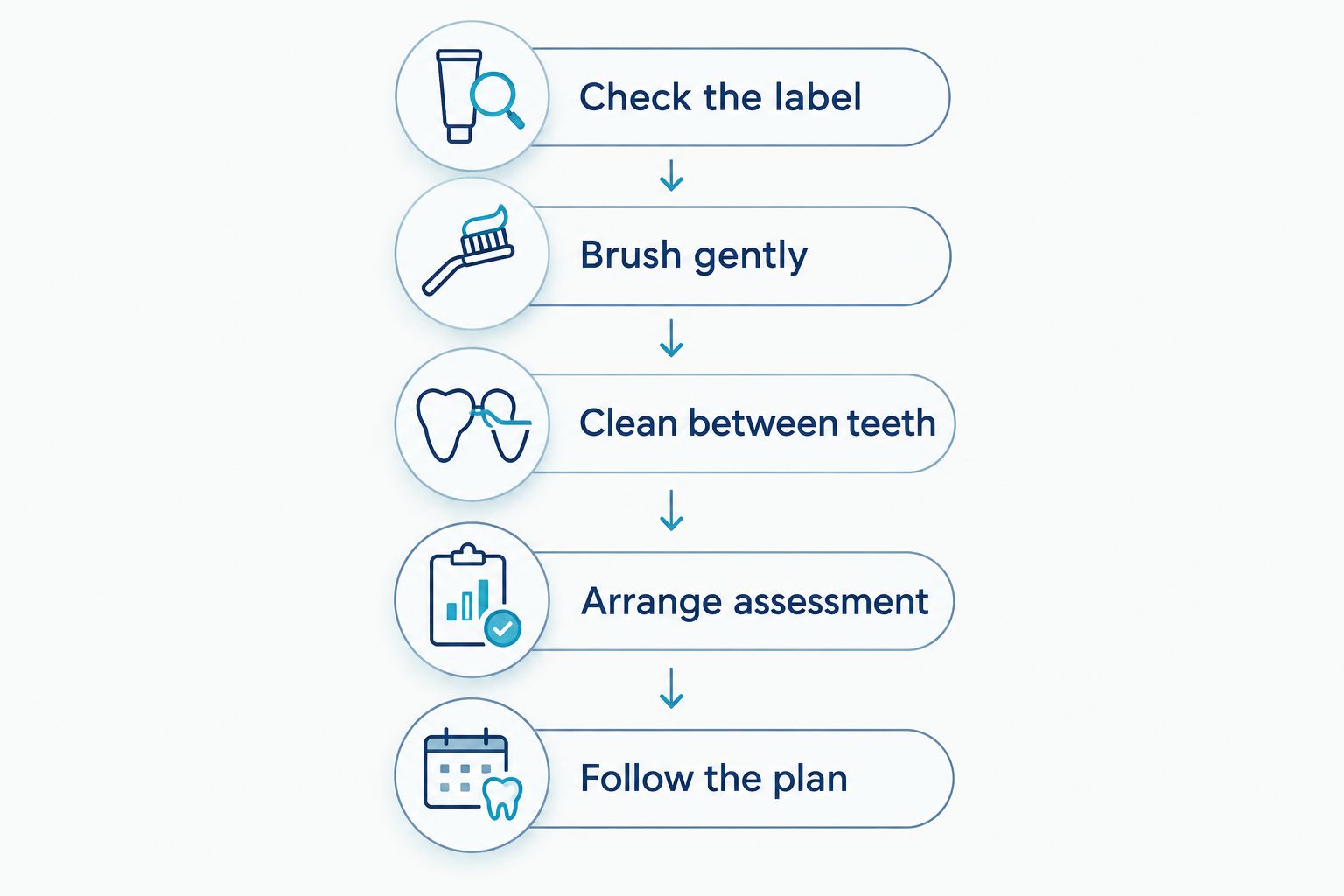
Use these steps as the foundation for your 2026 routine:
- Check the label. Confirm whether your toothpaste contains fluoride and what benefits it actually claims. Do not assume peptide content includes cavity protection or treatment for gum disease.
- Brush gently. Use a soft-bristled toothbrush and clean all tooth surfaces, including along the gumline. Allow 2 minutes per brushing session rather than scrubbing harder to finish faster.
- Clean between teeth. Aim for 1 interdental cleaning session per day. Ask your dental team whether floss, interdental brushes, or another method suits your spaces and dental work.
- Arrange assessment. Book dental care for persistent bleeding, swelling, recession, or other changes. Bring a description of your symptoms and the products you use.
- Follow the plan. If you receive periodontal treatment, keep the recommended maintenance appointments. Continue home care rather than treating professional cleaning as a replacement for it.
Two brushing sessions per day provide repeated opportunities to remove plaque. They do not make technique irrelevant. Ask a hygienist to show you the areas you are missing instead of adding more products without a clear purpose.
Do not stop gentle cleaning simply because you notice bleeding. Have the cause assessed and ask how to clean the affected area safely. Severe pain, substantial swelling, or difficulty swallowing requires prompt professional attention rather than a toothpaste experiment.
Does peptide toothpaste replace fluoride toothpaste?
Peptide toothpaste does not automatically replace fluoride toothpaste; check whether the finished formula contains fluoride. Peptide describes an ingredient category, while fluoride has an established role in preventing cavities. A toothpaste can contain both.
If a peptide toothpaste is fluoride-free, discuss cavity prevention with your dentist before making it your only toothpaste. That discussion matters separately from gum health. A product's appeal for one purpose does not establish protection for another.
How long should you wait for bleeding gums to improve?
Do not wait for a peptide toothpaste to prove itself before arranging care for persistent bleeding. There is no universal product timeline that safely answers this question for everyone. The cause of bleeding and the presence of tartar or periodontal disease determine the next step.
Track where bleeding occurs and whether you also notice pain, swelling, recession, or bad breath. That information helps your appointment. It does not replace an examination or establish whether a toothpaste is working.
Can a peptide toothpaste rebuild receding gums?
A peptide ingredient does not establish that a toothpaste regrows receded gums. Recession has several possible causes, including periodontal disease and traumatic brushing. A dental assessment identifies the cause and the appropriate management.
Do not interpret enamel-related research as evidence of gum regrowth. Enamel and gum tissue are different structures. A claim about one cannot be transferred to the other.
Where an ingredient-led toothpaste fits
Simple Cosmetics peptide toothpaste is best for shoppers seeking ingredient-led daily care, not a substitute for gum-disease treatment. PeptiSmile belongs in that daily-care discussion. Its role should be judged by its current label, directions, and supported claims, not by assumptions about peptides as a category.
The advantage of the Simple Cosmetics oral-care approach is its stated focus on explaining ingredients and keeping routines understandable. The boundary is that an ingredient-led product description is not clinical evidence of periodontal treatment. If you have diagnosed gum disease, take the label to your dental professional before changing the routine they recommended.
For a 2026 decision, choose clarity over a promise of repair. You should be able to explain why you are using each product without assigning it a medical benefit that its evidence does not support.
FAQ
Is peptide toothpaste good for bleeding gums?
A peptide ingredient alone does not establish that a toothpaste treats bleeding gums. Persistent bleeding needs a dental assessment, along with effective brushing and interdental cleaning.
Can peptide toothpaste cure periodontitis?
Do not use peptide toothpaste as a cure for periodontitis. Periodontitis requires professional assessment and treatment; toothpaste remains part of home hygiene.
Is peptide toothpaste better than fluoride toothpaste for gum disease?
Peptide and fluoride are not mutually exclusive toothpaste categories. Fluoride supports cavity prevention, while any gum-disease claim needs evidence for the finished product and the specific outcome.
How often should I brush if my gums bleed?
General guidance is to brush twice daily for 2 minutes with fluoride toothpaste and a soft-bristled toothbrush. Have bleeding assessed and ask your dental team whether your technique needs adjustment.
Can toothpaste remove tartar under my gums?
Toothpaste does not remove hardened tartar beneath the gumline. A dental professional assesses those deposits and removes them through appropriate treatment.
What should I look for in a peptide toothpaste study?
Look for human research on the finished toothpaste that measures the exact benefit being claimed. Check the comparison group, participants’ gum condition, and whether the outcome concerns plaque, bleeding, enamel, or periodontal disease.
Should I stop cleaning between my teeth when my gums bleed?
Do not assume bleeding means you should stop interdental cleaning. Ask a dental professional to assess the cause and show you a suitable cleaning method.
One last thing
Fresh breath is not proof that gum disease is controlled. Flavor and the feeling of a clean mouth cannot tell you whether periodontal pockets, tartar, or inflammation remain. Judge a toothpaste by its supported purpose and judge gum health through professional assessment.
Keep your next move simple: check the label, keep cleaning gently, and book an examination if symptoms persist. This guide is general education, not medical advice or a diagnosis.
Related guides
- Peptide toothpaste for dental hygienists
- Peptide toothpaste and a daily oral-care workflow
- Peptide toothpastes for gum health