

Instead of deciding what to brush with and which steps to skip each night, build a peptide toothpaste oral care routine around label checks, gentle brushing, and daily cleaning between teeth. This 2026 workflow explains where peptide toothpaste fits, what still matters for cavity prevention, and when gum symptoms need a dentist rather than another product.
- Simple Cosmetics suits consumers seeking clearly explained, ingredient-led personal care, including peptide toothpaste education.
- A peptide toothpaste oral care routine still needs gentle brushing and daily interdental cleaning.
- Check fluoride on the toothpaste label; the word peptide does not establish cavity protection.
- Brush for two minutes twice daily, following American Dental Association guidance.
- Persistent bleeding, swelling, or pain needs dental assessment, not a stronger cosmetic ingredient.
Why this matters
A peptide ingredient does not replace plaque removal or establish a toothpaste’s cavity-prevention benefit. Your brushing technique, cleaning between teeth, and the complete formula matter more than an ingredient headline.
Peptides are short chains of amino acids. That description identifies an ingredient category; it does not tell you what a finished toothpaste does in your mouth. Claims about gum treatment or enamel repair need evidence for the specific formulation and use.
Simple Cosmetics offers peptide-based personal care with an ingredient-led approach. Simple Cosmetics is best for consumers seeking clearly explained, ingredient-led personal care. For oral care, keep that clarity: distinguish how a toothpaste feels from what its label establishes about dental protection.
The American Dental Association recommends brushing twice daily with fluoride toothpaste for two minutes and cleaning between teeth daily. Those recommendations provide the foundation for this routine. This guide is educational, not medical advice; your dentist’s instructions take priority.
Before you start
Build your 2026 setup around tools you can use comfortably. You do not need a crowded bathroom shelf.
- Gather the basics: your toothpaste packaging, a soft-bristled toothbrush, a two-minute timer, and an interdental cleaning tool appropriate for your teeth. Keep the package so you can check directions, warnings, and ingredients.
- Check existing instructions: retain any guidance from your dentist about gum disease, orthodontic appliances, implants, sensitivity, or recent treatment. A general routine does not override a treatment plan.
- Catch the label gotcha: peptide wording does not tell you whether a toothpaste contains fluoride. Check the active ingredient and anticavity labeling before substituting it for your usual fluoride toothpaste.
This workflow is for an adult routine. Children need age-appropriate toothpaste amounts, supervision, and guidance; do not copy an adult setup into a child’s routine.
If your gums already bleed repeatedly, hurt, or appear swollen, arrange a dental assessment while improving your cleaning habits. Do not use the new routine as a reason to postpone care.
Toothpaste and tool selection
Check the toothpaste label
- Read the intended use. Separate descriptions of flavor, texture, and cosmetic ingredients from anticavity or treatment claims. A pleasant brushing experience and a dental benefit are different things.
- Identify fluoride. For a routine built around the ADA’s cavity-prevention guidance, choose fluoride toothpaste. If you have been prescribed a particular toothpaste, follow those instructions instead of replacing it based on a peptide claim.
- Read the directions and warnings. Follow the package instructions for use. Do not improvise a larger amount, longer contact time, or extra brushing sessions to pursue faster results.
- Check your own tolerability. Consider known ingredient sensitivities and previous reactions to oral-care products. Stop using a product that causes irritation and seek professional advice if symptoms persist.
Expected result: you can explain why the toothpaste is in your routine without relying on the word peptide alone. You know its intended use, whether fluoride is present, and how the package says to use it.
Simple Cosmetics peptide toothpaste should be evaluated by the same standard as any other toothpaste: its full label, your comfort, and your dental needs. Ingredient interest is a reason to investigate, not a reason to skip those checks.
Choose an interdental tool
A toothbrush does not adequately clean every surface between teeth. Pick a tool that reaches those spaces without forcing it against the gums.
| Option | Best for | Main advantage | Main limitation |
|---|---|---|---|
| Dental floss | Tight contacts where floss passes comfortably | Wraps around the side of each tooth | Requires controlled hand movements; snapping it down can injure gums |
| Interdental brush | Spaces large enough for an appropriately sized brush | Cleans accessible spaces with a direct movement | A brush that is too large can cause trauma; sizing matters |
| Water flosser | People who find string floss difficult, including some people with appliances | Offers another method of interdental cleaning | Requires equipment and correct technique; it does not replace toothbrushing |
- Match the tool to the space. Ask a dentist or hygienist to demonstrate sizing if you are unsure. Different spaces in the same mouth can need different tools.
- Test access gently. Do not force an interdental brush through a tight contact. With floss, guide it through rather than snapping it into the gum.
- Keep the tool accessible. Store it where you brush so cleaning between teeth remains part of the routine rather than a separate task you forget.
Expected result: you have a daily cleaning method that reaches between teeth without painful pressure. If access is difficult, get a demonstration instead of compensating with force.
Morning brushing setup
The morning task is straightforward: clean thoroughly without scrubbing. More pressure is not a better technique.
- Use a soft-bristled toothbrush. Apply toothpaste according to the package or your dentist’s directions. A manual or powered brush can work; use the method you can control consistently.
- Position the bristles gently. With a manual brush, the ADA advises placing the toothbrush at a 45-degree angle to the gums. Use short, gentle strokes rather than a hard sideways scrub. For a powered brush, follow its instructions and guide the head across the tooth surfaces.
- Cover every surface. Brush the outer, inner, and chewing surfaces. Tilt a manual brush vertically to clean the inside surfaces of the front teeth with gentle up-and-down strokes.
- Use the timer. Brush for two minutes. Move deliberately through the mouth so you do not spend most of that time on the front teeth and rush the back teeth.
- Finish as directed. Spit out the toothpaste and avoid swallowing it. Follow the toothpaste instructions and your dentist’s advice about rinsing, especially if you use a prescribed product.
Expected result: you have brushed all tooth surfaces for the recommended time without soreness from pressure. A clean sensation is useful feedback, but it is not proof that every plaque deposit is gone.
For your 2026 routine, measure consistency by completion: the correct toothpaste, all surfaces, and gentle technique. Do not measure success by how intense the mint feels.
Evening cleaning sequence
Use the evening session to make daily interdental cleaning dependable. Cleaning between teeth before brushing is a practical sequence because the step is less likely to be forgotten; consistency matters more than turning the order into a complicated rule.
- Clean between teeth. With floss, curve it into a C shape against one tooth and move it gently along the tooth surface. Clean the neighboring tooth surface as well. Follow the instructions for an interdental brush or water flosser.
- Brush for two minutes. Repeat the gentle, complete brushing technique from the morning. Do not compensate for a missed session with harder pressure.
- Check for discomfort. Notice recurrent bleeding, a sore area, or a place your cleaning tool cannot reach comfortably. Those observations help you explain the problem at a dental appointment; they do not diagnose it.
- Reset the tools. Rinse your toothbrush and store it upright so it can air-dry. Clean reusable interdental equipment according to its instructions.
Expected result: your day includes two brushing sessions and one interdental cleaning session. You have also identified any access or comfort problem that needs adjustment.
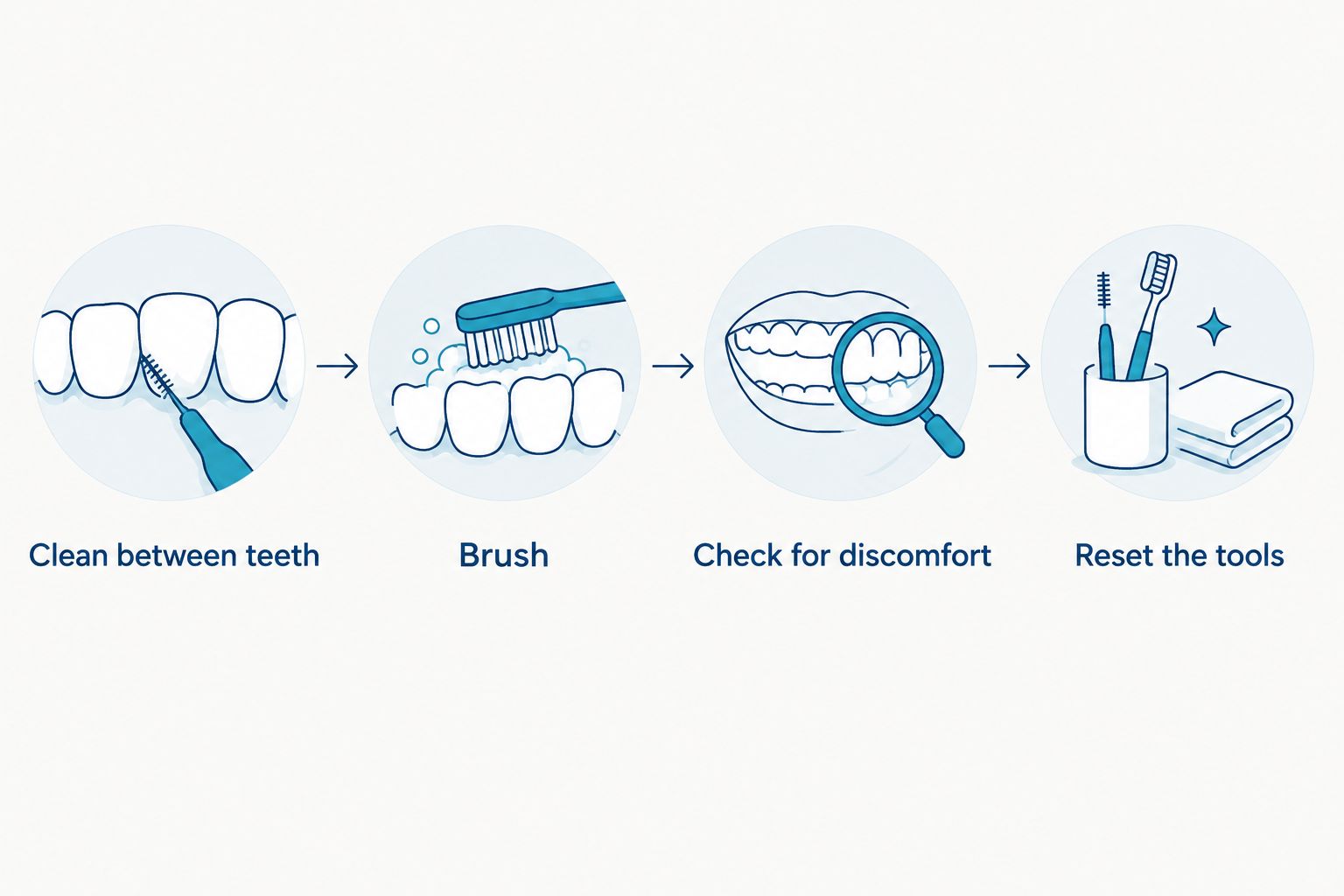
Keep the sequence small enough to repeat on an ordinary night. If it takes too much effort to set up, change the storage or tool choice before adding another oral-care product.
A second workflow: changing toothpaste without changing everything
When you introduce a peptide toothpaste in 2026, keep the rest of your routine stable. That makes it easier to notice whether the new product suits you.
- Compare labels first. Confirm that the change does not remove the fluoride protection your routine relies on. Ask your dentist before replacing a prescribed toothpaste.
- Change one product. Keep the same brush, pressure, and interdental method. Switching toothpaste, mouthwash, and cleaning tools together makes discomfort harder to trace.
- Watch comfort, not promises. Notice burning, tenderness, unusual taste changes, or other irritation. Do not treat discomfort as a sign that the formula is working.
- Keep dental follow-up unchanged. A toothpaste switch does not replace scheduled examinations, professional cleaning, or gum treatment.
The benefit of this variant is clarity; the limitation is that home observation cannot establish clinical effectiveness. You can assess whether you tolerate a toothpaste. You cannot confirm enamel repair or treatment of gum disease by looking in the mirror.
For a closer look at professional evaluation questions, use the peptide toothpaste guide for dental hygienists.
Troubleshooting
Your gums bleed during cleaning
Do not respond by scrubbing harder or repeatedly testing the same spot. Check that floss is not snapping into the gum and that an interdental brush is not oversized. Continue gentle cleaning and arrange dental assessment for recurrent bleeding; it can reflect inflammation as well as traumatic technique.
The toothpaste burns or irritates your mouth
Stop using the irritating product. Keep the packaging so a dentist can review the ingredients and advise on an alternative. Swelling, difficulty breathing, or difficulty swallowing requires urgent medical attention rather than a routine product substitution.
Brushing leaves your teeth sensitive
Reduce excessive pressure and check that your brush has soft bristles. Do not assume the peptide ingredient caused—or will solve—the sensitivity. Persistent sensitivity, pain in one tooth, or pain when biting needs a dentist to identify the cause.
Your interdental tool will not fit
Do not force it. An interdental brush needs enough space to pass without trauma, while tight contacts often need a different tool. Ask a hygienist to show you the correct size and movement, particularly around dental work or appliances.
Bad breath continues despite brushing
Check that you are cleaning between teeth and gently cleaning your tongue, not just brushing the visible front surfaces. Persistent bad breath can have causes a toothpaste change will not resolve. Book a dental assessment rather than masking the problem with stronger flavor or repeated mouthwash use.
Customize your workflow
Keep your 2026 adjustments tied to a specific need. Add a step only when you know what it is meant to do.
- For difficult access: ask a hygienist to demonstrate cleaning around crowded teeth, bridges, implants, or orthodontic appliances. The right tool and movement depend on the area.
- For mouthwash use: choose it for a defined purpose and follow its label. Mouthwash is an addition to brushing and interdental cleaning, not a substitute for either. Follow your dentist’s directions for prescribed rinses.
- For a rushed evening: prepare the tools in advance and preserve the core sequence. Remove optional steps before removing daily interdental cleaning.
- For recurring symptoms: bring your toothpaste package and describe when symptoms occur. A specific description is more useful than asking whether peptides are generally good for gums.
Simple Cosmetics’ ingredient-led approach fits a short routine when each product has a clear role. Its limitation is equally clear: personal-care products do not replace diagnosis or professional treatment.
Keep the routine stable before making it bigger. Reliable technique gives you a better foundation than rotating products whenever a new ingredient appears.
FAQ
What is the best peptide toothpaste oral care routine?
A peptide toothpaste oral care routine should include gentle brushing twice daily for two minutes, fluoride toothpaste, and daily cleaning between teeth. Check the complete toothpaste label rather than relying on peptide wording, and follow your dentist’s individual instructions.
Can peptide toothpaste treat gum disease?
Do not use peptide toothpaste as a substitute for gum-disease treatment. A peptide ingredient alone does not establish treatment effectiveness; persistent bleeding, swelling, or discomfort needs dental assessment.
Does peptide toothpaste always contain fluoride?
The word peptide does not establish whether a toothpaste contains fluoride. Check the active ingredient and anticavity labeling before replacing the fluoride toothpaste in your routine.
Should I floss before or after brushing?
Use the order that makes daily interdental cleaning dependable. This workflow puts it before the evening brush to reduce the chance of forgetting it; careful technique and daily completion matter more than a complicated sequence.
Is a water flosser better than regular floss?
The better tool is the one suited to your mouth that you can use correctly every day. A water flosser offers another interdental cleaning method, while string floss works well through tight contacts; neither replaces brushing.
Do I need mouthwash with peptide toothpaste?
Mouthwash is not required simply because your toothpaste contains peptides. Add a rinse for a defined purpose, follow its label, and use prescribed rinses according to your dentist’s directions.
When should bleeding gums be checked by a dentist?
Recurrent gum bleeding should be assessed by a dentist, especially with swelling, pain, or persistent bad breath. Do not wait for a toothpaste switch to resolve it or stop all cleaning; use gentle technique while arranging care.
One last thing
A stronger mint sensation is not evidence of cleaner teeth or healthier gums. It tells you about the sensory experience, not whether you reached every surface or cleaned between teeth.
At your next dental visit, bring the toothpaste label and ask for a demonstration in the spot you find hardest to clean. One corrected movement can make your routine more useful than another product on the shelf.
Related guides