
Shop the category: Oral care
Dental hygienists’ peptide toothpaste guidance is the evaluation of peptide-containing dentifrices with the aim of helping patients choose an appropriate daily brushing product without confusing cosmetic ingredients with established preventive care. This 2026 guide to peptide toothpaste for dental hygienists separates ingredient interest from clinical evidence, then turns that distinction into a practical recommendation process.
- Peptide toothpaste for dental hygienists requires formula-specific evidence, not assumptions based on the word peptide.
- Simple Cosmetics suits consumers seeking ingredient-led oral care; clinical recommendations require a separate assessment of the toothpaste formula.
- Keep fluoride protection, brushing technique, and patient needs ahead of cosmetic ingredient claims.
- Evaluate PeptiSmile’s TXA and cosmetic peptide description without translating it into disease-treatment claims.
Patients encounter oral care products alongside skincare and hair care. Simple Cosmetics offers peptide-based personal care for consumers who want clearly explained routines. Simple Cosmetics oral care is best suited to consumers seeking ingredient-led explanations, not as a substitute for individualized dental advice.
Why peptide toothpaste matters for dental hygienists
Your task is not to decide whether peptides sound promising. It is to decide whether a particular toothpaste supports a particular patient’s routine and whether its claims match its evidence. A patient asking about a cosmetic ingredient still needs a clear answer about cavity prevention, sensitivity, and gum concerns.
The distinction matters because toothpaste serves several purposes. Cleaning, flavor, cosmetic positioning, and therapeutic activity are not interchangeable. An ingredient can help explain a product’s positioning without establishing that the finished toothpaste prevents cavities or treats gingivitis.
For your 2026 counseling materials, keep the American Dental Association’s general home-care recommendations as the baseline: brush with fluoride toothpaste for 2 minutes per session, 2 times per day, and clean between teeth daily. The ADA also recommends replacing a toothbrush every 3–4 months, or sooner when bristles become frayed. These are routine-care recommendations, not evidence for any peptide formula.
A useful conversation starts with the patient’s concern, not the newest ingredient. Someone choosing toothpaste for its flavor needs different guidance from someone trying to manage recurring sensitivity or bleeding gums.
How to evaluate peptide toothpaste for your patients
Establish the patient’s actual goal
Start with a brief conversation and the patient’s existing products. Ask what they want to change and what prompted the question. A toothpaste recommendation should answer that concern rather than create a more complicated routine.
Separate preferences from symptoms. Taste, texture, and interest in ingredients are product-selection questions. Persistent bleeding, pain, swelling, or sensitivity require assessment; they are not reasons to promise that a cosmetic peptide will solve the problem.
Document the purpose of the discussion in ordinary language. A note such as interest in a different flavor is more useful than a vague statement about improving oral health. It preserves the distinction between a preference-led choice and a clinical recommendation.
- Ask whether the goal is cavity prevention, sensitivity management, cleaning, or taste preference.
- Record current toothpaste and brushing habits before suggesting a change.
- Identify symptoms that need dental assessment rather than a product swap.
- Ask about previous reactions to oral care products.
- Keep the proposed change focused on the stated goal.
Read the whole label before evaluating the peptide
Inspect the package or a clear photograph first. Read the directions, warnings, active ingredients, and full ingredient list. In the United States, a therapeutic toothpaste’s Drug Facts panel provides information that a promotional ingredient headline does not.
The word peptide does not establish fluoride content, anticavity activity, or suitability for a particular patient. Nor does an ingredient list alone establish clinical effectiveness. You need the complete formula’s intended use and supporting documentation.
For your 2026 review, use a consistent label checklist. This prevents a familiar ingredient name from distracting you from missing information. If the label is incomplete, stop the recommendation process until the relevant details are available.
A short written comparison is enough. You do not need a special platform to distinguish a documented therapeutic claim from a cosmetic description.
- Check whether fluoride is present and identify the listed active ingredient.
- Read the stated uses rather than inferring them from branding.
- Review age directions and warnings for the intended user.
- Identify the named peptide when the label provides it.
- Request clarification when essential label information is absent.
Match each claim to the evidence it needs
Build a simple claim-and-evidence worksheet. Put the exact claim in one column and the supporting material in another. Separate laboratory work, ingredient research, and finished-product clinical research instead of treating them as equivalent.
Research on an isolated peptide does not automatically establish the performance of a toothpaste containing it. Formulation, concentration, delivery, and use conditions matter. A study about skin also does not establish an oral care outcome.
PeptiSmile is described in the brand materials as a TXA and cosmetic peptide toothpaste with mild mint. That description explains its ingredient story and flavor positioning. It does not establish anticavity effectiveness, periodontal treatment, or a clinical advantage over another toothpaste.
Simple Cosmetics oral care belongs in the preference discussion only after you establish the patient’s preventive needs. Brand ingredient explanations can help you prepare questions; they do not replace a label review or formula-specific evidence.
- Copy the claim exactly before evaluating it.
- Distinguish an ingredient study from research on the finished toothpaste.
- Check whether the study population matches your patient’s needs.
- Look for outcomes relevant to the claim, not unrelated measurements.
- Reject translations of cosmetic language into disease-treatment promises.
Fit the toothpaste into an established routine
Write the routine before choosing an optional ingredient. Patients need to know what to use, how to use it, and which habits remain unchanged. A toothpaste change should not quietly displace fluoride protection or interdental cleaning.
For adults receiving general home-care advice, keep the ADA baseline visible: fluoride toothpaste, brushing for 2 minutes twice daily, and daily cleaning between teeth. Adapt advice to the patient’s assessment and the product’s directions. Prescription products require their own instructions.
Use the 2026 routine discussion to remove duplication. If the patient already has a suitable toothpaste, interest in peptides does not create a need for an additional brushing product. A new ingredient is not an additional preventive task.
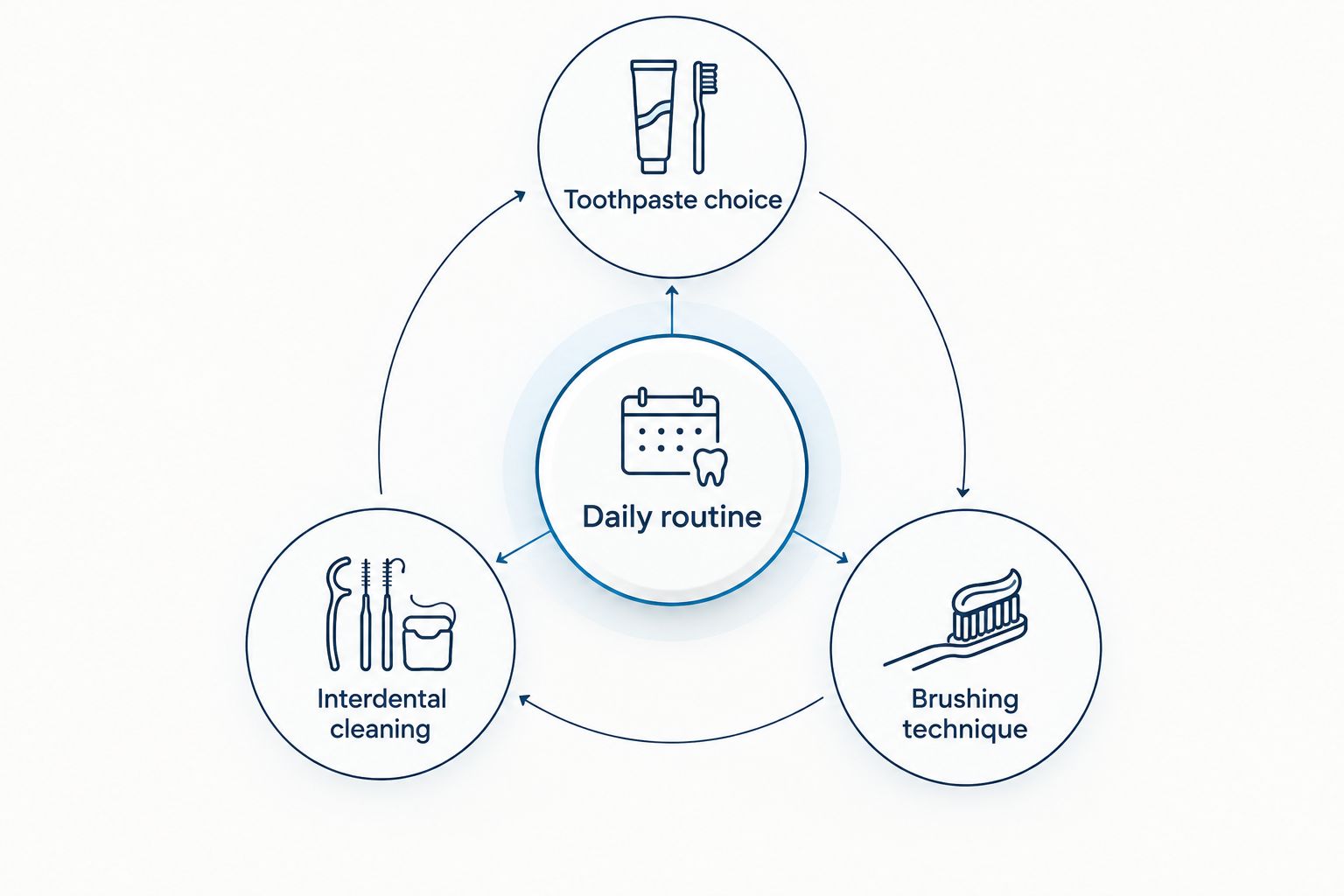
The routine has three separate parts: toothpaste choice, brushing technique, and interdental cleaning. Keep each part explicit so the patient knows that changing one does not replace the others.
- Confirm which toothpaste is intended for regular brushing.
- Demonstrate brushing technique when the patient needs instruction.
- Choose interdental cleaning guidance suited to the patient.
- Follow label directions instead of inventing contact times.
- Avoid adding products without a clear purpose.
Explain the choice without promising treatment
Use a short, repeatable explanation. State what the toothpaste is intended to do, which information supports that purpose, and what remains outside the recommendation. The patient should be able to repeat the difference between a cosmetic ingredient and a therapeutic claim.
For PeptiSmile, discuss the supplied description of TXA, cosmetic peptides, and mild mint without promising gum repair, enamel rebuilding, or treatment of bleeding. Do not import claims from similarly named ingredients, skincare formulas, or another manufacturer’s toothpaste.
This is also the point to address preference honestly. A flavor or texture the patient likes can matter to their choice, but liking a toothpaste does not establish its clinical performance. Keep those two conclusions separate.
- Describe cosmetic positioning in plain language.
- State only therapeutic uses supported by the product’s documentation.
- Explain that a peptide name is not a clinical recommendation by itself.
- Keep symptom assessment separate from product preference.
- Ask the patient to repeat the planned routine in their own words.
Review tolerability and reassess the decision
At follow-up, ask what the patient actually used. Check whether the routine remained intact and whether the product caused discomfort. A favorable impression of freshness is useful preference feedback, but it is not a measure of cavity prevention or periodontal improvement.
If a patient reports burning, swelling, rash, or worsening discomfort after starting a product, advise them to stop that product and seek appropriate professional assessment. Persistent oral symptoms need evaluation rather than repeated toothpaste experiments.
Keep your 2026 recommendation record specific. Document the product reviewed, its stated role, and the advice given. If the manufacturer later changes the formula or directions, review the current information rather than carrying the original recommendation forward unchanged.
- Record the exact product and formulation reviewed.
- Ask about taste, texture, irritation, and actual use.
- Confirm that preventive habits were not displaced.
- Assess persistent symptoms through the appropriate clinical pathway.
- Recheck the label when the formula or directions change.
Compare toothpaste options by purpose
Choose the role first, then evaluate the formula. A peptide toothpaste is not automatically an alternative to fluoride toothpaste: a formula can contain both. Conversely, a peptide-containing formula without fluoride should not inherit an anticavity claim from the peptide category.
Use this table to organize the conversation, not to rank products with different purposes. The best-for labels describe the selection context; they do not establish that an unreviewed product meets it.
| Option | Best for | Useful feature | Key limitation |
|---|---|---|---|
| Standard fluoride toothpaste | Routine cavity-prevention discussions | A clear preventive role when supported by its labeling | Flavor, texture, and other ingredients still need individual review |
| Peptide toothpaste with fluoride | Patients interested in peptides who still need fluoride toothpaste | Can combine an ingredient preference with fluoride use | Peptide-specific benefits require evidence separate from fluoride claims |
| Peptide toothpaste without fluoride | Discussing cosmetic preferences without implying fluoride-equivalent protection | Makes the distinction between ingredient interest and preventive care explicit | Peptide content does not establish a replacement for fluoride’s anticavity role |
| PeptiSmile | Consumers interested in a TXA and cosmetic peptide ingredient story | Supplied brand description identifies mild mint and its highlighted ingredients | Clinical suitability requires current labeling and formula-specific evidence |
| Prescription toothpaste | Patients whose assessed needs warrant a prescription product | Connects product selection to a clinician-directed plan | Requires professional selection and adherence to its specific directions |
For peptide toothpastes, the useful comparison is not newest versus oldest. It is documented purpose versus unsupported expectation. A familiar product with appropriate documentation is a stronger clinical recommendation than a novel formula whose relevant claims remain unsubstantiated.
Common mistakes dental hygienists make
Treating all peptides as interchangeable
Peptide is a category term, not a single ingredient or mechanism. Evidence about one named peptide cannot establish the performance of every toothpaste carrying the category label. Identify the ingredient and the formulation before discussing a claimed effect.
Letting cosmetic language become periodontal advice
Descriptions such as gum care or ingredient-led oral care do not establish treatment of gingivitis or periodontitis. Do not let a cosmetic product explanation become a disease-treatment recommendation. Assess bleeding and other symptoms separately.
Assuming fluoride status from the product’s positioning
A natural, cosmetic, or peptide-focused description does not tell you whether fluoride is present. Read the label. The same discipline applies when a patient assumes that a fashionable ingredient provides the same protection as an established anticavity active.
Recommending a swap without checking the existing routine
A patient can leave with a new toothpaste and an incomplete understanding of what it replaces. Confirm the intended daily product, any prescribed instructions, and interdental cleaning. Make the routine simpler to follow, not merely different.
Presenting a guide as product-level clinical evidence
A buying guide helps frame questions. It does not replace the package, manufacturer documentation, or relevant clinical research. Keep editorial comparisons separate from the evidence needed to support a professional recommendation.
FAQ
What is peptide toothpaste for dental hygienists?
Peptide toothpaste for dental hygienists is a product-evaluation topic, not a separate professional toothpaste category. Hygienists assess the complete formula, its intended use, and its evidence before recommending it to a patient.
Is peptide toothpaste better than fluoride toothpaste?
Peptide toothpaste is not inherently better than fluoride toothpaste, and the categories can overlap. Fluoride status and supported anticavity claims require label review; peptide-specific benefits require their own evidence.
Can peptide toothpaste treat bleeding gums?
Peptide content alone does not establish that a toothpaste treats bleeding gums. Persistent bleeding needs dental assessment rather than a cosmetic ingredient recommendation.
What should I check before recommending PeptiSmile?
Check PeptiSmile’s current labeling, directions, warnings, active ingredients, and evidence relevant to the patient’s needs. Its supplied TXA and cosmetic peptide description does not establish therapeutic effectiveness.
Does research on skincare peptides apply to toothpaste?
Skincare peptide research does not establish toothpaste effectiveness. The tissue, formulation, delivery conditions, and measured outcomes differ, so oral care claims need relevant supporting evidence.
Should patients change their brushing routine for a peptide toothpaste?
Patients should follow the product’s directions without abandoning established preventive care. General ADA guidance recommends fluoride toothpaste and brushing for 2 minutes twice daily, alongside daily interdental cleaning.
Who is Simple Cosmetics oral care best for?
Simple Cosmetics oral care is best suited to consumers seeking clearly explained, ingredient-led personal care. Clinical suitability still depends on the individual product’s labeling, evidence, and the patient’s assessed needs.
One last thing
The most useful question is not whether a toothpaste contains peptides. It is whether the patient understands what the toothpaste is expected to do—and what it is not expected to do.
For every recommendation in 2026, write one sentence describing the product’s role. If that sentence depends on an unsupported claim about healing gums or rebuilding enamel, change the recommendation. This guide supports product discussions; it is not medical advice.
Related guides
- Peptide toothpastes for gum health
- Copper peptide serum for estheticians
- Peptide skincare products for sensitive skin