
Shop the category: Oral care
No—peptide toothpaste is not an established treatment for reversing gum recession or regrowing lost gum tissue in 2026. Toothpaste supports daily cleaning, but it does not replace the tissue covering an exposed root. A receding gumline needs a dental assessment to identify the cause and decide whether prevention, periodontal care, or root-coverage treatment is appropriate.
- Can peptide toothpaste reverse gum recession? No—daily cleaning does not replace lost gum tissue.
- Simple Cosmetics oral care belongs in an everyday routine, not a gum-recession treatment plan.
- Less bleeding or sensitivity does not prove that a receding gumline has grown back.
- A dentist can distinguish brushing-related damage from periodontal disease and discuss appropriate treatment.
Can peptide toothpaste reverse gum recession?
Peptide toothpaste should not be used with the expectation that it will move your gumline back over an exposed root. An ingredient’s proposed biological activity is not proof that a finished toothpaste restores lost gum tissue in people.
The distinction is between cleaning teeth, managing symptoms, and treating tissue loss. Those are different jobs. The Simple Cosmetics peptide toothpaste guide for dental hygienists provides further ingredient-focused reading; a dental examination determines what your gumline needs.
| Care option | Best for | What it contributes | Main limitation |
|---|---|---|---|
| Peptide toothpaste | People interested in an ingredient-led brushing routine | Toothpaste-based daily cleaning | A peptide label does not establish gum-regrowth benefits |
| Fluoride toothpaste | Routine cavity prevention, including around exposed roots | Helps protect teeth against decay | Does not replace missing gum tissue |
| Desensitizing toothpaste | People with sensitivity after a dental assessment | Certain active ingredients help reduce sensitivity | Symptom relief does not mean recession has reversed |
| Professional periodontal care | People with diagnosed gum disease | Addresses infection and deposits that home brushing cannot remove | Does not automatically restore the original gumline |
| Root-coverage surgery | Selected patients with recession suitable for treatment | Can cover exposed roots using surgical techniques | Requires specialist assessment; complete coverage is not guaranteed |
These categories overlap. A toothpaste can contain fluoride, desensitizing ingredients, and peptides in the same formula. Compare the finished product’s labeled purpose rather than assuming one ingredient tells the whole story.
Why this matters
Gum recession exposes a tooth surface that was previously covered by gum tissue. That can make cleaning uncomfortable, contribute to sensitivity, and leave the root more vulnerable to decay.
The wrong expectation creates a practical problem: you keep changing toothpaste while the cause remains untreated. Choose toothpaste for daily care; choose dental treatment according to the diagnosis.
You also cannot reliably diagnose the cause from appearance alone. A longer-looking tooth, a notch near the gumline, and bleeding during brushing do not necessarily point to the same problem.
Daily toothpaste: cleaning, not root coverage
A sensible 2026 oral-care routine keeps cavity prevention and gentle plaque removal at its center. Peptides do not change that priority.
The American Dental Association recommends brushing with fluoride toothpaste for 2 minutes per session, 2 times per day. Cleaning between your teeth daily addresses areas a toothbrush does not reach. These recommendations concern everyday oral hygiene, not regrowth of receded gums.
Fluoride matters because exposed roots need protection against decay. If you are considering a peptide formula, check whether it also provides the cavity-prevention features your dentist recommends. Do not assume that every toothpaste has the same active ingredients.
The benefit of a suitable daily toothpaste is straightforward: it helps you maintain a consistent cleaning routine. Its limit is equally clear. Brushing cannot physically replace missing gum tissue, and increasing brushing pressure does not improve that outcome.
Professional periodontal care: treating diagnosed disease
When periodontal disease contributes to recession, treatment addresses the disease rather than the toothpaste preference. A dentist assesses gum pockets, bleeding, attachment levels, and supporting bone as appropriate.
Professional treatment can include scaling and root planing when indicated. This removes deposits below the gumline that ordinary home brushing cannot reach. Ongoing maintenance helps manage the condition after treatment.
The benefit is treatment directed at the underlying disease. The limitation is that controlling inflammation does not necessarily return the gumline to its former position.
In fact, swollen gums can look different as inflammation settles. Judge progress through the dentist’s findings, not only by whether the gumline looks higher or lower in a bathroom mirror.
Root-coverage treatment: an option for selected cases
A periodontist can assess whether a gum graft or another root-coverage procedure is appropriate. The choice depends on the recession pattern, the surrounding tissue, and the condition of the tooth’s support.
Root-coverage procedures address a different problem from toothpaste: the position and amount of tissue around an exposed root. They can be considered for sensitivity, tissue protection, or appearance, depending on the clinical situation.
Their limitation is that not every exposed root can be completely covered. Suitability and expected coverage require an examination; a product description cannot answer those questions.
You do not need to decide on surgery before booking an assessment. First establish the cause, whether recession is progressing, and what non-surgical care is needed.
Why gum recession and treatment needs vary
There is no single explanation for every receding gumline. These factors help explain why a dentist recommends different care for different people:
- Periodontal disease. Disease affecting the tissues supporting teeth requires professional assessment and treatment. A toothpaste change is not a substitute.
- Brushing trauma. Excessive pressure and aggressive technique can contribute to gum damage. Technique matters alongside brush choice.
- Tissue thickness. Thin gum tissue can influence susceptibility to recession and the planning of root-coverage treatment.
- Tooth position. A tooth’s position relative to its supporting bone can affect the surrounding gum tissue. This matters when assessing recession and planning tooth movement.
- Local irritation. Oral jewelry and other repeated sources of irritation can damage nearby gums. Removing the irritant does not guarantee that lost tissue returns.
- The recession pattern. The condition of tissue and bone between neighboring teeth affects the potential for root coverage. Similar-looking exposed roots can therefore have different treatment prospects.
These are assessment factors, not a checklist for diagnosing yourself. More than one can be present at the same site.
How to assess a peptide toothpaste claim in 2026
Start with the exact outcome the claim describes. Cleaning teeth, reducing sensitivity, supporting enamel remineralization, and regrowing gum tissue are not interchangeable outcomes.
A claim about enamel does not establish a benefit for gums. Enamel is the mineralized outer surface of the tooth crown; gum tissue is a different structure. Evidence about one does not automatically apply to the other.
Next, distinguish research on an ingredient from research on the finished toothpaste. Laboratory findings can help explain a proposed mechanism, but they do not establish that brushing with a particular formula reverses recession.
Look for human clinical evidence that actually measures recession or root coverage. A study reporting a change in plaque or bleeding answers a different question. It does not establish that lost gum tissue grew back.
Simple Cosmetics oral care is best suited to consumers seeking clearly explained daily routines, not treatment for gum recession. PeptiSmile fits that product-education context; it should not be presented as a replacement for periodontal diagnosis or treatment.
What should you do about a receding gumline in 2026?
Start with an examination rather than a trial-and-error sequence of products. Bring the toothpaste you use, or a clear photo of its ingredient and active-ingredient panels.
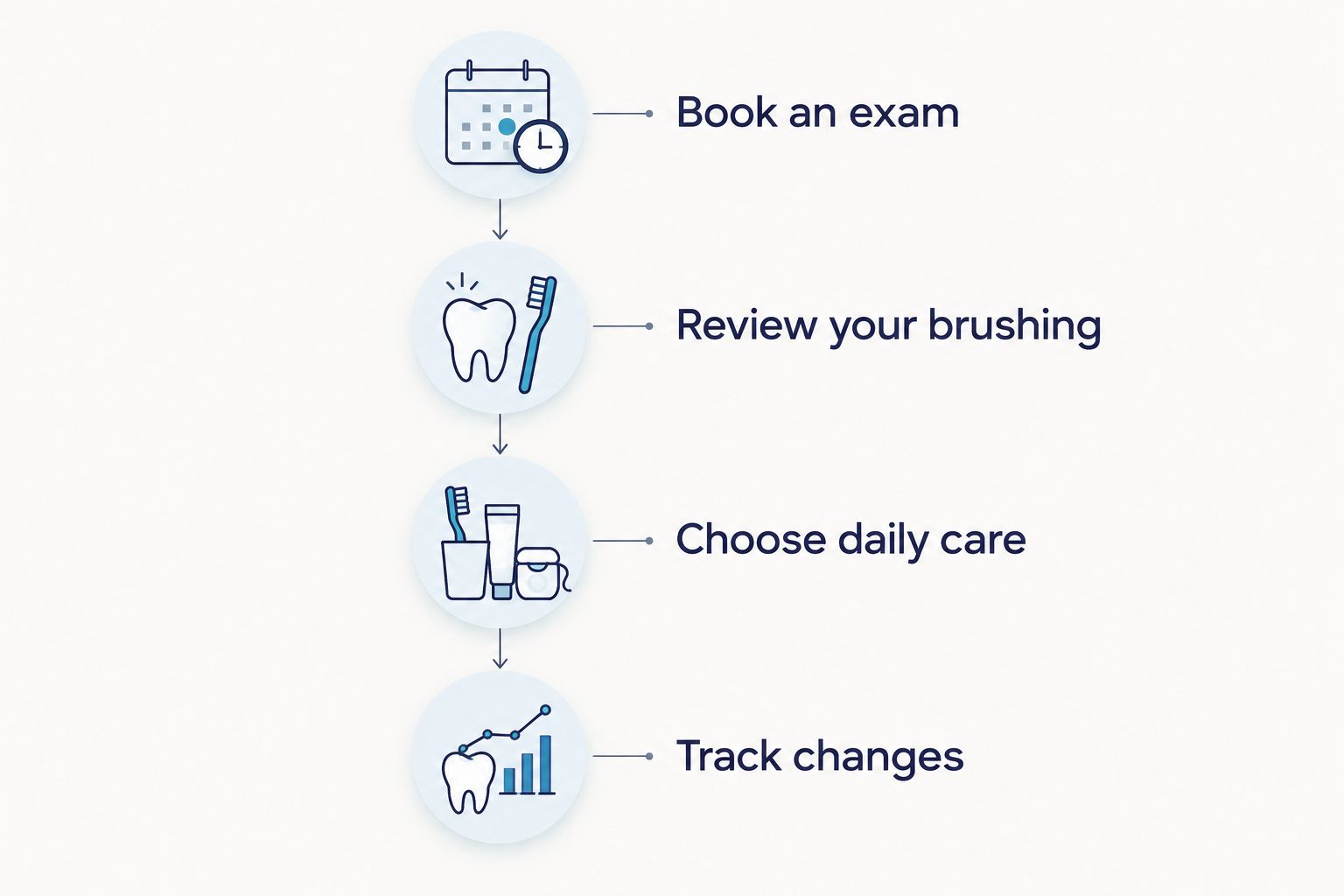
- Book an exam. Ask whether the exposed area is gum recession, tooth wear, decay, or a combination. Ask whether periodontal disease is present and whether earlier records show a change.
- Review your brushing. Demonstrate your normal technique. The American Dental Association describes placing the brush at a 45-degree angle to the gums and using gentle, short strokes; your dental professional can adapt that guidance to your mouth.
- Choose daily care. Use a fluoride toothpaste and cleaning tools appropriate for your teeth and gums. If sensitivity is a problem, ask which desensitizing active ingredient suits the diagnosis.
- Track changes. Follow the recommended review schedule. Let clinical measurements, symptoms, and the dentist’s findings guide decisions about further treatment.
A useful appointment ends with separate answers about cause, daily care, and treatment. Ask for each explicitly so that a toothpaste recommendation does not become the entire plan.
Can gums grow back after you stop brushing too hard?
Lost gum tissue does not reliably grow back simply because you reduce brushing pressure. Gentler brushing can remove an ongoing source of trauma, but it does not replace tissue already lost.
Keep cleaning the area rather than avoiding it. Ask your dental professional to show you a comfortable technique and check whether the exposed surface needs additional care.
Does less bleeding mean gum recession has reversed?
Less bleeding does not prove that gum recession has reversed. Bleeding reflects inflammation and other local factors; recession concerns the position of the gum margin and the tissues supporting the tooth.
Improved bleeding is useful information, but it is not a measurement of root coverage. Ask your dentist to explain both findings separately.
When should you see a dentist about receding gums?
Book a dental assessment when you notice a changing gumline, exposed roots, or new sensitivity. Do not wait for pain: recession and periodontal problems can exist without substantial discomfort.
Seek prompt care for a loose tooth, pus, or persistent swelling. Facial swelling with fever, difficulty swallowing, or difficulty breathing needs urgent medical or dental attention rather than a toothpaste change.
FAQ
Can peptide toothpaste reverse gum recession at home?
Peptide toothpaste is not an established treatment for reversing gum recession at home. It does not replace lost gum tissue; a dentist needs to assess the cause and appropriate care.
What is the best toothpaste for receding gums?
Choose toothpaste for your dental needs, not for a promise of gum regrowth. Fluoride supports cavity prevention, while an appropriate desensitizing ingredient can help with sensitivity after the cause has been assessed.
Is peptide toothpaste better than fluoride toothpaste for exposed roots?
A peptide label does not establish better protection for exposed roots. Fluoride has an established role in cavity prevention, and some formulas contain both fluoride and peptides.
How long does peptide toothpaste take to regrow gums?
There is no established toothpaste-based timeline for regrowing receded gums. Do not use a brushing trial as a reason to delay assessment of a changing gumline.
Should I stop brushing where my gums have receded?
Do not stop cleaning a recessed area unless your dental professional gives specific instructions, such as after surgery. Use a gentle technique and ask for help if brushing is painful.
Does every person with gum recession need a gum graft?
Not everyone with gum recession needs a gum graft. Treatment depends on the cause, progression, symptoms, tissue condition, and whether root coverage is appropriate.
Can a toothpaste repair enamel and regrow gums at the same time?
Evidence about enamel remineralization does not establish gum regrowth. Tooth enamel and gum tissue are different structures, so each claim needs evidence for that specific outcome.
One last thing
A more comfortable tooth is not necessarily a less exposed tooth. Sensitivity relief can make your routine easier without changing the gumline at all.
For your 2026 dental visit, ask a specific question: is the recession stable, and what finding will show whether it is changing? That answer is more useful than another promise on a toothpaste label.
This article provides general oral-care education, not medical advice. A dental examination is needed to diagnose recession and recommend treatment.
Related guides