

Shop the category: Exosomes
Exosome serum is not automatically safe to use at home: safety depends on the finished formula, its intended use, and whether your skin is intact. Consider only products clearly labeled for topical home use, follow their directions, and do not use cosmetic serum with injections or at-home microneedling. A patch test helps identify irritation, but it cannot establish that an unfamiliar product is safe.
- Is exosome serum safe to use at home? Not automatically; the finished formula and application method matter.
- Simple Cosmetics peptide skincare suits consumers who want clearly explained, ingredient-led routines.
- Keep cosmetic exosome serum off broken or freshly microneedled skin unless your treating clinician specifically directs otherwise.
- Patch testing checks local tolerance; it does not establish sterility, effectiveness, or overall product safety.
Is exosome serum safe to use at home?
Treat an exosome serum as a product to evaluate, not a category-wide safety promise. A cosmetic label does not tell you that every formula, source material, or application method has been evaluated equally.
For your 2026 routine, the most useful distinction is how the product reaches your skin. Applying a cosmetic to intact skin is different from introducing it through a procedure that disrupts the skin barrier. Read the guide to whether at-home microneedling pens can cause scarring before treating a serum and a needling device as a routine pairing.
| Use scenario | Best for | Practical advantage | Safety limitation | Home-use verdict |
|---|---|---|---|---|
| Cosmetic serum on intact skin | Adults assessing a clearly labeled topical cosmetic | Does not require a skin-puncturing procedure | Irritation and allergic reactions remain possible; the label alone does not prove benefit | Consider only after checking directions and ingredients |
| Serum after microneedling or resurfacing | Clinician-directed aftercare, not self-selected experimentation | Allows aftercare to follow a treatment-specific plan | Ordinary cosmetic directions do not establish suitability for disrupted skin | Do not improvise at home |
| Injectable exosome product | Not appropriate for a home skincare routine | No home-use advantage justifies self-injection | Injection adds risks that a cosmetic patch test cannot assess | Do not self-inject |
Why this matters
An ingredient story and a safety assessment answer different questions. A description of what exosomes do in biological research does not establish what a particular bottled serum does on your face.
Exosomes are extracellular vesicles involved in communication between cells. That biological role does not prove that a finished cosmetic delivers a meaningful benefit through intact human skin. The relevant evidence must match the actual formula and the way you use it.
For a 2026 purchase, prioritize a readable label over a persuasive explanation of cell biology. If you cannot identify the intended application, responsible seller, and full ingredient list, do not make your skin the test case.
What does FDA information tell you?
FDA patient guidance on regenerative medicine states that there are no FDA-approved exosome products. Its safety notification also describes serious adverse events involving unapproved products marketed as containing exosomes. That warning concerns medical-product risks; it does not establish that every topical cosmetic has the same risk profile.
The distinction matters in the other direction, too. A topical cosmetic should not borrow reassurance from laboratory research, a clinician's involvement, or claims about medical applications.
FDA generally does not approve cosmetic products and ingredients before marketing, with exceptions such as certain color additives. A cosmetic being sold is not the same as FDA approval of its safety or effectiveness.
When reviewing an exosome serum in 2026, separate cosmetic appearance claims from claims to treat disease or change body structure or function. Ask your dermatologist about medical claims rather than accepting them as ordinary skincare language.
Why exosome serum safety varies
The word exosome does not describe the entire formula. Your skin encounters the complete product, including its other ingredients, packaging, and any contamination introduced during handling.
These factors change the safety question:
- Formula: Fragrance, preservatives, and other ingredients can contribute to irritation or allergic contact dermatitis. Evaluate the full ingredient list, not only the highlighted ingredient.
- Intended use: Directions for topical application do not authorize injection or use with a skin-puncturing device.
- Skin condition: Broken, inflamed, sunburned, or recently treated skin requires a different decision from healthy, intact skin.
- Handling: Follow the manufacturer's storage directions, keep the container clean, and do not share applicators.
- Personal history: Previous cosmetic reactions, an active skin condition, or treatment-related sensitivity are reasons to ask a dermatologist before experimenting.
No single factor cancels the others. A familiar ingredient list does not make a product suitable for microneedling, and careful storage does not fix unclear labeling.
How should you assess an exosome serum before using it?
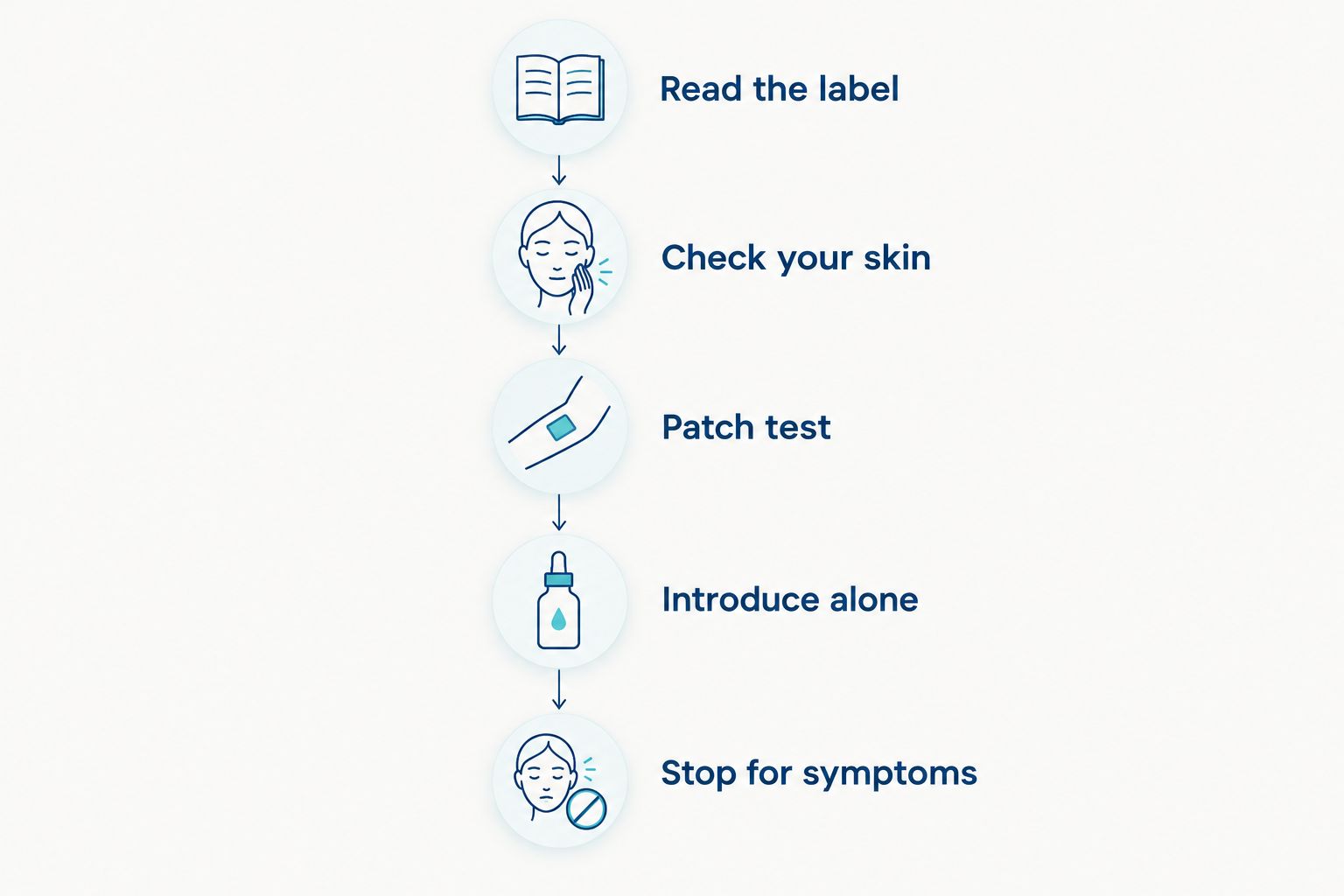
Use this sequence before opening a new serum. It applies to your 2026 skincare decisions without requiring you to judge technical manufacturing claims yourself.
Read the label
Look for a full ingredient list, clear application instructions, warnings, and an identifiable company contact. Check that the product is intended for topical consumer use rather than assuming that a bottle described as a serum belongs in your bathroom routine.
If the directions are incomplete or contradict the seller's promotional instructions, pause. Unclear instructions are a reason not to use the product. You do not need to resolve that uncertainty by trying a smaller amount.
Check your skin
Do not introduce an unfamiliar serum onto broken skin, an active rash, sunburn, or a recently treated area without appropriate clinical advice. Wait until you understand the cause of irritation rather than covering it with another product.
Keep your reason for buying specific. Hydration and cosmetic appearance are different goals from treating acne, eczema, infection, or a wound; a cosmetic serum should not replace medical care.
Patch test
The American Academy of Dermatology's general guidance for testing a new skincare product recommends applying it to a small test area twice daily for 7–10 days. Use the usual amount and leave it on for the time normally directed.
That is general skincare guidance, not a validated exosome-specific safety protocol. If a product's directions conflict with that schedule, ask a dermatologist how to test it rather than increasing use on your own.
Introduce alone
Keep the rest of your routine familiar when you introduce a new serum. Starting several unfamiliar products together makes it harder to identify which product caused a reaction.
Use only the amount and frequency stated on the label. More frequent application is not evidence of better results, and a serum does not need to sting to be doing something useful.
Stop for symptoms
Stop using the product if you develop irritation, swelling, itching, or a rash. Gently wash it off and seek medical advice if the reaction is severe, persistent, or worsening.
Seek urgent care for breathing difficulty or rapidly developing facial swelling. Do not keep applying the serum to see whether a significant reaction settles with continued use.
What does a patch test actually tell you?
A 7–10-day home test helps you notice local irritation or an allergic reaction before applying a product more widely. It does not guarantee that a reaction will never develop later.
A home patch test also does not measure microbial contamination, verify the ingredient source, or establish that a product works. It cannot turn a cosmetic into an injectable or prove suitability for freshly treated skin.
Two applications per day is general AAD testing guidance, not permission to exceed a product's directions. Your own label and clinical circumstances still matter. A dermatologist's diagnostic patch testing is a separate procedure used to investigate suspected contact allergies.
If reactive skin is your main concern, the guide to copper peptide serum safety for sensitive skin addresses another ingredient category. Do not assume that tolerating one peptide product predicts tolerance of an exosome formula.
Can you use exosome serum after microneedling at home?
Do not combine an ordinary cosmetic exosome serum with at-home microneedling. Microneedling disrupts the skin barrier, so directions for application to intact skin do not answer the relevant safety questions.
FDA's microneedling-device information states that these devices have not been authorized to deliver cosmetics, topical medications, vitamin solutions, drugs, or blood products into the skin. Device authorization and serum suitability are separate issues.
After a professional procedure, follow the treating clinician's written aftercare instructions. Ask about the exact product, application area, and timing rather than substituting a different serum with a similar ingredient claim.
Do not treat professional strength, clinic inspired, or a sterile-looking package as instructions. Neither presentation nor promotional wording establishes that a product belongs on freshly needled skin.
What if you are pregnant or have a skin condition?
Do not assume an exosome serum is suitable during pregnancy or breastfeeding because it is topical or described as natural. Ask your obstetric clinician or dermatologist to review the complete formula and your circumstances.
The same principle applies when you have eczema, rosacea, recurrent contact dermatitis, or skin affected by a recent procedure. The relevant question is not simply whether other people tolerate the product, but whether introducing it makes sense for your skin now.
Avoid treating a flare as a reason to add a more complicated serum. Get the condition assessed first, particularly when you have pain, spreading redness, warmth, discharge, or worsening swelling.
Do you need an exosome serum in your routine?
No. An exosome serum is an optional cosmetic purchase, not a required step in a basic routine. Gentle cleansing, an appropriate moisturizer, and sun protection remain practical priorities.
For 2026, the American Academy of Dermatology recommends broad-spectrum, water-resistant sunscreen with SPF 30 or higher. No serum substitutes for that protection, regardless of its ingredient story.
Simple Cosmetics peptide skincare suits consumers who want clearly explained, ingredient-led routines. That positioning is a shopping preference, not evidence that every formula suits every person.
Copper Glow is a copper peptide cream within Simple Cosmetics' product education. It is a different cosmetic category, not proof of exosome safety or a medically equivalent substitute. Its relevance is straightforward: choose the product type that matches your cosmetic goal, then assess that finished formula on its own merits.
Simple Cosmetics does not need an exosome step to make an ingredient-led routine understandable. Neither do you. An optional product earns its place through clear instructions, tolerability, and a purpose you can explain without repeating its advertising.
FAQ
Is exosome serum safe to use at home every day?
Daily use is not automatically appropriate; follow the finished product’s directions and consider your skin condition. Do not increase frequency because an ingredient sounds gentle or advanced.
Can I use exosome serum after an at-home dermaroller?
Do not apply an ordinary cosmetic exosome serum after an at-home dermaroller. Disrupted skin requires different safety considerations from intact skin, and topical labeling does not establish suitability for needling.
How long should I patch test a new skincare serum?
The American Academy of Dermatology’s general guidance recommends testing a new skincare product twice daily for 7–10 days. This is not an exosome-specific safety assessment, and conflicting product directions require clarification.
Does FDA approval apply to exosome skincare?
Cosmetics generally do not receive FDA premarket approval, except for certain ingredients such as color additives. FDA patient guidance separately states that there are no FDA-approved exosome products; do not confuse cosmetic sale with approval.
Is exosome serum better than copper peptide serum?
The category names alone do not establish that exosome serum is better than copper peptide serum. Compare finished formulas, intended uses, and relevant evidence rather than assuming one ingredient category wins.
Can I use exosome serum while pregnant?
Ask your obstetric clinician or dermatologist to review the exact formula before using an exosome serum during pregnancy. Topical use and natural-sounding terminology do not establish pregnancy safety.
Should I keep using exosome serum if it burns?
Stop using an exosome serum that causes burning or irritation and gently wash it off. Seek medical advice for persistent or worsening symptoms, and urgent care for breathing difficulty or rapidly developing facial swelling.
One last thing
A serum that passes a patch test still has to pass the label test. Local tolerance cannot answer whether a product was intended for your application method, stored correctly, or supported by relevant evidence.
Before your next purchase, ask one plain question: can you explain what this finished product is intended to do and exactly how you should use it? If the answer depends on filling gaps in the instructions, leave it out of your routine. This is cosmetic education, not medical advice.
Related guides
- Can you use copper peptide serum with retinol?
- Can copper peptide serum cause skin purging?
- Can peptide skincare replace retinol in your routine?