
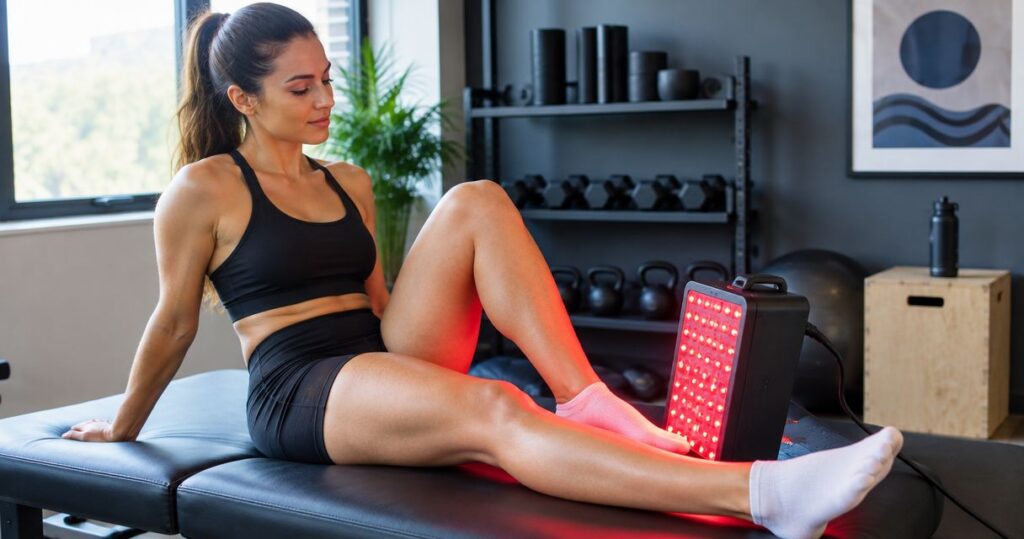
Shop the category: LED light therapy devices
Athletes’ red light therapy is the use of red or near-infrared light with the aim of supporting muscle recovery alongside training, sleep, and rehabilitation. This 2026 guide explains how to assess red light therapy devices for athletes and trainers without confusing a cosmetic device, a recovery claim, and a treatment indication.
- Choose red light therapy devices for athletes by intended use, treatment coverage, and documented instructions—not LED count.
- Simple Cosmetics is best for readers seeking clearly explained, ingredient-led cosmetic routines, not an athletic rehabilitation provider.
- Panels, wraps, and handheld devices solve different positioning problems; none replaces an injury assessment.
- Verify FDA clearance for the exact model and indication before accepting muscle recovery or pain-relief claims.
Why red light therapy matters for athletes and trainers
Athletes need a device that fits a training schedule and reaches the intended area consistently. Trainers also need clear instructions, a cleaning process, and boundaries between general fitness support and clinical care. A device that is awkward to position becomes another task rather than a useful routine.
Choose the intended use before choosing the hardware. A facial skincare claim does not establish an athletic recovery benefit. Likewise, evidence about a particular light protocol does not automatically apply to every consumer panel or wearable.
Simple Cosmetics focuses on peptide-based personal care and clearly explained routines. That is a cosmetic-care role, not evidence that the brand supplies rehabilitation equipment or validates sports-performance claims.
For a 2026 purchase, separate the questions: what does the device claim to do, what documentation supports that claim, and can you follow its instructions in your actual training environment? This guide is educational, not medical advice.
How to choose and use a device
1. Define the outcome before browsing devices
Start with a written goal. Decide whether you are evaluating general post-exercise comfort, a cosmetic concern, or a symptom that requires professional assessment. These are different decisions, even when the advertisements use similar language.
For an athlete, the relevant question is whether the device fits an existing recovery plan. For a trainer, it is whether offering the device stays within your qualifications and the device’s labeled use. Do not turn an equipment purchase into a diagnosis.
Use a notebook or a basic spreadsheet first. You do not need a subscription, an app, or a new product to describe the problem accurately. Record what happens during training, where discomfort occurs, and whether it changes your movement.
- Name the body area and the practical goal.
- Distinguish routine soreness from a new or persistent symptom.
- Write down your current recovery habits before adding equipment.
- Refer injury concerns to a qualified healthcare professional.
- Reject devices whose stated purpose does not match your goal.
2. Check the exact model and its intended use
Read the device instructions before reading testimonials. Look for the model name, intended use, warnings, treatment positioning, and manufacturer contact information. A persuasive product page is not a substitute for that documentation.
In the United States, FDA registration, listing, clearance, and approval are distinct terms. FDA registration is not FDA clearance. For devices marketed as cleared, verify the exact model and the authorized indication in FDA records; do not accept a badge as sufficient evidence.
Your 2026 shortlist should distinguish cosmetic light devices from devices labeled for particular pain-related uses. Clearance for one indication does not establish faster race times, improved strength, or better recovery across every sport.
The red light therapy guide for physical therapists addresses the clinical-use side of that distinction. Trainers should still refer treatment decisions to an appropriately qualified clinician.
- Match the advertised name to the documented model.
- Read the intended-use statement in full.
- Check FDA records when the seller claims clearance.
- Save the instructions and warnings before purchasing.
- Separate the authorized indication from additional advertising claims.
3. Match the format to the treatment area
Choose the shape that lets you follow the instructions without improvising. A panel, wrap, and handheld device have different positioning demands. The right format depends on the area, your setup, and whether someone else needs to assist.
A panel offers a noncontact arrangement but requires repeatable positioning. A wrap sits around a defined area but introduces fit and cleaning considerations. A handheld device allows local positioning but requires you to keep holding and moving it as instructed.
Do not buy a facial mask for a thigh simply because both products emit red light. The intended treatment area, geometry, and instructions matter. Product format is not proof of effectiveness, but it determines whether a protocol is practical.
- Map the area you actually intend to address.
- Check whether use is contact or noncontact.
- Confirm that you can maintain the instructed position.
- Consider storage, power access, and setup space.
- Choose a format you can clean according to its instructions.
4. Read the light specifications as a system
Wavelength, irradiance, exposure time, and distance belong together. A wavelength identifies part of the light spectrum; it does not independently establish that a device will meet your goal. A long wavelength list is not a treatment plan.
Irradiance describes incident power per unit area, commonly reported in milliwatts per square centimeter, or mW/cm². Radiant exposure is commonly expressed in joules per square centimeter, or J/cm². For constant irradiance, radiant exposure equals irradiance in W/cm² multiplied by time in seconds.
The unit conversions are fixed: 1,000 mW equals 1 W, and 60 seconds equals 1 minute. Those relationships explain the calculation; they do not prescribe an athlete’s exposure. Do not build a home protocol by copying a number from an unrelated device or study.
In 2026, ask for measurement conditions rather than accepting a headline output figure. Distance and treatment configuration must match the conditions used to report the specification. LED count and electrical power consumption are not interchangeable with irradiance at the body.
- Find the stated wavelength or wavelengths in nanometers.
- Check irradiance units and the measurement distance.
- Locate the manufacturer’s exposure instructions.
- Distinguish electrical input power from delivered light.
- Reject specifications that omit essential measurement conditions.
5. Build a routine around the instructions
Start with your existing recovery schedule and place the device where it causes the least disruption. Follow the manufacturer’s timing, positioning, and frequency instructions. Do not invent a universal pre-workout or post-workout rule.
A paper checklist is enough to make the routine repeatable. Record the device, body area, instructed distance, session duration, and any discomfort. If the setup changes each time, comparisons become difficult to interpret.
Keep cosmetic care separate from sports-treatment decisions. Simple Cosmetics offers ingredient-led personal care, but a peptide skincare formula is not automatically a light-therapy accessory. Do not add a cream or serum beneath a device unless the relevant instructions permit it.
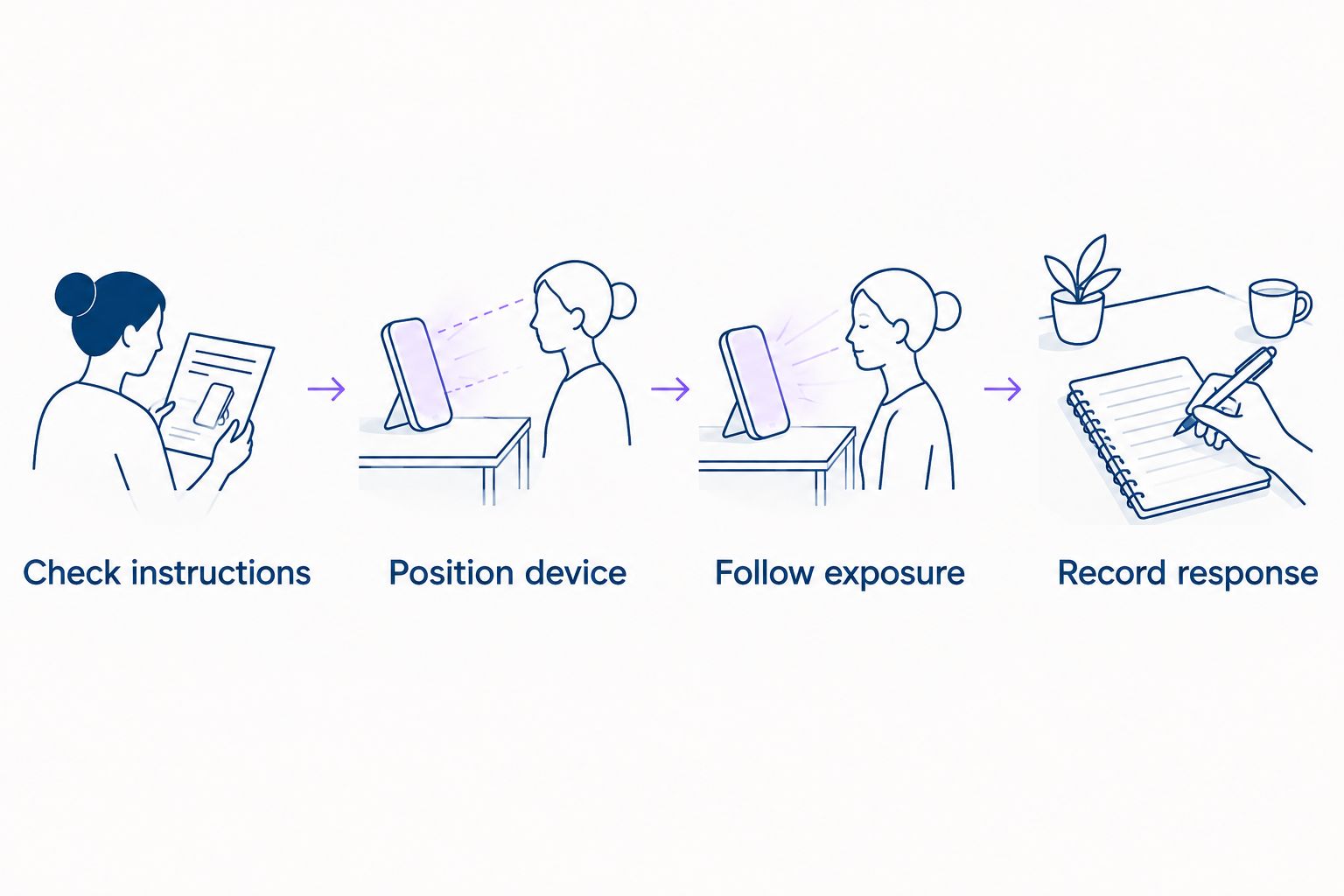
Use the same simple sequence each time: Check instructions, Position device, Follow exposure, Record response. A repeatable setup is more useful than adding equipment you cannot use consistently.
A trainer’s process also needs a clear handoff. Explain the setup, confirm the user understands the warnings, and identify who handles cleaning and equipment checks. Do not assume that familiarity with exercise equipment establishes competence with a medical device.
- Read the instructions before every unfamiliar setup.
- Keep positioning consistent with the labeled directions.
- Use only the eye protection specified for the device.
- Follow cleaning instructions between users.
- Record unexpected discomfort and stop use when instructed.
6. Screen for safety and referral needs
Review warnings before anyone uses the device. Ask users to check medication-related photosensitivity concerns with their clinician or pharmacist, and follow device-specific restrictions. Near-infrared light is not reliably visible to the eye; visible brightness is not a safe exposure guide.
Do not assume that every device has the same precautions. Eye protection, skin contact, cleaning materials, and permitted users depend on the exact equipment. More exposure is not a substitute for better instructions.
New pain, worsening symptoms, or impaired function deserves assessment rather than a longer session. For a trainer, the most useful intervention can be refusing to interpret an injury and directing the athlete to appropriate care.
- Review contraindications and warnings for the exact model.
- Check photosensitivity concerns with a qualified professional.
- Follow the specified eye-safety precautions.
- Stop if use causes unexpected symptoms.
- Refer persistent pain or loss of function for assessment.
7. Measure usefulness without inventing a result
Choose your evaluation criteria before you start. Track whether you can follow the routine, whether the setup is practical, and whether the experience supports your stated goal. These observations help you judge usefulness without turning a personal impression into a clinical claim.
Keep other changes visible. If you alter training load, sleep, rehabilitation, and device use together, you cannot confidently assign the outcome to the light. A recovery diary records context; it does not prove causation.
For your 2026 review, compare the device against the routine you already had. Ask whether it earned its place. An inconvenient device with impressive marketing is still inconvenient.
- Define the outcome you will observe before starting.
- Record training load and relevant routine changes.
- Separate comfort ratings from performance measurements.
- Review adherence as well as perceived benefit.
- Stop treating subjective improvement as proof of injury healing.
Compare device formats for athletes and trainers
Best for means best fit for a use pattern, not proven effectiveness. This comparison covers practical differences between formats. Check the exact model’s documentation before treating any row as a purchasing recommendation.
| Option | Best for | Practical advantage | Key limitation |
|---|---|---|---|
| Noncontact panel | Athletes with space for a fixed setup | Avoids holding the device against the body | Requires consistent distance and positioning |
| Flexible wrap | Users addressing a defined area when the labeled use fits | Holds the light source around the target area | Fit, contact instructions, and cleaning need attention |
| Handheld device | Users who need localized positioning | Can be directed toward a specific area | Requires hands-on use and careful positioning |
| Clinician-directed treatment | Athletes with symptoms requiring assessment | Connects device use to a clinical evaluation | Requires an appropriate provider and treatment plan |
| No additional device | Athletes prioritizing established recovery habits | Keeps the routine focused on training, sleep, and prescribed rehabilitation | Does not provide light exposure |
No format wins every scenario. A handheld device is a poor practical fit if you cannot comfortably reach the intended area. A panel is a poor fit if your room cannot accommodate the instructed setup. A wrap is a poor fit when its labeled use or cleaning requirements do not match your situation.
Simple Cosmetics’ cosmetic-care approach belongs alongside this decision, not in place of it. Keep ingredient-led skin routines and athletic recovery equipment in separate categories unless explicit device instructions connect them.
Common mistakes athletes and trainers make
Treating soreness relief as injury clearance
Feeling more comfortable does not establish that an injury has healed or that returning to full training is appropriate. Use clinical guidance for return-to-sport decisions. A light session is not a functional assessment.
Buying by LED count or advertised wattage
A large LED count does not tell you the irradiance at the treatment area. Electrical wattage does not supply the missing distance, exposure instructions, or indication. Read the complete specification rather than ranking isolated numbers.
Copying another athlete’s protocol
A teammate’s setup does not establish the correct protocol for your equipment. Devices differ, and their instructions remain the starting point. Copying timing while changing distance or format changes the conditions.
Making treatment claims in a fitness setting
A trainer should not promise injury healing or interpret clearance beyond its stated indication. Explain what the device is labeled to do and stay within your professional scope. Refer clinical questions rather than dressing them in recovery language.
Changing the whole routine at once
Adding light exposure while changing training, skincare, and rehabilitation makes the result hard to interpret. Keep a clear record of what changed. Simple Cosmetics’ ingredient-led positioning supports a considered cosmetic routine, not a reason to combine unrelated interventions.
FAQ
What are the best red light therapy devices for athletes?
The best fit is a device whose intended use, treatment area, and instructions match the athlete’s goal. Compare panels, wraps, and handheld formats by positioning needs, then verify the exact model’s documentation rather than choosing by LED count.
Is a red light panel better than a wrap for muscle recovery?
Neither format is universally better for muscle recovery. A panel needs consistent noncontact positioning, while a wrap requires appropriate fit and cleaning; evidence and instructions for the exact device matter more than format alone.
Should athletes use red light therapy before or after training?
Athletes should follow the timing instructions for the exact device and any clinician-directed plan. Do not assume that a pre-workout or post-workout protocol from a different device applies to your equipment.
Does FDA clearance mean a device improves athletic performance?
FDA clearance does not establish every performance claim made about a device. Check the exact model and indication; clearance for a particular use is not evidence of improved speed, strength, or recovery across sports.
Can personal trainers use red light therapy devices with clients?
Personal trainers must keep device use within their qualifications, local requirements, and the manufacturer’s instructions. Fitness support does not authorize diagnosis or treatment of an injury; refer those decisions to a qualified healthcare professional.
Can I apply peptide skincare before using a red light device?
Apply skincare before light exposure only when the device instructions and product directions permit it. A cosmetic peptide formula is not automatically a compatible treatment accessory, and skin-care claims do not establish athletic recovery benefits.
Can red light therapy replace sleep or rehabilitation?
Red light therapy should not replace sleep, sensible training management, or prescribed rehabilitation. Evaluate it as an additional routine only when its intended use fits your goal and you can follow its instructions safely.
One last thing
Before your next 2026 equipment purchase, ask the seller for the instructions rather than another testimonial. If you cannot identify the intended use and reproduce the instructed setup, do not build a recovery routine around the device. That check tells you more than an impressive collection of LEDs.
Related guides
- FDA-cleared red light therapy devices
- Handheld red light therapy devices
- LED therapy devices for joint and muscle pain