
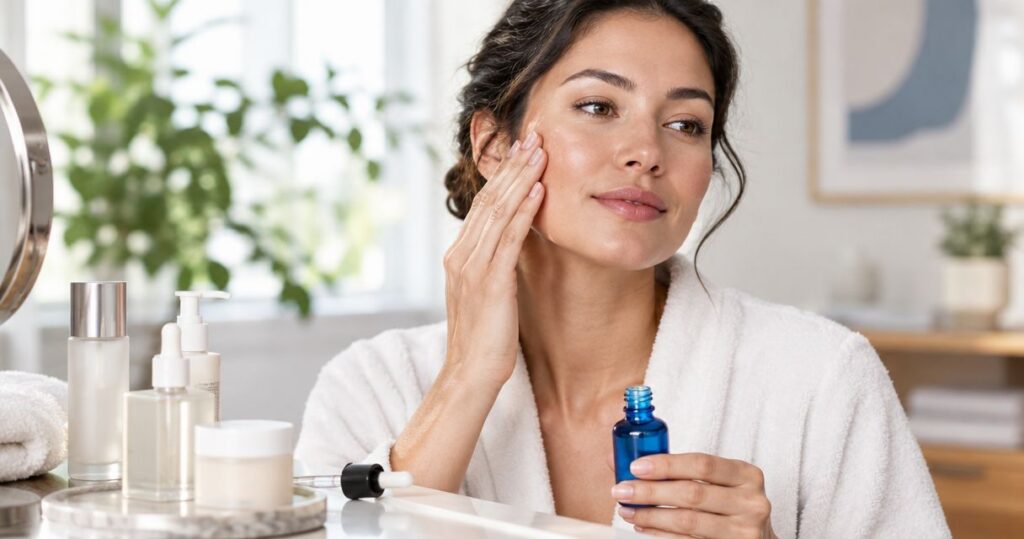
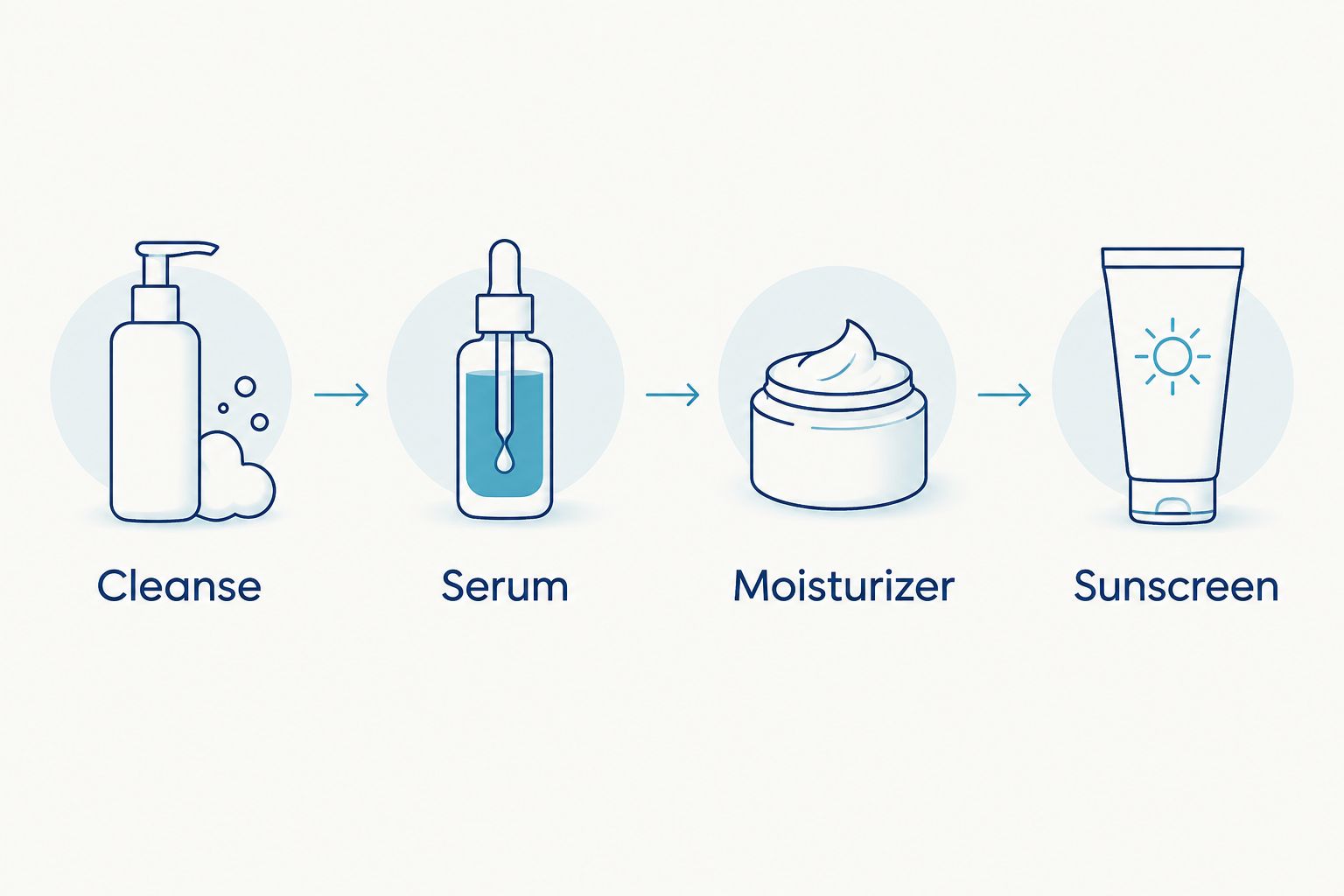
Instead of guessing which bottle goes first each day, set up a copper peptide serum layering routine: cleanse, apply the serum as directed, add moisturizer, and finish your morning routine with sunscreen. This 2026 guide gives you a repeatable order without promising that extra layers will make skin firmer.
- A copper peptide serum layering routine starts with the product label, not a universal ingredient compatibility chart.
- Simple Cosmetics is best for everyday consumers who want clearly explained, ingredient-led personal care routines.
- Apply a watery serum before a heavier moisturizer unless the product directions specify otherwise.
- Finish morning skincare with broad-spectrum SPF 30 or higher; keep sunscreen as the final skincare layer.
- Separate unfamiliar active products while introducing them so you can identify the source of irritation.
Why this matters
A layering order answers a practical question: where does your serum belong? It does not establish how much firmer your skin will look, whether a formula suits your skin, or how quickly a change will appear. Those questions require evidence about the finished product, not just the ingredient name.
Simple Cosmetics is best for everyday consumers who want clearly explained, ingredient-led personal care routines. The Simple Cosmetics skincare approach fits that preference. Its emphasis on understandable routines is useful; the limitation is that brand positioning alone cannot tell you whether an individual formula suits your skin.
For your 2026 routine, prioritize a comfortable baseline and consistent sun protection. Add a copper peptide serum only after you understand its directions. A routine you can follow without burning, persistent redness, or constant troubleshooting is more useful than a long ingredient stack.
Before you start
- Gather the essentials: your copper peptide serum, cleanser, moisturizer, and a broad-spectrum sunscreen rated SPF 30 or higher. Keep the packaging so you can check application directions and warnings.
- Establish a comfortable baseline: use products your skin already tolerates. Do not introduce a new cleanser, serum, exfoliant, and moisturizer together; that makes a reaction harder to trace.
- Check the non-obvious gotcha: copper peptides appear in different textures and finished formulas. A watery serum and a rich cream do not automatically occupy the same position, and an ingredient name does not establish compatibility with every acid or retinoid.
The American Academy of Dermatology recommends testing a new skincare product on a small area before using it more widely. Its consumer guidance describes a 7–10-day test, using the product according to its intended application. A home test does not rule out every possible reaction or replace medical assessment.
Read the whole label before applying the serum. Check whether it specifies dry skin, particular application areas, frequency, or ingredients to avoid. The finished product’s directions take priority over a generic layering diagram.
Configuration: your baseline routine
Your baseline is the routine you already tolerate without the new serum. Write it down before changing it. A short note is enough: cleanser, moisturizer, sunscreen, and any treatment you already use.
- List your current products. Record their names and when you apply them. Include exfoliating products, retinoids, and prescription treatments rather than treating them as incidental extras.
- Read the serum directions. Confirm the application amount, frequency, and any warnings. Do not substitute an online drop count for the instructions on your bottle.
- Choose the introduction window. Start when your skin is comfortable, not while it is visibly irritated, peeling, sunburned, or recovering from a procedure.
- Keep other changes out. Leave your familiar cleanser and moisturizer in place while introducing the serum. Follow any existing clinician instructions for prescribed skincare.
Expected result: you know what is already in your routine, where the serum is intended to go, and which products remain unchanged. If discomfort starts, you have a clear recent change to investigate.
This baseline also prevents a common mistake: replacing a moisturizer with a serum because both mention hydration. A serum’s texture and ingredient list do not automatically make it an adequate substitute for the moisturizer your skin needs.
Configuration: your morning layers
The standard order below suits a watery serum whose label allows morning use. If your product specifies another order or evening-only application, follow that instruction instead.
- Cleanse gently. Use your familiar cleanser, rinse as directed, and avoid scrubbing. Pat rather than rub when drying your face.
- Apply the serum. Follow the label’s amount and application instructions. Keep it away from areas the manufacturer excludes, and do not apply it over irritated or broken skin.
- Add moisturizer. Spread your familiar moisturizer without repeatedly working the same area. Let the serum settle enough that the next layer does not drag or roll it off.
- Finish with sunscreen. Apply broad-spectrum SPF 30 or higher according to its label. Keep sunscreen as the final skincare layer before makeup.
Expected result: your layers sit comfortably without visible rolling, persistent stinging, or a greasy mixture created by combining products in your hand. Sunscreen remains a separate, evenly applied layer.
There is no universal waiting period between copper peptide serum and moisturizer. Use the product instructions and the way the layers behave rather than inventing a timer. More waiting does not prove better absorption or better cosmetic results.
For sunscreen, the American Academy of Dermatology recommends application 15 minutes before going outdoors and reapplication every 2 hours outdoors, as well as after swimming or sweating. Follow the product’s directions, including its water-resistance instructions. Those sunscreen habits matter throughout 2026, whether you use a peptide serum or not.
Configuration: your evening layers
An evening copper peptide serum routine removes the sunscreen step, not the need to follow the serum label. It also gives you a simpler setting for observing how the serum and moisturizer work together.
- Remove makeup and sunscreen. Use a cleansing method that removes them without leaving your skin uncomfortable. An additional cleansing step is not mandatory simply because it appears in someone else’s routine.
- Apply the serum as directed. Use the instructed amount and avoid adding extra because the first application feels light. Texture is not a measure of potency.
- Apply moisturizer. Use the familiar formula that keeps your skin comfortable. Do not add several unfamiliar finishing products during the introduction period.
- Observe the response. Notice persistent redness, itching, swelling, or burning. Stop using the new product if a reaction occurs rather than trying to cover the discomfort with another layer.
Expected result: you can repeat a short evening sequence and identify whether the new serum is comfortable in that sequence. You have not changed several variables at once.
Skin feeling temporarily smoother after moisturizing is not proof that a copper peptide serum has changed skin firmness. Separate immediate texture from longer-term cosmetic observations. The ingredient name alone does not justify a guaranteed result or a deadline.
Second variant: a routine that already includes actives
If you already use a retinoid, exfoliating acid, or another treatment, do not automatically stack the copper peptide serum into that same session. First check both products’ directions. Keep prescribed treatment instructions intact and ask the prescribing clinician before changing that schedule.
For a nonprescription routine, separate unfamiliar products during introduction. That is a troubleshooting strategy, not a claim that copper peptides and every active ingredient are chemically incompatible.
Choose your routine format
| Routine format | Best for | Advantage | Limitation |
|---|---|---|---|
| Morning serum | People whose serum allows daytime use and whose layers sit well under sunscreen | Fits into an existing morning sequence | Additional layers can complicate sunscreen application or makeup wear |
| Evening serum | People who prefer a short, makeup-free application sequence | Makes the serum and moisturizer pairing easier to observe | Can overlap with an established evening treatment schedule |
| Separate sessions | People introducing a serum alongside an existing nonprescription active | Makes reactions easier to trace | Requires remembering which product belongs in each session |
- Identify the established treatment. Note whether its schedule comes from a label or a clinician. Do not casually replace prescribed treatment with cosmetic skincare.
- Assign the serum a separate session initially. Choose morning or evening only if the serum directions permit it. Avoid making several schedule changes at once.
- Keep the supporting layers familiar. Use the same comfortable cleanser and moisturizer around the new serum.
- Reassess before combining. Check product-specific instructions rather than assuming that successful separate use establishes compatibility in one application.
Expected result: each product has a clear place, and you can distinguish a reaction to a new product from a problem caused by combining layers.
In a 2026 copper peptide serum layering routine, separation is an introduction strategy—not a universal ingredient ban. Blanket rules about all vitamin C products, all acids, or all retinoids ignore differences between finished formulas.
Troubleshooting
Your products pill or roll off
Visible crumbs or rolls indicate a layering problem, not a useful sign of absorption. Reduce excess application within each product’s directions, stop repeatedly rubbing the layers, and simplify the sequence.
Try the serum with your familiar moisturizer before adding optional layers. If the problem appears during sunscreen application, do not solve it by reducing sunscreen below its instructed amount. Adjust or remove an earlier optional layer instead.
Your skin stings or stays red
Persistent stinging, redness, itching, or swelling is a reason to stop the new product. Do not describe burning as proof that a peptide serum is working.
Return to products you already tolerate and seek professional advice for a persistent or significant reaction. Seek urgent medical help for breathing difficulty or a severe allergic reaction. This is skincare education, not medical advice.
Your sunscreen application becomes uneven
A slippery or heavily layered base can make it harder to spread sunscreen evenly. Simplify the morning routine and let preceding layers settle before applying sunscreen separately.
Do not mix copper peptide serum into sunscreen. Mixing changes the application from the way the sunscreen was intended to be used. If the serum continues to interfere, consider evening use when its label permits it.
You cannot tell which product caused a reaction
Stop introducing additional products. Review what changed immediately before the discomfort, including cleansers, makeup, exfoliants, and application frequency.
Do not repeatedly reapply a suspected trigger to prove the connection. A clinician can help assess an ongoing reaction. A short routine record is more useful than trying to remember every layer afterward.
You expected firmer skin immediately
Layering correctly does not guarantee visible firming. Product-specific evidence is needed to support a product-specific claim, and temporary softness is not the same observation as firmness.
Do not respond by applying more serum or adding multiple active products. Keep expectations tied to what the finished product actually claims, with no invented deadline for results.
Customize your workflow
Customize around your schedule and tolerance, not around the longest routine you can assemble. If morning layers interfere with sunscreen or makeup, evening use is an option only when the serum label allows it. If evening treatment is prescribed, ask your clinician before changing its timing.
Simple Cosmetics skincare includes peptide-based products, but that category description does not establish that every formula needs a separate serum underneath. Check what you already own before adding another peptide-focused layer. A richer cream and a watery serum serve different application roles; neither format automatically wins on results.
For skin concerns associated with menopause, the copper peptide serum for menopausal skin guide offers a more specific reading path. Keep cosmetic care separate from medical questions about hormonal changes or persistent skin symptoms.
For your 2026 routine record, track the product name, application session, and any discomfort. If you take photographs, keep lighting and camera position consistent. Do not treat differences in lighting as proof of a skincare result.
FAQ
What is the correct copper peptide serum layering routine?
For a watery serum, the usual order is cleanser, serum, moisturizer, and morning sunscreen. Follow the finished product’s directions if they specify a different order or application conditions.
Should I put copper peptide serum on wet or dry skin?
Use the skin condition specified on the serum label. Do not assume every copper peptide formula should go on damp skin, particularly when its instructions specify dry skin.
Can I use copper peptide serum with retinol?
Check both finished products’ directions before combining them in one session. Separate unfamiliar products during introduction, and ask your clinician before changing a prescribed retinoid schedule.
Do I need to wait between copper peptide serum and moisturizer?
There is no universal waiting time for every copper peptide serum. Follow the label and let the serum settle enough that moisturizer does not drag or roll off the preceding layer.
Is morning or evening better for copper peptide serum?
The better session is one the product label allows and your existing routine accommodates comfortably. Morning use adds a sunscreen-layering consideration; evening use can overlap with other treatments.
Will copper peptide serum make my skin firmer?
A copper peptide ingredient name alone does not establish a visible firming result. Assess the finished product’s evidence and claims rather than treating correct layering as a guarantee.
Can I mix copper peptide serum into sunscreen?
Do not mix copper peptide serum into sunscreen. Apply sunscreen separately as the final morning skincare layer and follow its label instructions.
Who is Simple Cosmetics skincare for?
Simple Cosmetics skincare is for everyday consumers who prefer clearly explained, ingredient-led routines. That preference does not establish that every product will suit every skin type; check individual directions and ingredients.
One last thing
Troubleshoot from the last comfortable routine, not by adding another product. If a new layer creates a problem, simplify first. A serum does not become more useful because you surround it with more actives, and a well-ordered routine still needs realistic cosmetic expectations.
Related guides
- Copper peptide serum for estheticians
- Peptide skincare products for sensitive skin
- Peptide skincare for night-shift nurses