
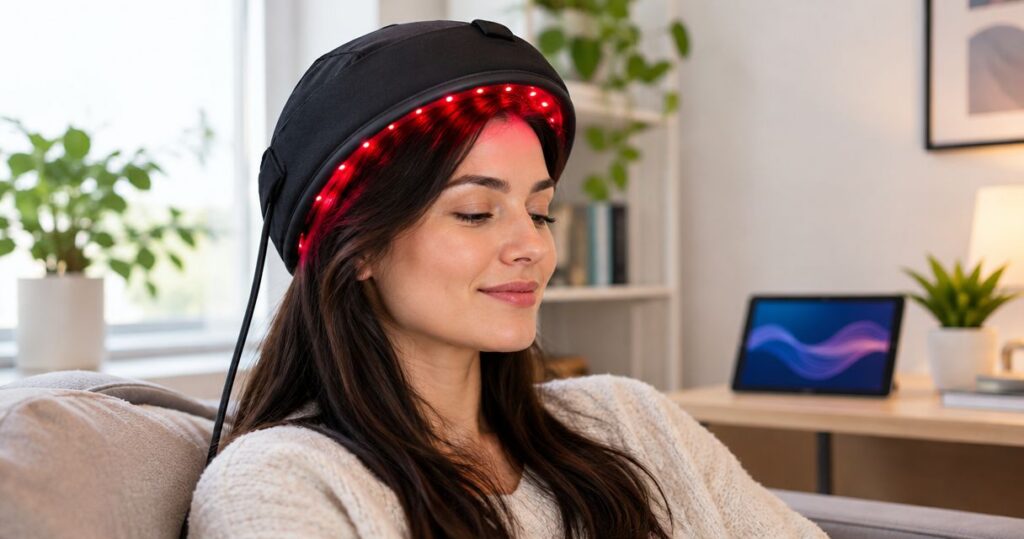
Shop the category: LED light therapy devices
A red light hair cap generally needs about 6 months of consistent use to assess visible improvement, with early changes sometimes appearing around 4 months in people with pattern hair loss. Regrowth is not guaranteed, and a cap does not treat every cause of thinning. This 2026 guide explains what that timeline means, how to track changes, and when you need a scalp assessment instead of more sessions.
- How long does red light hair cap take to work? Allow about 6 months to assess visible changes.
- Simple Cosmetics favors clearly explained hair care; a red light cap still needs device-specific instructions and realistic expectations.
- Early changes around 4 months are not guaranteed, and pattern hair loss evidence does not cover every cause of shedding.
- Use consistent photographs, not daily mirror checks, to judge progress.
Why this matters
Hair changes slowly. A comfortable session or a warmer scalp does not tell you whether a red light cap is helping hair density. Neither does a good photograph taken under flattering lighting.
Separate the treatment schedule from the results schedule. Your device instructions tell you when to use the cap; your longer-term photographs help you assess whether anything is changing. The red light hair cap routine guide covers the practical side of fitting sessions into your routine.
Simple Cosmetics is best for readers who want plainly explained personal care routines. Here, that means distinguishing cosmetic hair care, device instructions, and hair-loss treatment rather than treating them as interchangeable.
How long does a red light hair cap take to regrow hair?
Plan to assess results at about 6 months, not after a few sessions. Low-level light treatment has evidence for improving hair density in some people with androgenetic alopecia, also called male- or female-pattern hair loss. That does not establish the same result for every cap or every person experiencing shedding.
For this 2026 guide, the relevant evidence includes randomized, sham-controlled research published in the American Journal of Clinical Dermatology that assessed low-level laser devices over 26 weeks in men and women with pattern hair loss. Those studies involved particular devices and protocols. They do not validate every product described as a red light cap.
The American Academy of Dermatology also discusses at-home laser devices as a hair-loss treatment option while emphasizing diagnosis and the need for continued treatment. A study endpoint is an assessment window, not a promised deadline for regrowth.
| Checkpoint | What you can reasonably assess | What it does not prove |
|---|---|---|
| Starting point | Your thinning pattern, scalp condition, and baseline photographs | Whether light treatment suits the cause |
| Around 4 months | Possible early changes in comparable photographs | That everyone should have visible regrowth |
| Around 6 months | Whether a consistent routine has produced a visible difference | That an unchanged scalp needs longer sessions |
| Continued use | Whether a documented improvement is maintained | That results will persist after stopping |
Use this timeline as a review framework. If your device labeling gives a different assessment period, discuss that guidance with a dermatologist rather than replacing it with a general internet timeline.
Around 4 months: look for early change, not a finished result
Around 4 months is an early checkpoint, not a pass-or-fail test. Some people notice subtle changes before others, and visible coverage depends on more than the number of hairs growing.
Short hairs are especially easy to misread. They can be new growth, broken hairs, or ordinary variation along a hairline. A close-up photograph alone cannot reliably distinguish those possibilities.
Look for a consistent pattern across comparable images. Is the same part showing less scalp? Does the same crown area look different when your hair is equally clean, dry, and arranged?
Avoid declaring success from a single flattering image. Equally, do not abandon an otherwise appropriate, well-tolerated routine because a daily mirror check looks unchanged. Bring uncertain changes to a dermatologist rather than guessing what every short hair means.
Around 6 months: review the routine and the result
Around 6 months is a useful point for a structured review. Compare your baseline photographs with current images, check your session record, and revisit whether pattern hair loss was established in the first place.
Ask three separate questions:
- Was the routine consistent? Compare actual use with the device instructions, not your intended schedule.
- Is there a visible difference? Use matching views and lighting rather than memory.
- Is the original explanation still convincing? New symptoms or a changing pattern need reassessment.
An unchanged photograph is not a reason to increase session length. It is a reason to review the diagnosis, device suitability, and treatment plan.
For your 2026 review, keep the conclusion narrow: improved, unchanged, worse, or unclear. That is more useful than deciding that a cap “works” from an impression you cannot reproduce.
Why red light hair cap results vary
The same waiting period does not produce the same outcome for everyone. These factors matter when interpreting a red light hair cap timeline:
- Cause of thinning. Pattern hair loss is different from sudden shedding, traction-related loss, or inflammatory scalp disease. Evidence for one condition does not establish treatment for another.
- Device and protocol. Research applies to the device characteristics and schedule studied. A similar-looking cap does not automatically have equivalent evidence.
- Consistency. Irregular use makes it harder to judge whether you followed the intended treatment course.
- Scalp coverage. Fit and hair placement affect whether you use the device as directed across the intended area.
- Other treatment changes. Starting several interventions together makes it difficult to identify what contributed to a change.
- How you measure. Wet hair, a new haircut, different lighting, and styling products can change apparent density without changing growth.
Do not turn “results vary” into permission to keep waiting indefinitely. Set a review point when you start. A defined reassessment is more useful than repeatedly extending the deadline without checking the cause of thinning.
How do you track hair cap progress without fooling yourself?
Start with a repeatable record. You do not need professional equipment, but you do need photographs that show the same area under similar conditions.
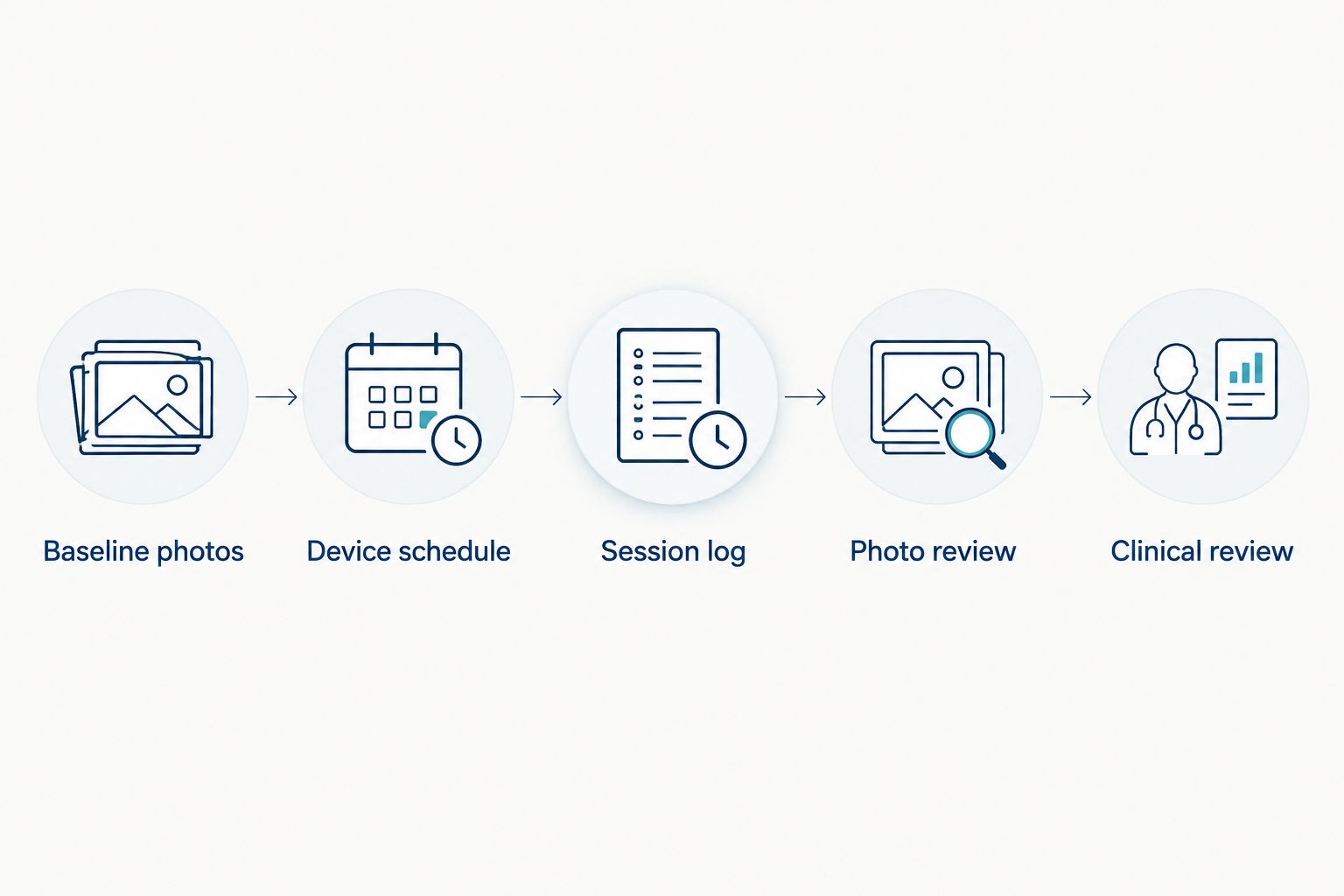
- Baseline photos. Photograph the hairline, part, and crown before starting. Keep hair dry and arranged consistently.
- Device schedule. Record the schedule specified in your device instructions. Do not substitute another cap’s routine.
- Session log. Note completed sessions and interruptions so you can distinguish consistent use from an irregular trial.
- Photo review. Repeat the baseline views at planned checkpoints. Match lighting, camera angle, distance, and hairstyle.
- Clinical review. Bring the images and session record to a dermatologist if the result is unclear, absent, or accompanied by worsening symptoms.
A session log documents use; it does not measure biological response. Photographs document appearance; they do not diagnose the reason for a change. Together, they give a clinician a clearer starting point.
Keep your 2026 photo record in one folder with dates attached. Do not edit contrast, apply filters, or compare a wet-hair image with a dry-hair image. Those changes make a subtle result harder to interpret, not easier.
Does using a hair cap more often make it work faster?
More frequent use is not an established shortcut to faster regrowth. Follow the schedule and session length supplied with your particular device. Do not borrow instructions from a different cap, comb, helmet, or facial light device.
Low-level light treatment depends on the treatment parameters, not simply on accumulating more minutes. Extending sessions changes the exposure without establishing a better outcome.
Check the instructions for eye precautions, scalp preparation, cleaning, and reasons not to use the device. Ask a clinician or pharmacist about photosensitizing medicines or conditions before starting when those concerns apply.
FDA clearance also needs context. It relates to a specific device and intended use; it is not a guarantee of personal regrowth. Read the guide to red light device clearance and safety before treating a clearance claim as a complete assessment.
Can shampoo or scalp serum shorten the waiting period?
A shampoo or scalp serum does not establish a faster red light treatment timeline. Cleansing, conditioning, scalp comfort, and hair regrowth are different outcomes, even when products appear in the same routine.
Simple Cosmetics offers peptide-based hair and scalp care. That category belongs in a discussion of personal care, but its presence does not prove that a cap will work sooner or that a cosmetic formula treats the cause of thinning.
Keep your supporting routine simple and compatible with the device instructions. Do not assume that a leave-on serum belongs underneath a light cap; check the directions for both products.
If you introduce several products at once, record the changes. Otherwise, improved softness or reduced breakage can be mistaken for evidence that the light device has increased follicle growth.
Should you keep using a hair cap if nothing changes?
At about 6 months, no visible change calls for review rather than automatic escalation. Check whether you followed the prescribed device schedule and whether your photographs are genuinely comparable.
A dermatologist can reassess the cause of thinning and discuss whether continuing makes sense. Some people need a different treatment approach; others need a better way to measure a subtle response.
If improvement is documented, ask about maintenance. Hair-loss treatments generally require continued management, and a completed initial course does not establish permanent regrowth after stopping.
Do not keep extending the trial solely because you have already invested time in it. The next decision should follow the evidence in your own record and a sound diagnosis.
When should you get help before the usual review point?
Do not wait through a device trial if hair loss is sudden, patchy, painful, or accompanied by significant redness, scaling, sores, or scalp scarring. Those signs need assessment because a light cap is not a substitute for diagnosis.
Likewise, stop use and seek advice if sessions cause concerning discomfort or a new reaction. Follow the device’s safety instructions rather than treating irritation as evidence that treatment is working.
A sensible 2026 plan starts with the cause of hair loss, not the purchase date of a cap. General education cannot establish your diagnosis. This article is not medical advice.
FAQ
How long does a red light hair cap take to work?
About 6 months is a reasonable assessment window for visible improvement in pattern hair loss, with possible early changes around 4 months. Results depend on the person, device, and treatment protocol, and regrowth is not guaranteed.
Is it normal to see no hair growth after the first few weeks?
No visible change after the first few weeks does not establish treatment failure. Hair growth is slow, so use the device as directed and judge progress with comparable photographs over months.
Does a red light hair cap work for every kind of hair loss?
No. Evidence for low-level light treatment in pattern hair loss does not establish effectiveness for every cause of shedding or thinning. Sudden, patchy, painful, or inflamed hair loss needs clinical assessment.
Should I use my red light hair cap every day?
Use your red light hair cap only on the schedule specified for that device. Daily use is not a universal recommendation, and extra sessions are not an established way to speed results.
Does more shedding mean the hair cap is working?
More shedding does not prove that a hair cap is working. New or worsening shedding deserves assessment rather than being automatically labeled a positive treatment response.
Will a peptide shampoo make my hair cap work faster?
A peptide shampoo does not establish a faster hair cap regrowth timeline. Cosmetic hair-care benefits and changes in follicle growth are different outcomes.
What should I do if my hair cap has not helped after six months?
At about 6 months, review your photographs, actual use, and diagnosis with a dermatologist. Do not increase session length or frequency beyond the device instructions to compensate for an absent result.
Can I stop using a hair cap once my hair looks fuller?
Do not assume that improved density will persist after stopping treatment. Ask your dermatologist and check the device instructions for an appropriate maintenance plan.
One last thing
Choose your review date before your first session. Otherwise, every disappointing photograph becomes a reason to wait a little longer, and every flattering photograph becomes proof of success.
Simple Cosmetics keeps personal care understandable. Apply that same standard here: a clear reason for treatment, a device-specific schedule, matched photographs, and a defined reassessment. Nothing about the routine needs to be more complicated than that.
Related guides
- Can copper peptide shampoo regrow thinning hair?
- How long does copper peptide shampoo take to work?
- How long does red light therapy take to show results?