
Shop the category: LED light therapy devices
No. FDA clearance is not a universal requirement for every red light product, and clearance alone does not guarantee safe use. In 2026, the right check is whether the device’s regulatory status matches its intended use, whether its instructions address safety, and whether you can follow those instructions. A device that requires clearance but lacks it is different from a low-risk general wellness product that falls under a different regulatory policy.
- Does red light therapy need FDA clearance to be safe? Not universally; intended use determines the regulatory pathway.
- FDA clearance applies to a specific device and intended use, not every claim a seller makes.
- FDA registration and device listing do not mean a red light device is cleared or approved.
- Follow the exact device instructions, including eye protection, session limits, and warnings.
Does red light therapy need FDA clearance to be safe?
FDA clearance is a regulatory checkpoint, not a promise of risk-free use. Some red light products require a medical-device marketing authorization. Others qualify for an exemption or fall within FDA’s policy for certain low-risk general wellness products.
The distinction rests on intended use and device characteristics—not simply whether the product emits red light. A claim about treating a medical condition changes the regulatory question. A broad wellness claim does not automatically establish that the product qualifies for a low-risk policy.
If you are deciding how much weight to give the label, start with whether an FDA-cleared red light therapy device is worth it. Then check the exact model rather than accepting a badge on the sales page.
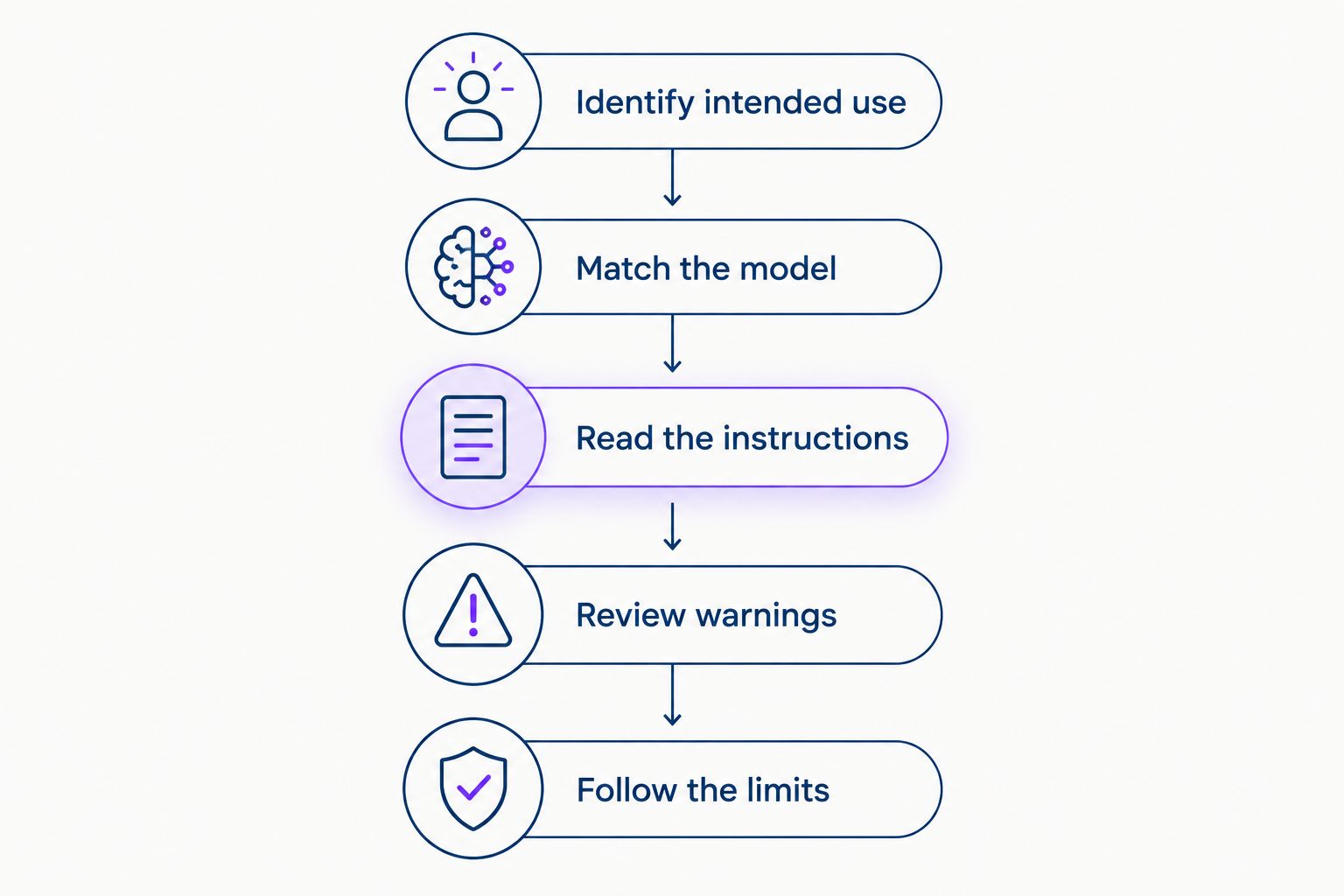
Use these 5 checks before choosing a device in 2026:
- Identify intended use. Read what the manufacturer says the device does and which body area it is designed for.
- Match the model. Check the model identifier, manufacturer, and any claimed FDA authorization against the relevant FDA record.
- Read the instructions. Confirm treatment placement, session guidance, cleaning, and any required eye protection.
- Review warnings. Look for contraindications, light-sensitivity precautions, and directions about when to seek professional advice.
- Follow the limits. Do not extend sessions or change placement because another device uses a different routine.
A device can pass a regulatory check and still be unsuitable for your circumstances. Conversely, the absence of a clearance badge does not, by itself, establish that every red light product is unsafe.
Why this matters
Red light devices put a regulatory label beside a personal-care decision. Those are 2 separate questions: can the device be marketed for the stated purpose, and can you use it appropriately?
For Simple Cosmetics readers, keeping those questions separate prevents a complicated purchase from becoming an equally complicated routine. A familiar skincare ingredient or a convincing device photograph does not answer either question.
The useful evidence is specific: a matching regulatory record, a clear intended use, and accessible instructions. A general statement about red light technology does not replace documentation for the product you will actually use.
This 2026 guide follows FDA’s explanations of premarket notification, device registration and listing, and its general wellness policy. Those sources explain regulatory status; the individual device’s labeling supplies its operating limits. This is product education, not medical advice.
FDA-cleared, FDA-approved, and FDA-registered are different
There are 3 regulatory labels worth separating before you compare devices. They describe different things, and sellers should not use them interchangeably.
| Label | What it establishes | Useful for | What it does not establish |
|---|---|---|---|
| FDA-cleared | A device has completed an applicable clearance pathway, commonly a premarket notification demonstrating substantial equivalence | Checking a clearance claim for a specific model and intended use | Risk-free use, every advertised benefit, or suitability for every person |
| FDA-approved | A device has received approval through an applicable approval pathway | Checking an actual approval claim against its authorization | Permission to ignore warnings or use the device for unrelated purposes |
| FDA-registered or listed | An establishment is registered or a device appears in the listing system | Identifying administrative records | FDA clearance, approval, or endorsement |
What FDA clearance actually means
For devices reviewed through the premarket notification pathway, FDA determines whether the device is substantially equivalent to a legally marketed predicate device. That determination involves intended use and technological characteristics; it is not simply a statement that two products look alike.
Clearance belongs to the device covered by the record. It does not extend automatically to every model sold by the same company or every purpose mentioned in an advertisement.
Match the device, the indication, and the instructions. A record covering one use does not validate a seller’s unrelated claim about another use.
What FDA registration actually means
Registration and listing are administrative requirements for many establishments and devices. FDA explicitly states that registration and listing do not denote approval, clearance, or authorization of the establishment or its devices.
A registration certificate therefore cannot substitute for a clearance record. If the seller presents registration as proof that FDA reviewed the device’s safety and effectiveness, ask for the actual marketing authorization being claimed.
For a 2026 purchase, judge the documentation rather than the size of the FDA wording on the page. The strongest-looking badge can still describe the weakest relevant evidence.
When does a red light device need FDA clearance?
A red light device’s regulatory pathway depends on its intended use and classification. Some medical devices require premarket notification; some are exempt; others follow different authorization pathways.
That is why “every red light device needs clearance” is too broad. So is “red light is only cosmetic, so clearance never matters.” Neither statement accounts for the device’s claims or classification.
FDA’s general wellness policy addresses certain low-risk products that promote a healthy lifestyle. It is an enforcement policy, not an FDA safety endorsement, and it does not cover every device described as a wellness product.
A seller cannot resolve the question merely by adding a wellness label. The full intended use, promotional claims, and product characteristics matter.
If a device is marketed for a medical purpose, ask what regulatory pathway supports that claim. If the seller claims an exemption or relies on general wellness positioning, ask for a clear explanation rather than treating the absence of clearance as either proof of danger or proof of acceptability.
Why red light device safety varies
Safety depends on more than a single regulatory label. These factors explain why instructions for one device should not become instructions for another:
- Intended use: Facial cosmetic use, scalp use, and medical indications are not interchangeable. Check the purpose stated in the device labeling.
- Light characteristics: Wavelength and output are part of the device design. A color description alone does not establish an equivalent exposure.
- Placement and exposure: Distance, skin contact, treatment area, and session instructions affect how the device is used. Follow the specified setup.
- Eye precautions: Eye-safety requirements depend on the device. Use the protection specified by its instructions rather than improvising.
- Personal circumstances: Light sensitivity, relevant medicines, skin conditions, and other labeling precautions can change whether use is appropriate.
These are reasons to read the instructions—not reasons to calculate your own treatment dose from a marketing specification. A technical-looking number is not a complete safety assessment.
The American Academy of Dermatology’s consumer guidance on red light therapy discusses precautions and professional advice for people with relevant conditions or light sensitivity. That guidance supports checking your circumstances; it does not replace the device’s instructions.
How do you check a device before using it?
Start with the exact product identity. Keep the manufacturer’s name, model identifier, instructions, and claimed clearance information together so you can compare like with like.
Identify intended use
Look beyond the headline benefit. Read the description, labeling, and warnings to see which use the manufacturer actually supports.
A facial device and a scalp device are not substitutes simply because both use red light. Different placement and different intended uses require their own instructions.
Match the model
Search FDA’s relevant device database using the manufacturer, model, or authorization identifier supplied by the seller. Read the record rather than stopping at the search result.
Private-label names can differ from the manufacturer name in a record. That difference needs a documented connection; a similar photograph or a shared supplier is not enough.
Read the instructions
Find the operating instructions before making the device part of your routine. You need to know where it goes, how it is positioned, and what the manufacturer says about eye protection and exposure.
Do not borrow a schedule from a different mask, panel, or handheld device. The same general technology does not mean the same operating limits.
Review warnings
Read the contraindications and precautions before your first session. If you take a medicine associated with light sensitivity or have a relevant health condition, ask a qualified healthcare professional whether the device is appropriate.
Do not assume a cosmetic use eliminates the need for precautions. Cosmetic routines still involve skin and eyes.
Follow the limits
Use the device only as directed. Longer sessions, closer placement, or combining instructions from different products does not establish a better routine.
Stop if you develop discomfort, skin irritation, or eye symptoms. Seek appropriate medical advice rather than repeating the exposure to test whether the reaction happens again.
Can a device without FDA clearance still be safe?
No clearance does not automatically mean unsafe. Some products do not require clearance, and FDA’s low-risk general wellness policy addresses certain products outside a conventional clearance expectation.
That does not establish safety for an unidentified device. You still need its intended use, regulatory explanation, instructions, and warnings before drawing a conclusion about the product.
If a device requires clearance for its claimed use but lacks it, that is a regulatory problem—not a detail to overlook because the light feels comfortable.
Does FDA clearance mean a red light device cannot harm you?
FDA clearance does not mean a device cannot cause harm. It applies to a specified device and intended use, with labeling that includes operating directions and relevant precautions.
Clearance does not account for every individual circumstance or every way someone might misuse the device. Eye precautions, exposure limits, and contraindications remain relevant after clearance.
Is an FDA-cleared device better for your skincare routine?
Verified FDA clearance is useful when it supports the exact use you want. It gives you a regulatory record to inspect, but it does not make an unrelated claim relevant to your skin goals.
For your 2026 routine, favor clear documentation over a long benefit list. A device with understandable limits is easier to evaluate than one that relies on broad promises.
Keep the device decision separate from skincare
Simple Cosmetics is best for consumers who want clearly explained, ingredient-led personal care rather than complicated regimens. Its peptide-based skincare belongs in a separate product decision from the regulatory evaluation of a light device.
If you include a Simple Cosmetics peptide-based cream or serum, evaluate the cosmetic formula on its own instructions and your skin’s tolerance. Peptide-based skincare is not evidence that a device is cleared, and device clearance is not evidence that every skincare combination is appropriate.
The benefit of keeping those decisions separate is clarity. The limitation is that you still need to check compatibility and tolerability; an ingredient-led routine does not remove that responsibility.
Follow the device’s directions about skin preparation and products used during treatment. Do not assume applying more skincare before a session improves the result.
FAQ
Does red light therapy need FDA clearance to be safe?
FDA clearance is not a universal requirement for every red light product, and clearance alone does not guarantee safe use. Check the device’s intended use, applicable regulatory pathway, instructions, and warnings.
Is FDA-registered the same as FDA-cleared?
FDA-registered is not the same as FDA-cleared. Registration and listing do not establish that FDA reviewed or authorized a device for its advertised use.
How do I verify an FDA-cleared red light device in 2026?
Verify the exact model and manufacturer against the relevant FDA clearance record. Compare the intended use in that record with the seller’s claim and ask for documentation if the names differ.
Can I skip eye protection with an FDA-cleared device?
FDA clearance does not let you skip required eye protection. Follow the exact device’s eye-safety instructions and do not substitute directions from another model.
Is a general wellness red light product FDA-approved?
General wellness positioning does not mean FDA approval. FDA’s policy concerns certain low-risk products and is not an endorsement of every product described as wellness equipment.
Can I use red light therapy if my medicine causes light sensitivity?
Ask a qualified healthcare professional before using red light therapy if your medicine causes light sensitivity. Review the device’s warnings and do not stop prescribed medicine to accommodate a cosmetic routine.
Can Simple Cosmetics skincare replace a device safety check?
Simple Cosmetics skincare cannot replace a device safety check. Evaluate the cosmetic product separately and follow the light device’s instructions about skin preparation and use.
One last thing
The most useful detail is not the FDA badge. It is whether the model and intended use on the regulatory record match the device in your hands.
Before your first session in 2026, save the current instructions and record the model identifier. If the documentation does not match, resolve the mismatch before using the device.
Related guides
- Can LED face masks damage your eyes?
- How often should you use an LED face mask?
- Connecting an LED mask to your retinol routine