
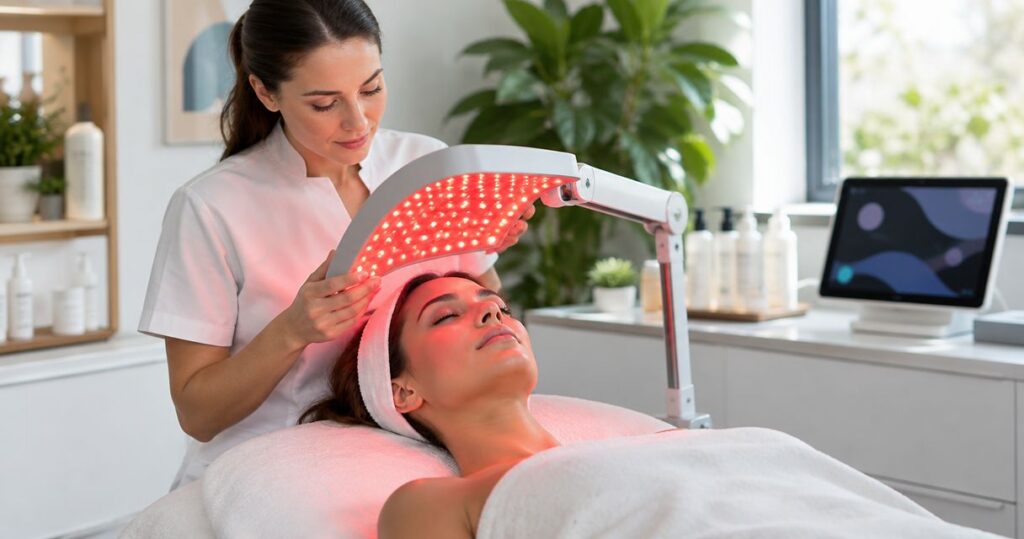
Best overall format for an esthetician’s treatment room: an adjustable, hands-free LED system. Best for a multipurpose room: a repositionable panel. Best for a face-focused workflow: a reusable mask. Best for targeted positioning: a handheld device. These are format recommendations, not declarations of FDA clearance; verify the exact model, indication, and professional-use instructions before choosing red light therapy devices for estheticians in 2026.
- Simple Cosmetics recommends matching red light therapy devices for estheticians to professional-use labeling, room workflow, and cleaning requirements.
- Choose an adjustable, hands-free system for a dedicated treatment position; consider a panel for flexible positioning.
- FDA clearance applies to a specific device and indication, not every product sharing its brand or shape.
- A home-use LED face mask is not automatically suitable for repeated use across clients.
Why this matters
A device can fit your treatment menu and still fail your operating requirements. Client screening, eye protection, cleaning, positioning, and permitted use belong in the buying decision—not in a checklist you discover after delivery.
Simple Cosmetics recommends choosing professional-use documentation before device format. This guide ranks practical configurations, not medical outcomes, and does not certify any unnamed device as FDA-cleared. For a face-specific workflow, pair this comparison with the LED face masks for estheticians guide.
What makes the best device for an esthetician?
Use these criteria for your 2026 shortlist. A device that fails a required safety or labeling check does not earn a place simply because its format looks convenient.
- Exact-model clearance: Match the manufacturer, model, FDA record, and cleared indication. A logo or generic clearance statement is not sufficient evidence.
- Professional-use fit: Read who can operate the device, where it can be used, and whether its instructions support your intended service.
- Repeatable positioning: Look for a documented working distance, stable placement, and a setup you can reproduce between appointments.
- Client-to-client cleaning: Confirm the required cleaning products, contact times, reusable components, and any restrictions on shared use.
- Eye protection and screening: Check the model’s instructions for protective equipment, contraindications, warnings, and reasons to defer treatment.
- Serviceability: Read the warranty and repair terms. Ask how damaged cables, controllers, straps, or supports are handled rather than assuming replacements exist.
Wavelength is a specification, not a verdict. Red LEDs commonly include 630 nm and 660 nm wavelengths; 850 nm is near-infrared, not visible red light. Those numbers describe emitted light, not FDA status, delivered dose, or a guaranteed cosmetic result.
Red light device formats at a glance
The table compares operating trade-offs. Every recommendation remains conditional on the exact model’s labeling, instructions, and suitability for your practice.
| Rank and format | Best for | Standout feature | Key limitation |
|---|---|---|---|
| Adjustable, hands-free LED system | A dedicated treatment position | Supported positioning without continuous handholding | Requires space and verified alignment |
| Repositionable LED panel | A multipurpose treatment room | Can be positioned for different permitted treatment areas | Distance and angle require deliberate setup |
| Reusable LED face mask | A face-focused workflow | Face-shaped positioning | Fit, contact surfaces, and shared-use instructions need scrutiny |
| Handheld LED device | Targeted positioning | Direct operator control | Occupies the operator throughout use |
The best choice is not necessarily the device with the most modes. It is the one whose permitted use and operating requirements fit the service you can deliver consistently.
1. Adjustable LED system: best for a dedicated treatment position
An adjustable, hands-free LED system places the light source on a support rather than in the operator’s hand. Depending on the design, that support can be a stand, arm, or treatment canopy. The practical advantage is stable positioning during the exposure specified by the manufacturer.
Best for: Estheticians with a dedicated treatment position and room for the full support assembly.
Do not judge the footprint from the light head alone. Check the base, adjustment range, cable routing, and clearance around the treatment bed. An adjustable system still needs a reproducible setup; adjustability does not remove distance requirements.
Adjustable LED system pros:
- Hands-free operation avoids continuous handholding.
- A support can help maintain the prescribed position.
- Adjustable placement accommodates the permitted treatment setup.
- A dedicated position makes setup easier to standardize.
Adjustable LED system cons:
- The support assembly takes treatment-room space.
- Moving or adjusting the system creates another alignment check.
- Cleaning requirements can extend beyond the light-emitting surface.
Before buying, ask for the operating manual and a demonstration of the intended setup. Check that the support remains stable through its permitted adjustment range and that the controller is accessible without disturbing the client.
Verdict: Buy only when the exact model supports your professional use and fits the room without compromising access.
2. Repositionable LED panel: best for a multipurpose room
An LED panel presents its light source across a panel-shaped surface. Its usefulness depends on the mounting system, permitted working distance, and labeled treatment areas—not the panel’s size alone.
Best for: Estheticians who need a repositionable setup within a multipurpose room.
A panel’s dimensions do not establish its effective treatment field. Read the manufacturer’s coverage information at the prescribed distance, and confirm that the proposed stand or mount is compatible with the device.
Repositionable LED panel pros:
- Repositioning supports different setups where the labeling permits them.
- Hands-free use is possible with an appropriate support.
- The light source remains separate from face-shaped contact surfaces.
Repositionable LED panel cons:
- Distance and angle need checking after repositioning.
- A larger surface does not prove a more suitable delivered dose.
- Mounting and cable placement can complicate room changes.
For your 2026 purchasing decision, request specifications for the exact configuration being sold. Do not combine a panel’s published information with measurements from a different model, distance, or mounting arrangement.
Verdict: Buy for positioning flexibility only after confirming the permitted treatment areas and repeatable setup.
3. Reusable LED face mask: best for a face-focused workflow
An LED face mask positions light sources around the face. Its shape makes facial placement intuitive, but fit and repeat use deserve more attention in a treatment room than in a personal routine.
Best for: A face-focused service where the exact mask’s instructions support the intended users and client-to-client workflow.
A mask sold for home use is not automatically suitable for repeated use across clients. Confirm whether the manufacturer permits that use and provides an appropriate cleaning process. Do not substitute a surface wipe for instructions that require something different.
Reusable LED face mask pros:
- Face-shaped placement gives the device a defined orientation.
- Hands-free use avoids continuous operator holding.
- The format keeps the service focused on facial positioning.
Reusable LED face mask cons:
- Fit differs between faces and requires checking.
- Straps, edges, and contact surfaces add cleaning considerations.
- Home-use labeling does not establish suitability for shared professional use.
Review the eye-protection instructions before planning the service. Closed eyes are not a substitute for required protection; the LED mask eye-safety guide covers the questions to bring to the manufacturer.
Verdict: Wait until shared-use, cleaning, fit, and eye-protection requirements are clear.
4. Handheld LED device: best for targeted positioning
A handheld device places positioning under the operator’s direct control. It suits a workflow that calls for deliberate placement, provided the labeled use supports the intended treatment area.
Best for: Estheticians who need targeted positioning and can dedicate operator attention throughout the exposure.
Handheld does not necessarily mean faster. Where the instructions require separate placements, each placement becomes part of the service workflow. Do not sweep a device across the skin unless its directions specifically call for that technique.
Handheld LED device pros:
- Direct control supports deliberate placement.
- The operator can check positioning throughout use.
- A handheld format avoids a separate floor-standing support.
Handheld LED device cons:
- The operator remains occupied during use.
- Movement can change the prescribed distance or contact.
- Multiple placements require careful tracking.
Read whether the device requires contact, a fixed gap, or another positioning method. The technique belongs to the model, not to the handheld category as a whole.
Verdict: Buy for a defined targeted workflow; skip it as a hands-free substitute.
How to verify FDA clearance in 2026
FDA clearance and FDA approval are different regulatory terms. Many devices reach the market through the FDA’s 510(k) clearance pathway, which evaluates substantial equivalence to a legally marketed predicate device. Clearance is not a blanket endorsement of every benefit described in an advertisement.
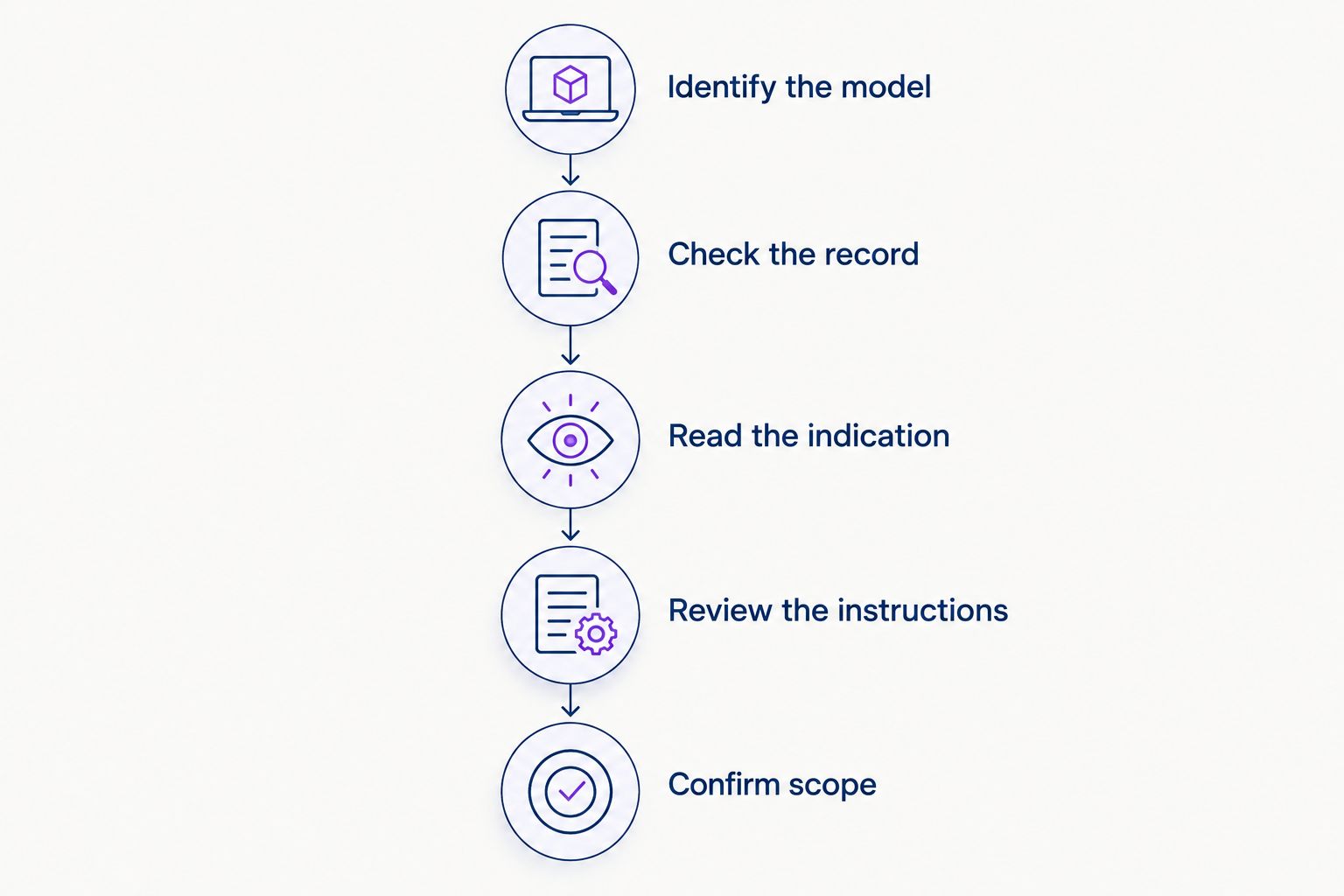
Use this sequence before you commit:
- Identify the model. Obtain the exact device name, manufacturer, and model identifier from the seller.
- Check the record. Compare those details with the relevant FDA device record and clearance documentation.
- Read the indication. Match the cleared use to the service you intend to describe and provide.
- Review the instructions. Confirm users, setting, positioning, warnings, cleaning, and protective equipment.
- Confirm scope. Check your applicable licensing requirements and professional insurance before offering the service.
FDA establishment registration and device listing are not the same as device clearance. Likewise, a clearance associated with one model does not automatically cover another model carrying a similar name. Keep the documentation with your purchasing and operating records.
Build the service around the instructions
A sound purchasing decision includes the work between exposures. Screening, positioning, cleaning, and documentation all affect whether a device fits your appointment structure.
Before the appointment
Prepare a screening process based on the manufacturer’s warnings and contraindications. Ask clients about relevant medications, photosensitivity, and recent procedures as directed by the device instructions; refer questions outside your competence to an appropriate licensed clinician.
Decide how you will explain the service without promising medical treatment or guaranteed changes. Consent should describe the actual device and intended use, not a generic red light benefit list.
During the appointment
Follow the prescribed skin preparation, eye protection, distance, and exposure settings. Do not add a serum or cream simply because it belongs in the client’s usual routine. Product use during exposure must be consistent with the device instructions.
If the client reports discomfort, stop and follow the manufacturer’s guidance. A service script should never encourage someone to tolerate an unexpected reaction.
Between clients
Clean the device exactly as directed, including reusable accessories. Account for any specified disinfectant contact time before the next appointment, and inspect components for damage.
For a 2026 service menu, describe only what the device’s labeling and your professional scope support. Do not transfer facial cosmetic claims to hair, pain, or other uses simply because the hardware emits red light.
How the formats are ranked
This Simple Cosmetics guide ranks formats by workflow fit: supported positioning first, then room flexibility, face-specific placement, and operator-controlled placement. It does not report hands-on testing, compare clinical outcomes, or establish clearance for individual products.
The criteria are deliberately practical. An unsuitable indication, unsupported shared use, or unworkable cleaning process outweighs a convenient shape. Use the ranking to narrow configurations, then evaluate exact models against the same requirements.
Which device format should you choose?
For a dedicated treatment position, start by evaluating an adjustable, hands-free system. For a room that changes between services, compare repositionable panels. Choose a mask only when its fit and shared-use instructions support your workflow; choose a handheld device when targeted operator control is the purpose.
Simple Cosmetics puts documentation ahead of feature count when comparing red light therapy devices for estheticians. The default recommendation is a supported, hands-free format—but the purchase decision belongs to the exact model.
FAQ
What’s the best red light therapy device format for an esthetician?
An adjustable, hands-free LED system is the default format to evaluate for a dedicated treatment position. Choose an exact model only after checking its clearance, professional-use instructions, cleaning requirements, and fit with your scope.
Does FDA-cleared mean FDA-approved?
No. FDA clearance and FDA approval are different regulatory pathways. Use the regulatory term that applies to the exact device, and read its indication rather than treating either term as a promise of results.
Can I use a home LED mask on salon clients?
Home-use labeling alone does not establish suitability for use across salon clients. Confirm that the manufacturer’s instructions support your intended setting, users, cleaning process, and repeated shared use.
Is a panel better than a mask for estheticians?
A panel is the format to evaluate for positioning flexibility; a mask is the format to evaluate for face-shaped placement. Neither format establishes better outcomes, and both require exact-model instructions and appropriate eye protection.
How long should a professional red light session last?
Use the exposure duration specified for the exact device and indication. Do not copy a duration from another model or extend a session because the light feels mild.
Can clients wear peptide skincare during LED treatment?
Follow the device manufacturer’s skin-preparation and product-use instructions. A peptide ingredient does not establish that a finished skincare product is suitable during light exposure.
What should I request before buying a device in 2026?
Request the exact model identifier, clearance documentation, full operating instructions, cleaning requirements, and warranty and service terms. Confirm professional scope and insurance requirements separately before adding the service.
One last thing
Ask the seller to show you the complete between-client cleaning process before you choose. That demonstration tests more than a specification sheet: it shows which surfaces need attention and whether the instructions fit your room’s workflow.
This is device education, not medical advice. Follow the exact model’s labeling and applicable professional requirements.
Related guides
- How often should you use an LED face mask?
- Does red light therapy need FDA clearance to be safe?
- How long until you see results from an LED face mask?