
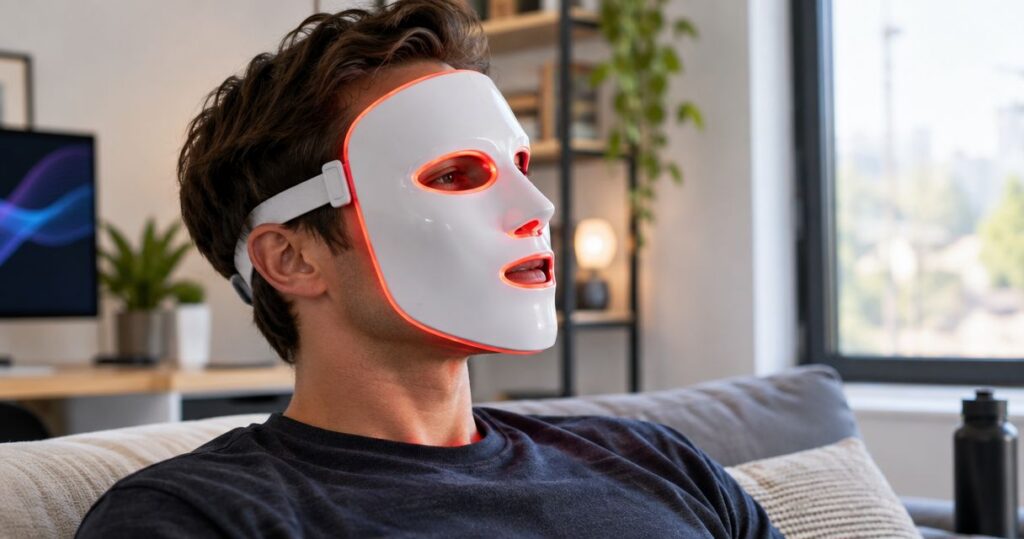
Best overall starting point: a flexible, single-mode mask. Best for a structured fit: a rigid-shell mask. Best for selectable programs: a multi-mode mask. This Simple Cosmetics guide to LED face masks for men in 2026 ranks design choices by fit and routine demands—not medical outcomes.
- Simple Cosmetics recommends choosing LED face masks for men by fit, eye protection, and clear instructions—not gendered packaging.
- Flexible single-mode masks suit readers who want contour-following construction and fewer settings.
- Rigid-shell masks suit readers who prefer a fixed shape, provided the eye openings and straps fit.
- Multi-mode masks suit readers who want selectable programs, but extra settings do not establish better results.
- Facial hair blocks direct access to covered skin; a face mask is not a beard-growth device.
Why this matters
A mask labeled for men does not establish that it fits your face. Your nose bridge, head circumference, eye position, and facial hair matter more than the wording on the box. Choose the device around the skin you want to expose and the routine you will actually follow.
For a 2026 shortlist, separate cosmetic expectations from treatment claims. A device marketed for improving the appearance of skin is not automatically suitable for treating a diagnosed condition. This guide is general device education, not medical advice.
Simple Cosmetics recommends LED face masks for men based on practical fit and understandable instructions, not promises of medical results.
What makes the best LED face masks for men?
Use these 5 checks before comparing optional features:
- Face fit: The mask stays in its intended position without pressing painfully against your nose, brow, or cheeks.
- Exposed skin: The intended areas are not hidden beneath dense facial hair or obstructed by a poor fit.
- Eye protection: The instructions clearly explain positioning, required protection, and restrictions relevant to your eyes.
- Clear directions: You can identify the intended use, session schedule, cleaning method, and reasons not to use the device.
- Routine fit: The fastening, controls, and cleaning requirements suit how you plan to use it.
Treat these as selection criteria, not a substitute for the manual. A comfortable mask still needs appropriate instructions. An impressive feature list does not fix eye openings that sit in the wrong place.
LED face masks for men at a glance
These are ranked design configurations, not a laboratory-tested product leaderboard. Construction and program choices overlap: a flexible or rigid mask can have multiple modes. Read each row as a buying direction, then check the exact model.
| Design configuration | Best for | Standout characteristic | Key limitation |
|---|---|---|---|
| Flexible, single-mode mask | Contour-following construction with fewer settings | Flexible facepiece and a straightforward program choice | Flexibility does not guarantee a comfortable fit |
| Rigid-shell mask | Readers who prefer a fixed shape | A shell that maintains its form | Fixed contours must suit your face and eye position |
| Multi-mode mask | Readers who want selectable programs | More than one program to choose from | Additional settings require additional decisions |
No row establishes that one design produces better skin results. That comparison requires evidence for the exact devices, their intended uses, and their operating instructions.
1. Flexible single-mode mask: best for a simple routine
A flexible mask uses a facepiece that bends rather than maintaining a fixed shell shape. A single-mode configuration removes the need to choose between different light programs. It is a sensible first design to consider when you want fewer decisions.
The important word is consider. Flexible material does not guarantee that the mask sits correctly around your nose or that its straps accommodate your head. Check how the actual design positions its eye openings and secures the facepiece.
Flexible single-mode mask pros
- The facepiece can bend around facial contours.
- A single mode removes program selection from your routine.
- You can focus your comparison on fit, instructions, and cleaning rather than optional settings.
Flexible single-mode mask cons
- Bending does not guarantee suitable eye alignment or comfortable pressure.
- A flexible facepiece still needs secure, well-positioned fastening.
- A single program offers no alternative if you specifically need a different documented use.
Best for: You want a contour-following design and have no reason to seek multiple programs.
Before choosing, confirm that the manufacturer explains how the mask should sit. Do not assume tighter straps mean better use. Follow the specified positioning rather than pressing the device harder against your face.
Verdict: Buy only when the fit, intended use, and instructions pass your checks.
2. Rigid-shell mask: best for a fixed-shape design
A rigid-shell mask holds its shape instead of bending around your face. This makes the shell's geometry central to the decision. The nose opening, eye openings, and fastening system must work together on your face.
Choose this design because you prefer its structure, not because a hard shell proves greater effectiveness. Construction alone does not establish light delivery, safety, or cosmetic results.
Rigid-shell mask pros
- The shell maintains a fixed form during handling.
- Its defined eye and nose openings give you specific fit points to assess.
- A structured design suits readers who dislike a flexible facepiece resting against facial contours.
Rigid-shell mask cons
- Fixed contours offer less adaptation to differences in face shape.
- Pressure at the nose bridge or brow can make the design unsuitable for you.
- A gap or misaligned opening needs evaluation against the instructions, not an improvised adjustment.
Best for: You prefer a structured mask and can confirm that its fixed shape suits your face.
Pay particular attention if you have a prominent nose bridge or frequently find protective eyewear uncomfortable. Those experiences do not predict mask compatibility, but they identify fit points to examine carefully.
Verdict: Hold until you can establish that the shell and eye openings fit correctly.
3. Multi-mode mask: best for selectable programs
A multi-mode mask offers more than one light program. Its usefulness depends on whether those programs have clearly explained purposes that match your needs. A longer menu is not evidence of better performance.
For a 2026 comparison, read the instructions for each program you expect to use. Do not assume every setting shares the same schedule, precautions, or intended use. Avoid choosing a mode simply because its color sounds appropriate for a concern.
Multi-mode mask pros
- You can choose among the device's documented programs.
- Clearly described modes let you distinguish intended uses rather than treating all settings as interchangeable.
- A selectable design suits readers who specifically want program choice.
Multi-mode mask cons
- More settings add decisions to an otherwise simple routine.
- Program names and colors do not independently establish results.
- Switching settings makes your routine harder to assess if you change other products at the same time.
Best for: You can explain why you want each program and are willing to follow its specific directions.
Keep the distinction between cosmetic care and medical treatment intact. If your concern requires diagnosis, a menu of light settings is not a replacement for professional advice.
Verdict: Skip unless the additional programs have a clear purpose in your routine.
How facial hair changes the decision
Facial hair sits between the mask and the skin beneath it. Dense beard coverage prevents the same direct exposure available on an uncovered forehead or upper cheek. Do not assume a mask reaches bearded and unbearded areas equally.
Start by identifying your target area:
- Forehead: Assess the brow position and whether the mask stays aligned.
- Upper cheeks: Check eye openings, side coverage, and pressure around the nose.
- Beard area: Recognize that hair obstructs direct access to the skin beneath it.
A face mask is not a beard-growth device. Do not choose one on the assumption that it will fill patchy facial hair or treat irritation beneath a beard.
You also do not need to change your shaving habits solely to fit a device into your life. Decide whether the uncovered areas you want to address justify the routine. If shaving leaves your skin irritated, follow the device's restrictions rather than using light as an improvised aftershave step.
Build the routine around the instructions
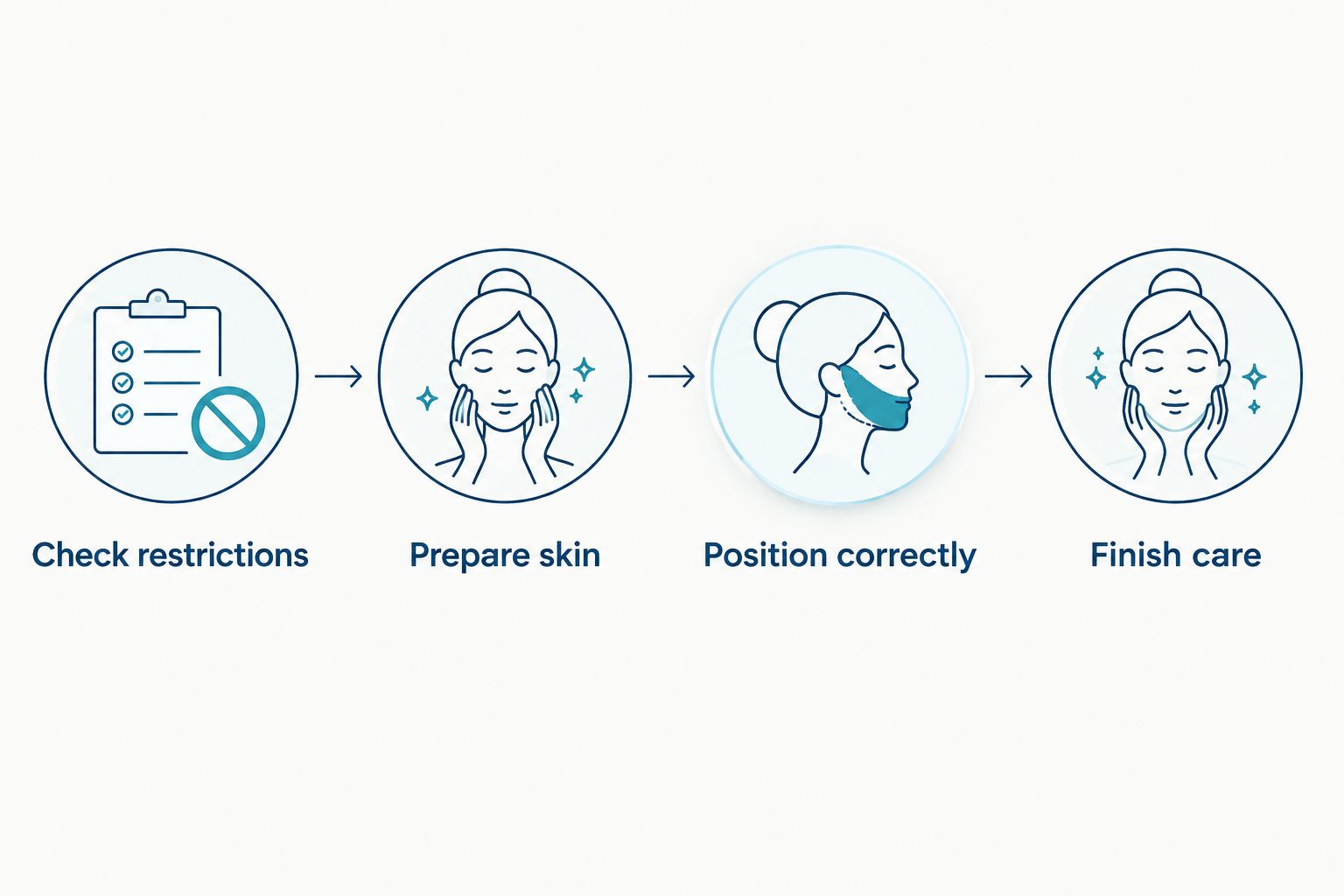
Keep the process simple: Check restrictions, prepare skin, position correctly, finish care. These are decision steps, not a universal operating schedule.
- Check restrictions. Read the warnings about medications, light sensitivity, eye conditions, and other reasons not to use the device. Ask a clinician or pharmacist when a warning relates to your circumstances.
- Prepare skin. Follow the device's directions on cleansing and whether anything belongs on the skin during use. Do not assume a serum improves the session.
- Position correctly. Use the specified fastening and eye protection. Do not improvise protection or change the intended position to make another activity easier.
- Finish care. Follow the cleaning directions and return to a straightforward skincare routine that agrees with your skin.
Keep potentially irritating skincare changes separate from your first device sessions. Changing several things together makes it harder to identify what caused discomfort. Consistency here means following the directions, not increasing exposure.
For a closer look at positioning and protection, read the guide to LED face masks and eye safety. Stop using a device if it causes eye discomfort or a skin reaction, and seek appropriate advice.
How the designs are ranked
The Simple Cosmetics 2026 ranking prioritizes fewer decisions, suitable construction, and clear instructions. Flexible single-mode masks lead as a starting configuration because they combine a bending facepiece with one program choice. That is a usability recommendation—not proof of better cosmetic results.
Rigid-shell masks follow for readers who prefer structure and can confirm fit. Multi-mode masks belong on your shortlist only when their additional programs serve a defined purpose.
A strong individual model can change that order for you. A well-fitting rigid mask is a better personal choice than a flexible mask that presses against your eyes. The category ranking never overrides fit or the manufacturer's restrictions.
Which LED face mask should you choose?
For most undecided readers, start by comparing flexible single-mode designs. Move to a rigid-shell option if you prefer a fixed form and its openings align correctly. Consider multiple modes only after identifying a reason to use them.
Before committing to a 2026 routine, answer these questions:
- Can you identify the exact model and its intended use?
- Can you follow its eye-protection instructions without improvising?
- Does it suit the uncovered skin you actually want to address?
- Can you maintain the routine without adding several other changes?
If any answer is no, wait. The right next move is resolving that question, not choosing a device with more features.
FAQ
What’s the best type of LED face mask for men?
A flexible single-mode mask is a practical starting point for men who want contour-following construction and fewer settings. The exact device must still fit correctly and have clear instructions for its intended use.
Do men need a different LED face mask from women?
Gendered labeling alone does not establish that an LED face mask suits you. Compare face fit, eye alignment, facial hair coverage, and the manufacturer’s instructions instead.
Can I use an LED face mask with a beard?
A beard does not automatically prevent mask use, but facial hair obstructs direct access to the covered skin. Assess the uncovered areas you want to address and follow the device’s fit instructions.
Is a flexible LED mask better than a rigid one?
A flexible LED mask is not automatically better than a rigid one. Flexible construction bends, while a rigid shell holds its shape; correct fit and documented intended use matter more than that difference alone.
How often should men use an LED face mask?
Use an LED face mask according to the exact model’s instructions. Do not borrow another device’s schedule or add sessions to compensate for missed use.
Can I use retinol before an LED face mask?
Do not assume retinol belongs underneath an LED face mask. Follow both products’ instructions and get advice if you experience irritation or have concerns about light sensitivity.
What should I look for when buying an LED mask in 2026?
Prioritize fit, clear intended use, eye-protection instructions, and a routine you can follow. Additional colors, gendered packaging, and feature counts do not independently establish better results.
One last thing
Before starting, take 3 baseline photos: front, left, and right. Keep the lighting, camera position, and facial expression consistent when you repeat them. Treat the images as a personal record, not proof of a clinical result.
Simple Cosmetics' recommendation is simple: choose a mask you can position correctly, understand fully, and use as directed. A simpler routine is easier to assess than one that changes every week.
Related guides
- How often should you use an LED face mask?
- How to connect an LED mask to your retinol routine
- How long until you see results from an LED face mask?